

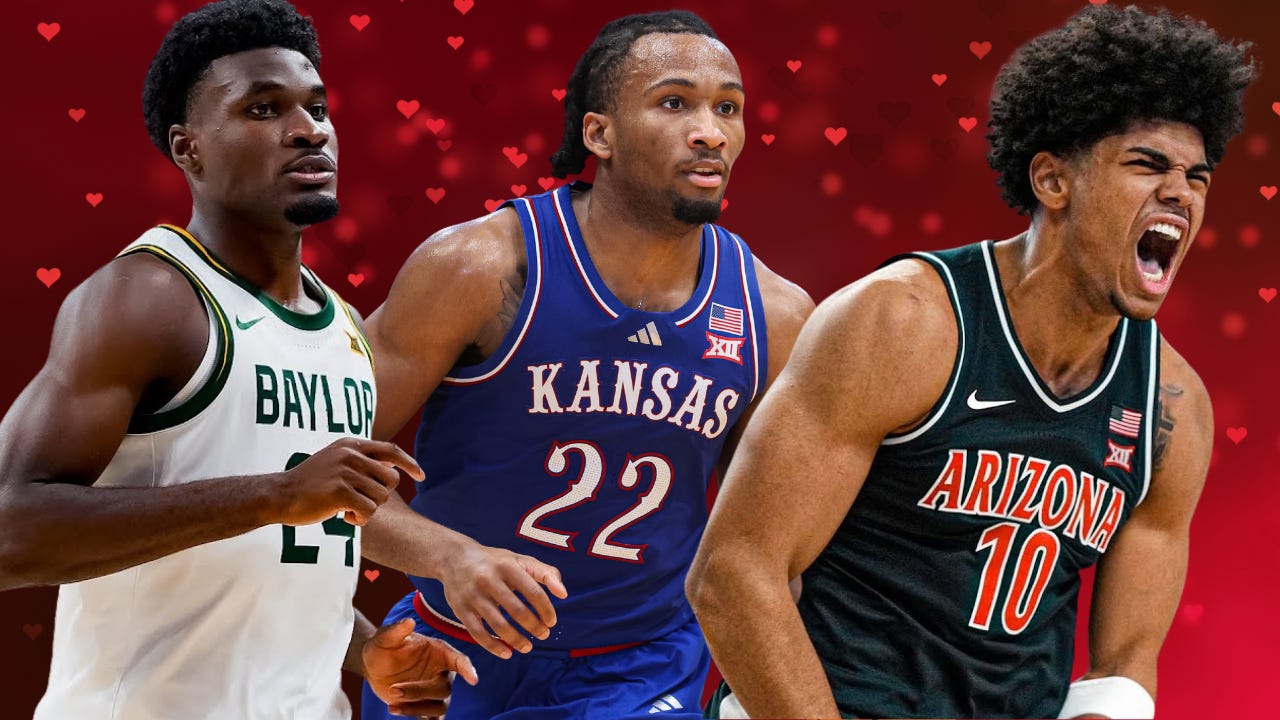
The college basketball season has gotten off to an exciting start. Freshman Phenomena are stealing the show, returners are building their draft cases, and we’ve seen several game of the year candidates in the first two weeks.
To commemorate the beginning of the college basketball season, I’m here to give you my top 14 prospects. These rankings heavily rely on each prospect's pre-NCAA samples, as I refuse to make many changes based on a five-game sample. Each prospect has a short excerpt on what I love about them and what I am looking for this season, along with a more in-depth article that I wrote before the season began. This is meant to be a preliminary board, and I will expand it to 30 names as we enter conference play.
Happy Draft season!
1. Cameron Boozer, F, Duke
What I Love:
Boozer has the best pre-NCAA profile of any prospect I have ever scouted. He’s impacted the game at every level since he was 15, and I’ve had to scratch my head to find a hole in his game. The Forward is an excellent driver, post player shooter, defender, rebounder and processor.
What I am looking for:
My biggest question surrounding Boozer is his lack of vertical athleticism and how that will affect him as a finisher against opponents of similar size and/or length. He often relies on his combination of strength and touch, but how will that translate against better athletes on the NCAA and, eventually, the NBA stage? Boozer does not possess a ton of wiggle, hip mobility, or overall fluidity so that I will be monitoring his self-creation throughout his freshman campaign.
Cameron Boozer, the Tim Duncan of the 2026 NBA Draft

When evaluating draft prospects, I often spend too much time analyzing player comparisons and projected outcomes. Truthfully, perfect comparisons never exist, and indulging in the exercise is probably a waste of time.
2. Darryn Peterson, G, Kansas
What I love:
Peterson is the most complete guard prospect I have ever scouted—a true elite two-way player without an identifiable hole in his profile. He’s a ridiculous driver, with a Shai Gilgeous-Alexander-esque handle, while being a gifted interior passer and supreme shot-maker. Defensively, he’s an excellent off-the-ball and can hold his own at the point of attack.
What I am looking for:
I’ve wanted to see his 3PAR increase, but then he started his collegiate career with a 66.7 in Kansas’s exhibition game against Louisville and hasn’t slowed down since. Another minor concern is his ability to make advanced reads and handle blitzes and traps in the pick-and-roll.

3. AJ Dybantsa, F, BYU
What I Love:
If Peterson is the best guard prospect I’ve ever scouted, then Dybantsa may be the best wing scorer I've ever scouted. Dybanta averaged 26.4 PPG on 64.3 TS% last season—a ridiculous number given his shot diet. He’s a violent slasher and a great athlete who can and will get to the basket whenever he wants.
What I am looking for:
I am looking for Dybantsa to take and make more threes, create more separation with his handle in the half court, improve as a playmaker, and provide consistent defensive impact. At times, he can have a bit of scoring blindness on his drives and miss open teammates, and he often took plays off defensively during his pre-NCAA play.
AJ Dybantsa has the highest Ceiling in the 2026 NBA Draft?

A few days ago, I asked Twitter which of the consensus top three prospects in the 2026 NBA Draft has the highest ceiling.
4. Jayden Quaintance, F/C, Kentucky
What I love:
Quaintance may be my favorite prospect in the entire class. I think he’s the best defensive prospect since Victor Wembanyama; the numbers back it up.
A 4.2 defensive box-plus minus (DBPM), 9.8 block percentage, two steal percentage, 18.4 rebounding percentage, and a +8 defensive on/off swing underscore his impact at 17 in a high major conference.
Quaintance’s strength, motor skills, instincts, and athleticism are unmatched, and they will allow him to anchor a defense as soon as he steps on an NBA floor.
What I am looking for:
Offensively, the picture is a bit murkier. He’s an excellent play-finisher and an underrated passer, but he doesn't project as a viable shooter, and his touch around the rim has room for improvement. Quaintance is also coming off a significant injury that could hurt his twitchiness and athleticism.
Jayden Quaintance reminds me of a famous Looney Tunes character

The original Looney Tunes shorts aired from the 1930s until the late 1960s and featured characters like Bugs Bunny, Daffy Duck and Tweety.
5. Caleb Wilson, F, North Carolina
What I love:
I think Wilson will challenge Quaintance for the title of best defender in the class. The Forward is an elite athlete with excellent twitch and covers a lot of ground. Wilson averaged 4.5 stocks per game over a 94 a game sample in high school (Junior and Senior seasons + 2024 EYBL).
What I am looking for:
Offensively, I have questions about how he will score in the half-court, especially off the dribble, but he’s shown mid-range touch, playmaking, and connective passing. I’ll be monitoring how his handle—which is pretty loose—and jumper progress throughout the season.
6. Bennett Stirtz, G, Iowa
What I Love:
Stirtz is the paradigm of possession by possession maximization. Despite high usage, he never turns the ball over and carried Drake’s load throughout last season. He’s an excellent driver and pick-and-roll operator who understands pace and leverage. Last year, he took a big step as a pull-up shooter while being one of the best court-mappers in the nation.
What I am looking for:
I am looking to see if Stirtz can maintain his production and impact in the Big Ten, as a lack of top-end burst and middling vertical athleticism could be tougher to overcome on the high-major level. If he’s able to replicate last year’s success in the Big Ten (which I think he will), I’ll have no problem keeping him in the top ten.

7. Mikel Brown, G, Louisville
What I love:
Brown’s intersection of nuclear shooting, positional size (height), ball-handling, and playmaking underscores his case as a potential franchise guard. He’s a good bet to shoot over 10+ 3PA/100 and finish with a 1.5+ AST/TO ratio. His numbers may not jump off the page in a loaded Louisville backcourt, but that’ll only add to the idea that he can play on and off the ball.
What I’m looking for:
Brown had an unconventional high school development path—he grew nearly 5 inches over the last 2 to 3 years, which added a few inches to his vertical. I’ll be monitoring how he continues to adjust to his height and added weight with a focus on his ability to get to and finish at the rim—an area in which he struggled pre-NCAA.
Is Mikel Brown worthy of a Top Five Pick in 2026?

From the early 2000s to the late 2010s, Louisville courted some of the best guards in college basketball.
8. Koa Peat, F, Arizona
What I Love:
At 6-foot-8, 235 pounds, Peat is an interior-slanted scorer who uses his intersection of size, strength, and touch to finish at the rim. Peat supplements his physicality with touch, a workable handle for his size, and a budding mid-range game. Off the ball, he adds value as a play-finisher, offensive rebounder, and connective passer who blossomed into a legitimate facilitator by the end of high school. Defensively, he makes timely rotations, covers ground, generates stocks, and can guard multiple frontcourt spots.
What I am looking for:
I am looking for Peat to rework his process a bit, get all the way to the rim, and not settle for tough mid-range shots that drag down his two-point percentage. I would also love to see how well he scores outside of fifteen feet as a shot, just 21% from three and 64% from the line in high school. I find this increasingly important, as Peat is a good—but not elite—athlete, and some of the physical advantages he relied on may not scale at higher levels. I’ll be monitoring how he adjusts when he can’t simply overpower defenders.
Pro comparison: 2020-2023 Aaron Gordon

9. Nate Ament, F, Tennessee
What I love:
Ament’s ability to stretch the floor, score in the mid-range, move the ball to his teammates, and cover ground defensively builds out an intriguing tall two-way wing profile with a wide range of outcomes. I enjoy his ability to put the ball on the floor in transition, switch on to smaller perimeter players, and rebound despite his light frame.
What I am looking for:
I am hesitant to project any star outcomes for Ament because he struggles to create separation due to a relatively weak handle and a lack of burst, bend, and strength. I am wary of Ament’s ability to punish mismatches against guards that coaches will inevitably place on him because of his deficiencies, and think he’ll be best utilized as an off-ball super play-finishing wing that can create a shot or two. I’m looking to see if he can self-create and score at the rim efficiently enough to prove me wrong.
Nate Ament is one of the most unique prospects in the 2026 NBA Draft

If you told James Naismith in 1891 that 6-foot-9-inch players would be able to block a shot, dribble the ball up the court, throw it behind their back, and then launch a shot 30 feet away from the rim, he’d grab his soccer ball, take down his peach basket and call you crazy.
10. Hannes Steinbach, F, Washington
What I Love:
Steinbach was a double-double machine overseas, and it has continued during his time at Washington. He is one of the best rebounders in the class, consistently swallowing up misses with his elite hands and functional athleticism. His ability to catch contested passes and convert through traffic speaks to his coordination, touch, and functional athleticism, all of which make him a highly efficient play-finisher around the rim. He’s also shown adeptness as a driver and a connective passer, with hints of real shooting potential, which only adds to the intrigue of his long-term offensive profile.
What I am looking for:
My biggest question with Steinbach is whether he has enough length and vertical pop to anchor a defense as a full-time five. He competes and positions himself well, but I’m monitoring how consistently he can protect the rim, deter drives, and finish plays as a backline defender.
11. Patrick Ngongba, C, Duke
What I love:
After Maliq Brown went down last season, Ngongba flashed the rolling, post-scoring acumen, rebounding, above-the-break passing, and solid defense that he displayed at Paul VI in high school. From February 17th to March 27th (when he began to get significant minutes), he averaged 18.8 points, 9,6 rebounds, and 2.6 assists per 40 minutes. The sophomore is a versatile big that profiles as a weapon in the short roll and a potential post hub for an offense. Ngongba isn’t a true rim protector, but has a gargantuan wingspan and great hands.
What I am looking for:
Ngongba’s touch around the rim and free-throw shooting could suggest some future three-point shooting potential, so I am intrigued about the possibility of that, as well as watching how he defends the rim and in space with a larger role.
12. Tounde Yessoufou
What I love:
Yessoufou isn’t Anthony Edwards, and he’s not close to it, but he still possesses a ton of traits that should be enticing for NBA teams. The wing is an elite athlete with an NBA-ready body that adds value on both sides of the ball. Offensively, he profiles as a play-finisher, adept at slashing to the rim (especially in transition), catching lobs and grabbing offensive rebounds. In a more scaled-down role, Yessoufou has the potential to be an elite defender. He averaged nearly four stocks per 40 minutes in high school and has the size and athleticism to guard 1-3.
What I am looking for:
Yessoufou struggles to operate in the half-court due to an underdeveloped handle, an underwhelming touch, and some difficulty processing defenses as a creator. He was a low-percentage (32.6%), low-volume (28.2 3PAR) three-point shooter for the bulk of his high school career, so I am monitoring how that progresses throughout his freshman campaign at Baylor.
13. Kingston Flemings, G, Houston
What I love:
Flemings is an excellent player with the ball in his hands. He’s the type of guard that you can’t keep in front of you or keep out of the paint. Despite being 6’3, 170lbs, he shot a mind-boggling 74% from two as a senior and has multiple seasons of inside the arc dominance. When he can't get to the rim, he has counters in the mid-range and is adept at creating the initial advantage to get his teammates involved.
What I am looking for:
Flemings' 3PAR and 3PT% hovered around 30 percent in high school. I am looking for him to increase his three-point volume and accuracy, especially on pull-up jumpers, but his free-throw percentage (83%) and mid-range touch leave me optimistic that it can progress. Additionally, I believe he needs to add to his 170lb frame to make life easier both offensively and defensively.
14. Labaron Philon, G, Alabama
What I Love:
Philon profiles as a complementary guard who fits cleanly next to a high-usage initiator thanks to his pick-and-roll passing, ability to collapse defenses, and strong ball security. He consistently manipulates help, makes timely interior reads, and keeps the offense stable without needing high usage himself. Defensively, he brings real playmaking value—his 2.9 steal percentage reflects how well he anticipates actions and disrupts rhythm at the point of attack. His combination of connective playmaking, decision-making, and defensive instincts gives him a clear pathway to an NBA role as a secondary guard.
What I am looking for:
My main questions with Philon revolve around his finishing and vertical athleticism. He shot just 44% in the half-court last season, struggled to generate free throws, and recorded zero half-court dunks—an indicator that his lack of vertical pop limits him as a finisher despite having enough burst and understanding of driving angles to get downhill. I’ll also be watching how his pull-up shooting develops, as becoming a more consistent off-the-dribble threat would open the floor for his PnR playmaking and allow him to punish defenders who sag off. If he can add functional strength, improve his touch at the rim, and steady his pull-up, Philon projects as a reliable complementary guard who wins the turnover battle on both ends.
Interested where you’re at on a couple lottery guys for me: Aday Mara and Christian Anderson?