

One of the most prevalent phenomena in the NBA and NBA Draft space over the last 15 or more years is the devaluing of small guards.
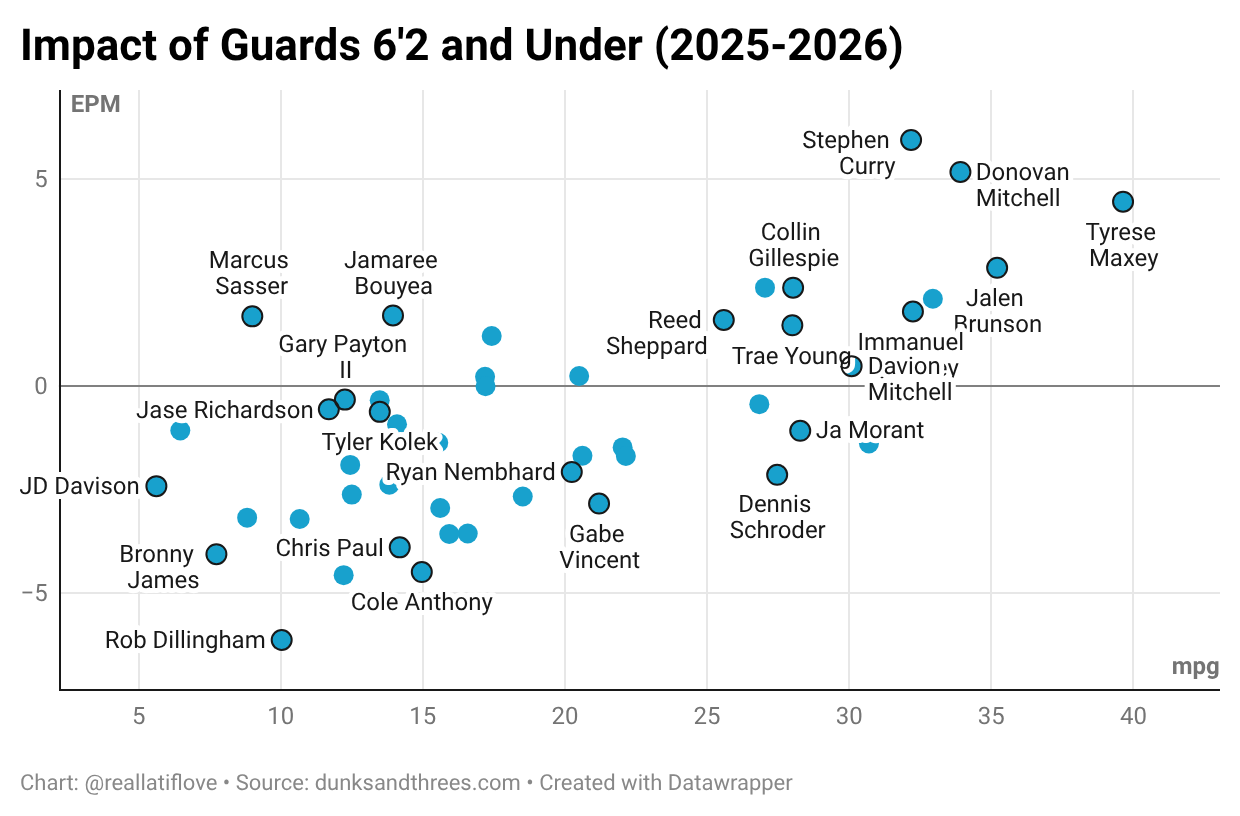
This season, just 57 players in the NBA are 6’2 and under, and only 42 of them play 10 minutes or more.
Essentially, the bar for smaller guards to be impactful is at an all-time high as players have become bigger, more athletic, and more skilled. Coaching has become so advanced on both sides of the ball that employing a small guard, especially in the playoffs, can bleed an immeasurable amount of value.
In the chart below, you’ll notice that players such as Donovan Mitchell, Stephen Curry, Jalen Brunson, and Tyrese Maxey — a few of the best offensive players in the world — sit at the intersection of playing time and impact.
You’ll also notice that the vast majority of guards under 6’2 fall below a neutral estimated plus-minus (EPM).
The level of offensive impact needed to be a high-minute player in high-leverage situations is difficult to project for the vast majority of prospects, and maintaining it over a career is rare.
Take Ja Morant and Trae Young, for example, both of whom peaked as offensive engines capable of driving +5 offenses that are now viewed as, at best, neutral assets around the league.
Young was traded to the Wizards for CJ McCollum and Korey Kispert this week, with no additional draft capital, and Morant appears to be on the way out of Memphis any day now.
The year’s cycle features several small guards — notably Darius Acuff, Christian Anderson, Labaron Philon, Bradoen Smith, Tamn Lipsey, and Tahaad Pettiford, who will test the limits of how high evaluators can rate this seemingly dying breed of players.
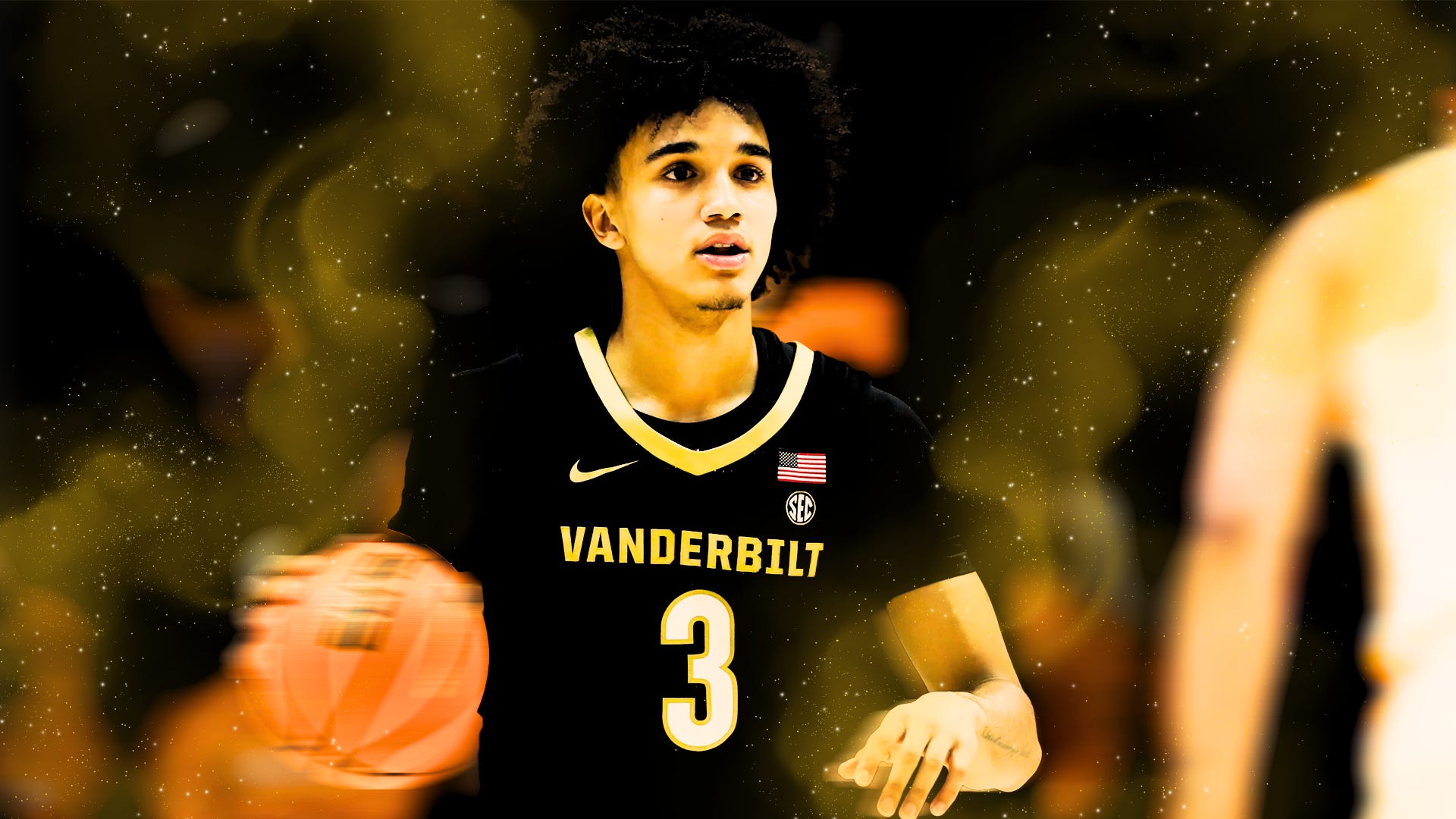
Yet even among this class, testing the modern tolerance for size, no guard strains those boundaries more than Vanderbilt’s Tyler Tanner—a 6’0”, 170-pound guard who, through sheer production and the Commodores’ 16–0 start, has forced his way into NBA Draft conversations that players built like him are no longer supposed to enter.
But can he beat the odds?
A disqualifying query?
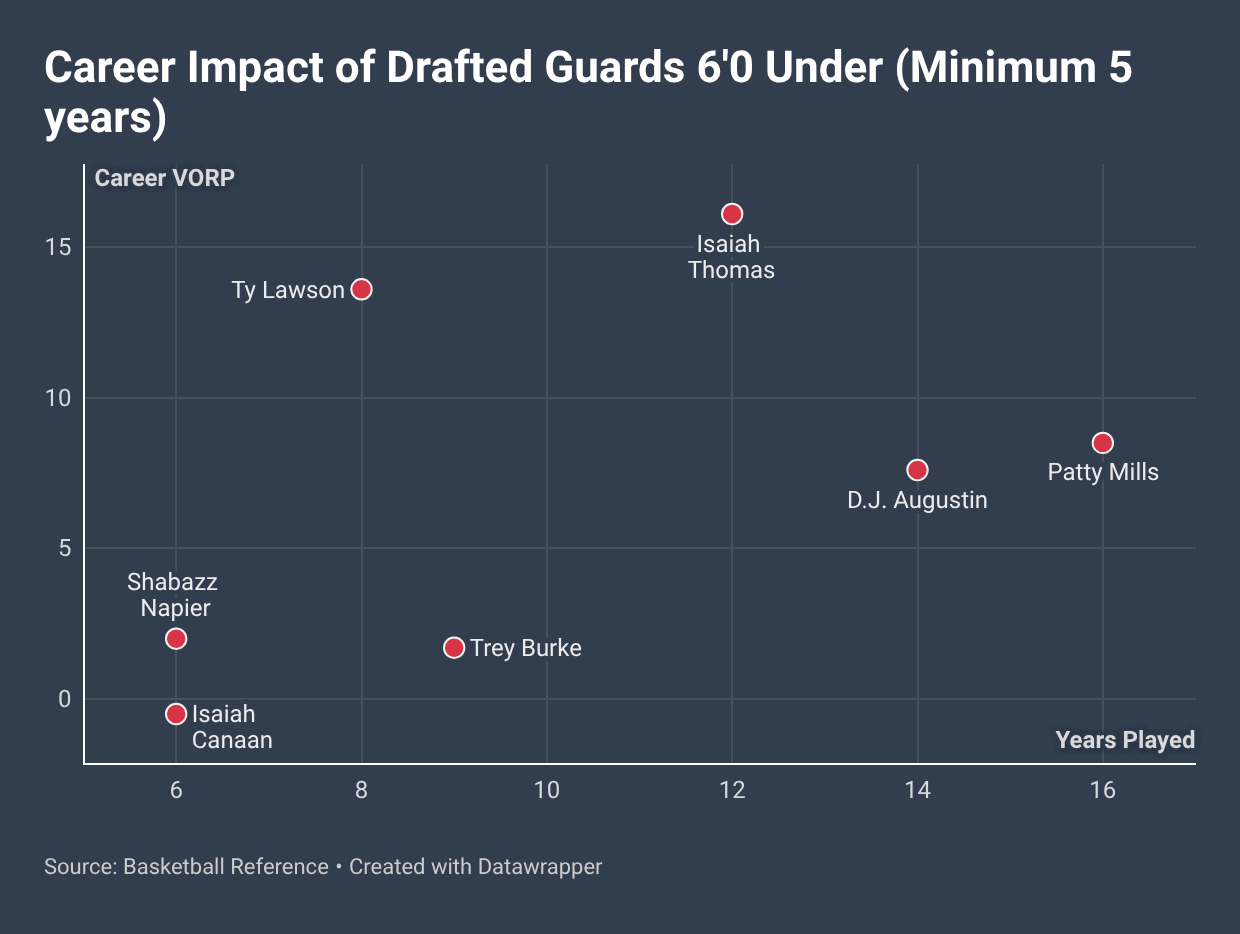
Since 2008, just 23 players, 6’0 and under, have been drafted. Only three have been first-round picks.
Of those 23, only seven players — Isaiah Thomas, Ty Lawson, Patty Mills, DJ Augustin, Trey Burke, Shabazz Napier, and Isaiah Cannaan played more than five seasons in the NBA.
Outside of a few outliers, it’s simply not a list that you’d want a potential first-round pick to find himself in.
However, I firmly believe that Tanner is a better prospect than each of the names listed here, and that starts with his athleticism.
Outlier traits to overcome the obstacles
For a guard built like Tyler Tanner, the margin for error is nonexistent. Size-based disqualifiers mean he cannot simply be good—he must be meaningfully different from his peers in ways that translate to the NBA.
For Tanner, those differences are twofold: functional athleticism and an innate feel for the game. Together, they fuel a profile that is historically unprecedented for guards of his size.
Of the 23 guards listed above who measured 6’0” and were drafted since 2008, just two—Russ Smith (19) and Peyton Siva (15)—recorded more than 10 dunks in a single collegiate season. Tanner has already registered 13 in 16 games, putting him on pace to shatter those benchmarks entirely.
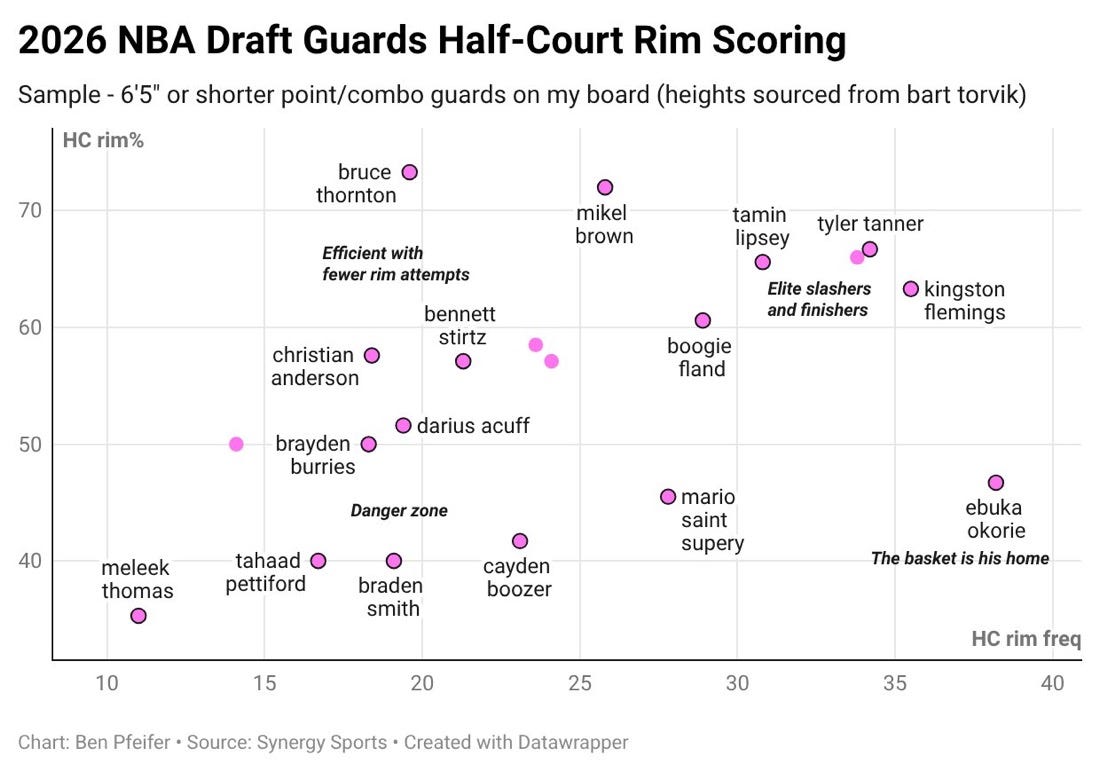
Tanner possesses a lightning-quick first step that consistently blows by defenders, paired with short-area explosiveness that allows him to change directions and speed in an instant. There’s a suddenness to his game—a jitterbug quality—that bends defensive coverages and forces rotations. To this point in the season, the guard has generated 1.18 points per drive, has a 57.0 free-throw rate when attacking the basket, and is finishing at 63 percent (31-49) at the rim in the half-court.
These marks place him among the class's best half-court drivers, with a high rim frequency and a rim field goal percentage.
His functional athleticism doesn’t just show when creating paint touches. It has also translated defensively in ways that few guards of his size have ever matched.
Tanner stands alone as the only high-major guard under 6’0 to post at least a two-block percent and a four-steal percent.

However, it must be noted that over the past two seasons, Vanderbilt has been an excellent context for generating defensive playmaking numbers.
The Commodores rank in the 97th percentile in Hakeem percentage (steal% + block%) and maintain that level with him off the floor, but on film, his defensive awareness is evident.
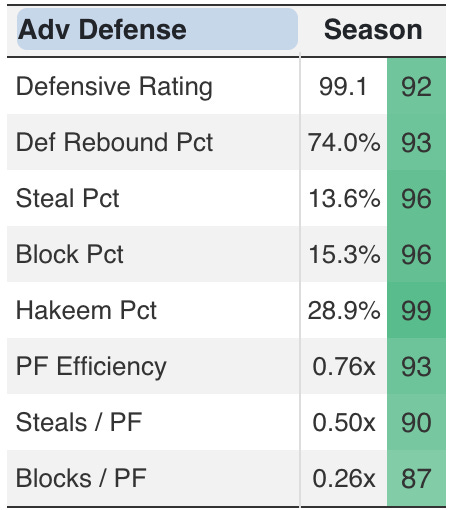
Tanner consistently reads actions one step ahead, allowing him to jump passing lanes before windows fully open and contest shots that most guards his size couldn’t fathom disrupting. The steals often turn directly into transition opportunities, and his six blocks on the season speak not just to rare verticality, but to timing and motor.
At the point of attack, he’s a tenacious defender who frequently picks up ball-handlers as they cross half-court in an effort to start possessions with chaos. Tanner is adept at getting low in his stance, flipping his hips, and sliding his feet to beat his opponents to the spot and get around screens.
That aforementioned cerebral processing is present on the offensive end as well. Tanner boasts a 3.0 assist-to-turnover ratio and has emerged as one of the most effective pick-and-roll ball handlers in the country, generating 1.011 points per possession.
He derives the bulk of his playmaking value from his ability to get downhill, bend a defense, and then find an open teammate. He reads where help will come from extremely well and consistently makes his decision before it gets there. Tanner is a gifted interior passer (3.5 assists per 40 inside the paint) who can deliver passes with both hands.
The Commodores have offered him an excellent context for playmaking production with bigs who can roll and pop and multiple shooters along the perimeter.
Overall, Tanner’s impact on the game is undeniably an outlier for his size. He plays much bigger than his size and weight, and is arguably the highest feel guard prospect in the class, as seen by his AST/TO and steal percentage integration.
Below is a chart that illustrates how rare a start to the season Tanner is having.
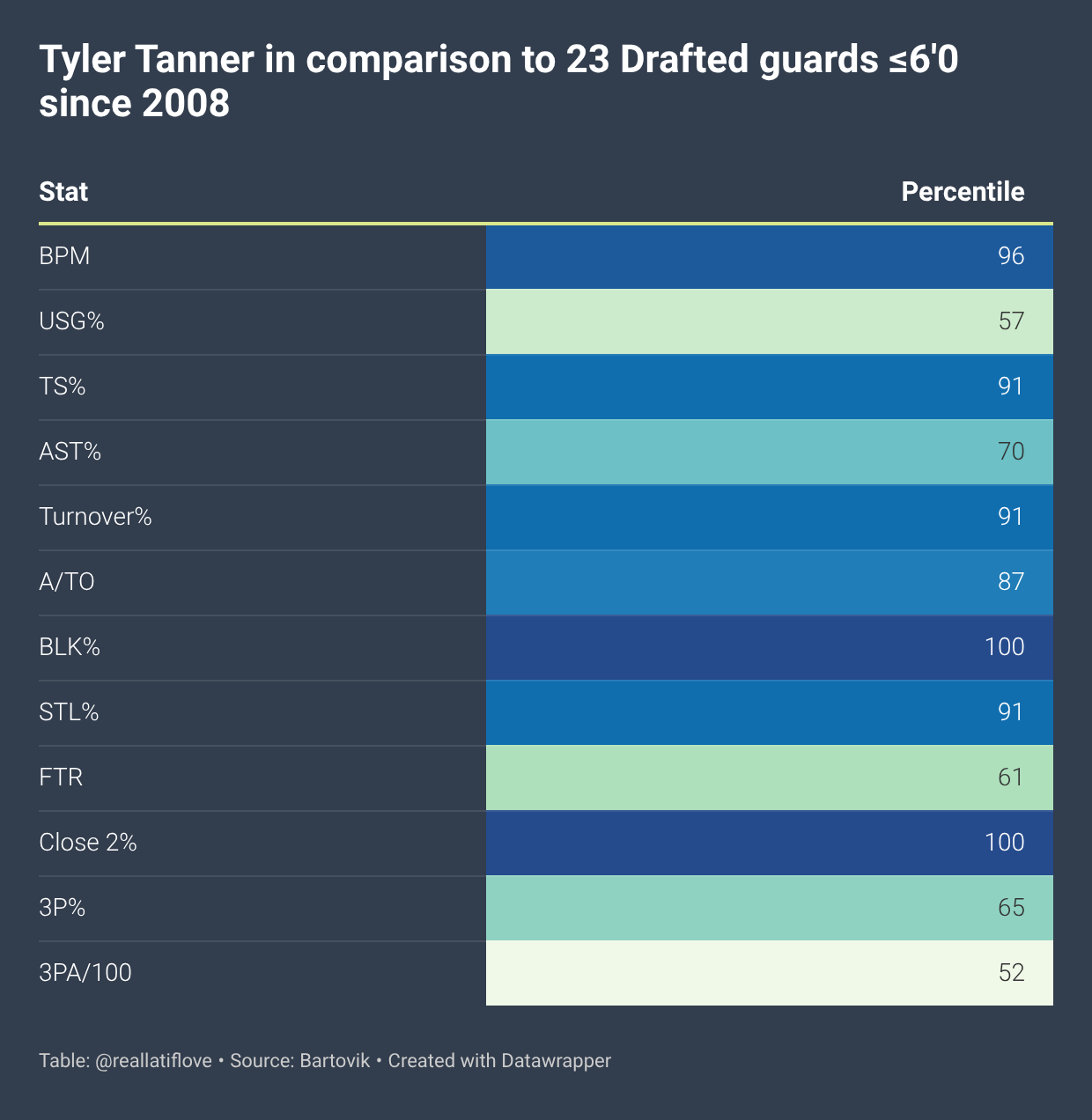
Vanderbilt’s star is the epitome of an outlier and is arguably the best prospect at his size in the Bartovik era, but he does have limitations that could hold him back from success.
Cost of Admission
Before entirely buying into Tanner as a legitimate NBA prospect, especially one that has been mocked as high as the lottery by multiple evaluators, it’s necessary to confront the most glaring questions in his profile—questions that historically have disqualified guards of his size.
The first, and most pressing, is his shooting profile.
Despite his offensive production, Tanner does not take and make enough threes to be generally required to offset his size disadvantage. He’s attempting just 7.6 three-point attempts per 100 possessions, placing him in the 48th percentile among drafted guards listed at 6’0 and under, and has a 37.4 3PAR.
Tanner has yet to prove himself a reliable pull-up shooter. He’s shooting 5-17 on pull-up threes, and during his freshman season, he converted just 26.6 percent of his total three-point attempts.
For a guard whose margin for error is low, lukewarm shooting indicators are not ideal.
To Tanner’s credit, he has drastically improved as a shooter this season, upping his percentage to 38.8 and increasing his free-throw percentage to 85.7 from 75 percent last season.
Though he’s struggled as a pull-up shooter, he’s been ample enough (40.8 percent) off the catch.
The next layer of concern comes on the defensive end.
Even with Tanner’s gaudy playmaking numbers and apparent willingness to defend, he is still likely to be a target for opposing offenses—particularly in playoff environments where matchups are optimized. While his height places him at a disadvantage, it’s his 170-pound frame that raises the most significant red flags at the NBA level.
Tanner does somewhat make up for his small frame in length, with a rumored +5 wingspan, but he’ll still be susceptible to getting overpowered by bigger and stronger guards and be a target vs teams who frequently mismatch hunt.
To his credit, Tanner competes. He plays more like 6’5 than 6’0 and is willing to engage physically despite his disadvantage. But effort alone doesn’t eliminate functional concerns. Without substantial weight gain, his defensive viability may be reliant on how aggressively opponents choose to involve him.
NBA Projection: Lead Guard
I’m not yet ready to project Tanner as a star guard at the next level, as there are still some offensive indicators that need to trend in the right direction. In addition to increasing his three-point volume, I think it would be beneficial for Tanner to develop his mid-range counters, as paint touches become harder to come by in the NBA.
I believe this will be especially crucial as he operates against drop coverage. To this point in his career, he’s shooting 30.4 percent on mid-range jumpers and 32 percent on runners, which has drug down his two-point percentage in the pick and roll to 50 percent.
However, given his ancillary tools, I believe he can be an impactful NBA player without looking like what we generally think a star should. Tanner projects as a lead guard who can run the offense and have a positive impact on turnover differential on both sides of the ball.
Unlike most point guards, he doesn’t need high usage to be impactful and is viable off the ball, not only because of his catch-and-shoot ability, but also because of his ability to attack closeouts and attack against shifting defenses.
He’s also shown the ability to scale up in a limited sample size without back-court partner Duke Miles off the floor. In the three games where he’s shoulder 30+% usage, he’s averaged 24 points on a 59 true-shooting percentage and maintained a 1.9 AST/TO ratio.
Ultimately, Tanner has the makings of a moderate-usage lead guard bet (a la Fred Vanvleet) who has a strong influence on a team winning the possession battle (arguably the most important key to winning a basketball game), who can be slotted next to another high-usage creator and toggle on and off the ball on offense.
His value is not dependent on the use of a rigid, heliocentric offense. Instead, it’s rooted in possession maximization — his ability to generate and protect advantages without monopolizing the ball, to pressure defenses as a driver, to create extra possessions with steals, and to minimize wasted ones with elite decision-making.
Those traits will scale. And they matter most in the margins where games are decided.
In a league that has steadily raised the cost of admission for smaller guards, Tanner’s profile reads less like a bet on archetype and more like a bet on process.
He’s an outlier in every meaning of the word and the best bet among the smaller guards in this class to overcome size concerns. He should comfortably be the first guard 6’0 and under to be selected in the first round since Trey Burke in 2013.
great article
with how well rounded he is, I find it hard for him to bust in the NBA. He has it all(rim finishing, plus passing, plus shooting, legit defensive stats, athleticism)
Only thing I question is how legit the shooting is. I honestly want to see him stay 1 more year to improve, but I think he's playing so well he doesn't