

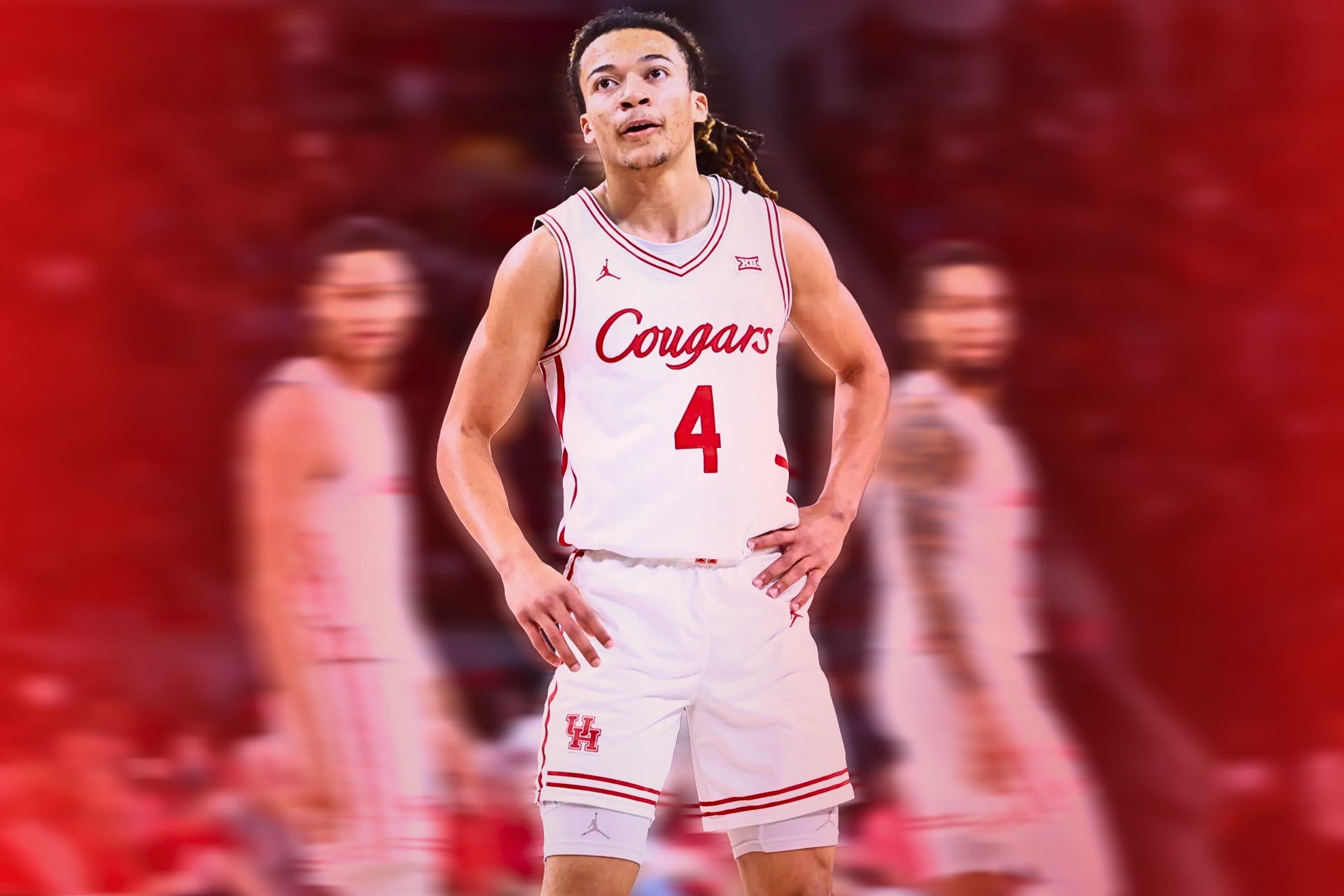
In Kelvin Sampson’s 11-year tenure at Houston, he’s accomplished about as much as a coach can achieve short of winning a national championship.
He is a multiple-time conference and national award winner, earning four AAC Coach of the Year honors, back-to-back Big 12 Coach of the Year awards, and being a consistent Naismith Coach of the Year finalist across multiple seasons.
In his time leading the Cougars, they’ve been a perennial title threat, winning over 75 percent of their games and making multiple trips to the sweet 16, the elite eight, and the final four.
Yet, throughout all his success in H-Town, he’s failed to balance it with developing freshmen into premier NBA talent, instead opting to build through retention and, eventually, the transfer portal.
That was until last offseason, when Sampson secured three top 25 recruits for the first time in his career. Of those three, freshman point guard Kingston Flemings has undoubtedly been the best and projects to be Sampson’s best prospect in his very long career.
Here’s why.
World-Bending Driving
If you’d never watched Flemings and turned on his tape for the first time, the first thing that would stand out is his driving ability. Flemings has Sonic the Hedgehog-esque speed, which he uses to constantly bend defenses.
Despite his speed and unparalleled burst, Fleming stays composed as a driver, never looking out of control, and is adept at changing speeds in an instant. The freshman’s body control and touch intersection, understanding of driving angles, and unorthodox one-foot finishes are the foundation of his viability as a driver, but it’s his counters in the mid-range that demarcate him.
Whenever Flemings ins’t able to create a lane to the rim or a team is playing drop coverage, he’s able to stop on the dime and rise up in the mid range to the tune of 44.6 percent on non-rim twos. Flemings can seemingly access a mid-range jumper from anywhere inside the arc. His elevation on his jump shot and ability to square his shoulders, despite occasional fluky footwork, allow him to problem-solve in the paint in a way reminiscent of T.J. McConnell.
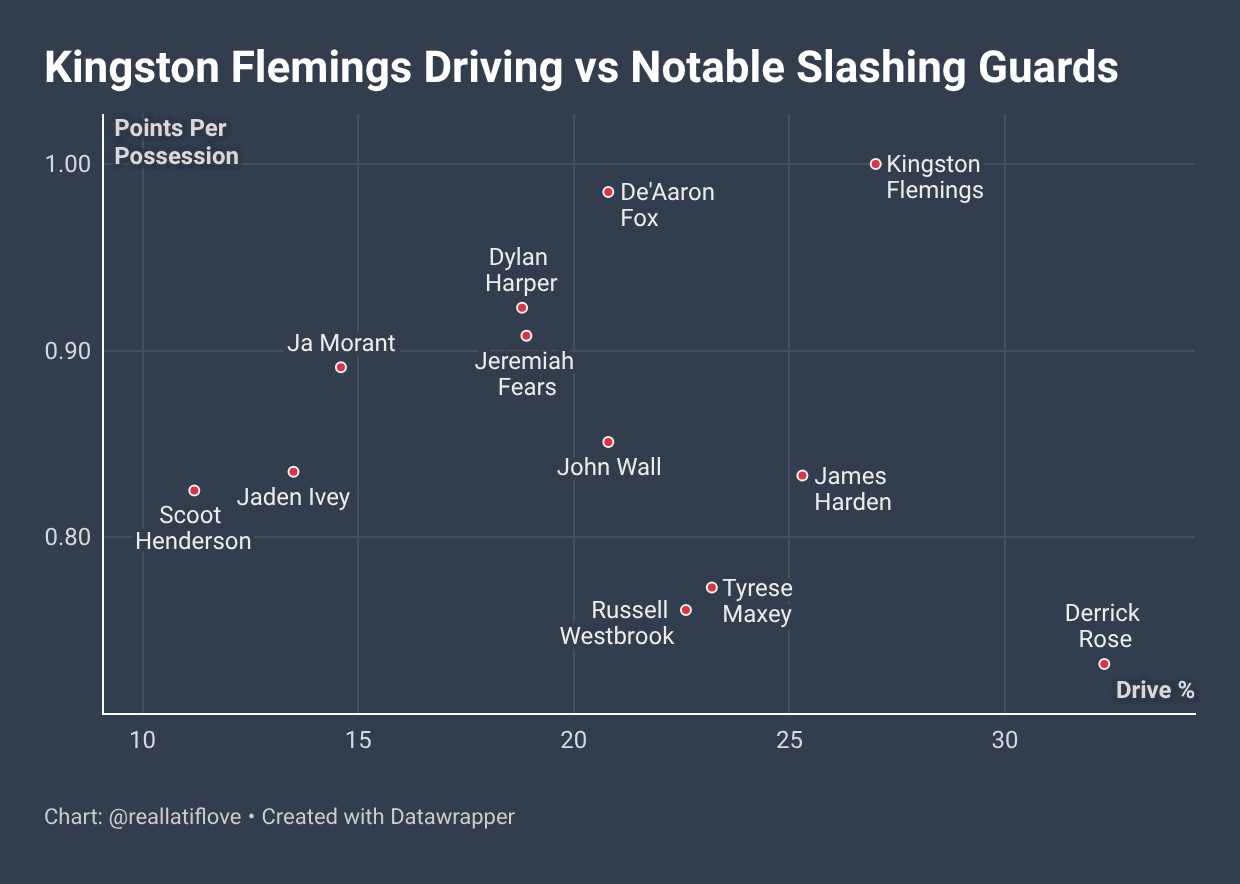
Fleming’s solution in the mid-range maxes out his productivity as a driver, making for a driving profile that is not simply good, but historical.
Below is a chart comparing Fleming’s drive frequency and efficiency to those of a few notable slashing guards. His 27 percent drive percentage and subsequent 1.000 points per possession are paramount amongst guards 6’5 and under, though it is essential to note that the average points per possession was lower 15 years ago.
Fleming's dominant driving enables him as a passer as well, and his ability to collapse a defense, create paint touches, and then find his teammates makes him one of, if not the best, playmakers in the class. He boasts a near 35-assist percentage with just below 25.6 usage and has a 3:1 AST/TO ratio.
Though a significant portion of Fleming’s playmaking ability stems from his ability to get downhill, he derives value from simply quickly processing defense. Flemings is cerebral in the sense that he can toggle between quickly making a read off the catch and being patient and probing in the pick-and-roll.
He’s a gifted interior passer, but has also shown the propensity to make advanced reads, such as skip passes to the opposite slot/corner to find shooters.
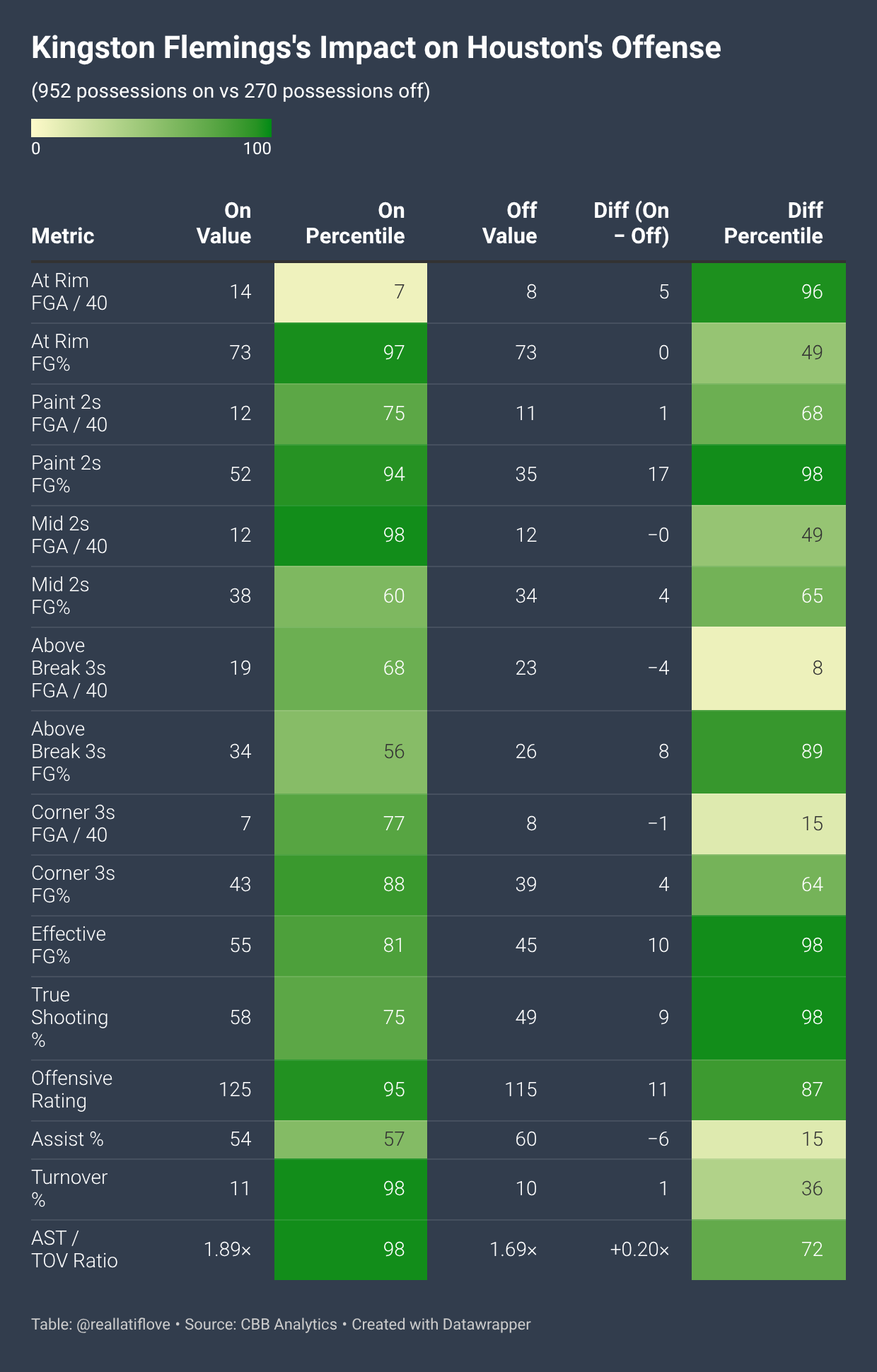
Flemings’s ability to collapse defenses, score at the rim and in the midrange, and create for others without turning the ball over has led to Houston’s offense being drastically better with him on the court, even when he’s not scoring efficiently.
Below is a chart with data from CBB Analytics detailing Fleming’s impact on Houston’s offense.
As the chart shows, the Cougars' offense is taking far more shots at the rim with Fleming on the floor, with similar efficiency to when he is off the floor, and shooting much better in the paint. Houston’s overall offensive rating is much higher with Fleming on the court; they take care of the ball more (though in a relatively low turnover environment) and shoot better from behind the arc as a result of his playmaking.
Though Flemings is efficient and a conduit for elite offense for the Cougars, his scoring process raises significant red flags for his NBA translation.
Disqualifying Queries?
As you can probably tell, Flemings is an interior slanted guard that thrives at getting into the paint, but he does not draw fouls nearly as much as his profile would suggest he should. Flemings has a 28.9 FTR and a 25.0 FTR on drives, drawing a shooting foul on just 8.8 percent of his drives.
More importantly, his three-point rate is just 27.6, which is incredibly low for a perimeter creator, much less a sub-6’5 guard in the modern era.
Below is a query of drafted guards 6’5 and under who find themselves within an intersection of fewer than seven three-point attempts per 100 possessions and below 30 FTR in their pre-draft seasons. Three-point attempts per 100 is used as a proxy because Bartorvik does not allow sorting by 3PAR, but many of these players fall within the <30 3PR / <30 FTR intersection.
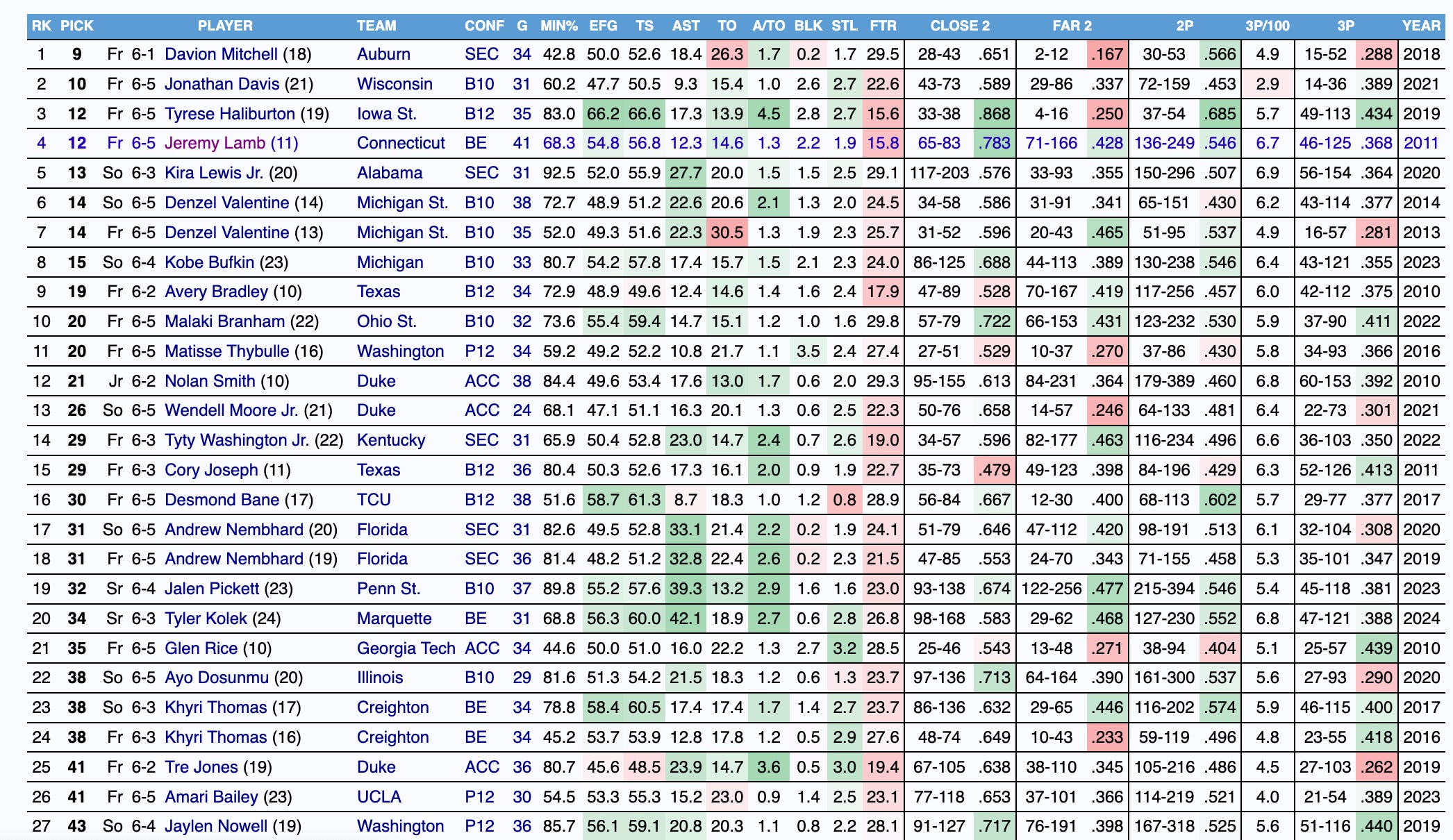
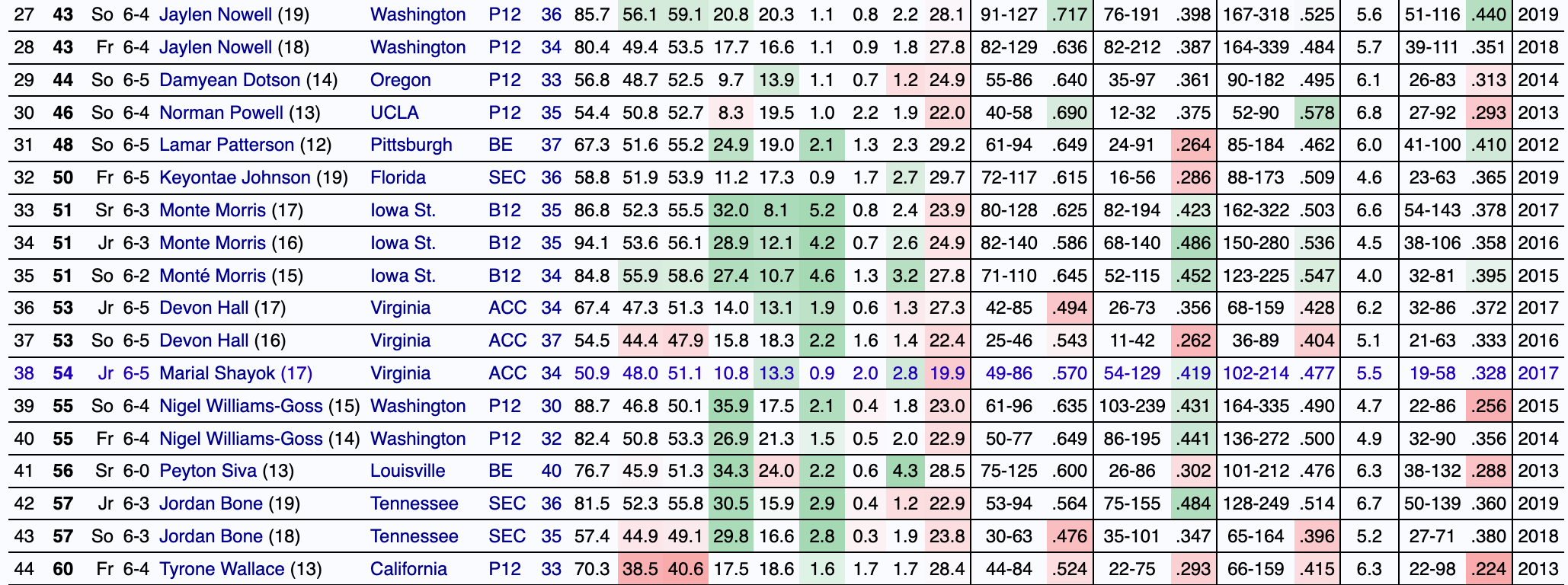
The list is filled with players who either couldn’t stick around in the league or have been underwhelming scorers. 16 of the 35 players listed met this criterion in their pre-draft seasons (and throughout their collegiate career for the players who spent multiple years in college), and nearly all of them who’ve played significant minutes in the NBA fall below the average true shooting percentage.
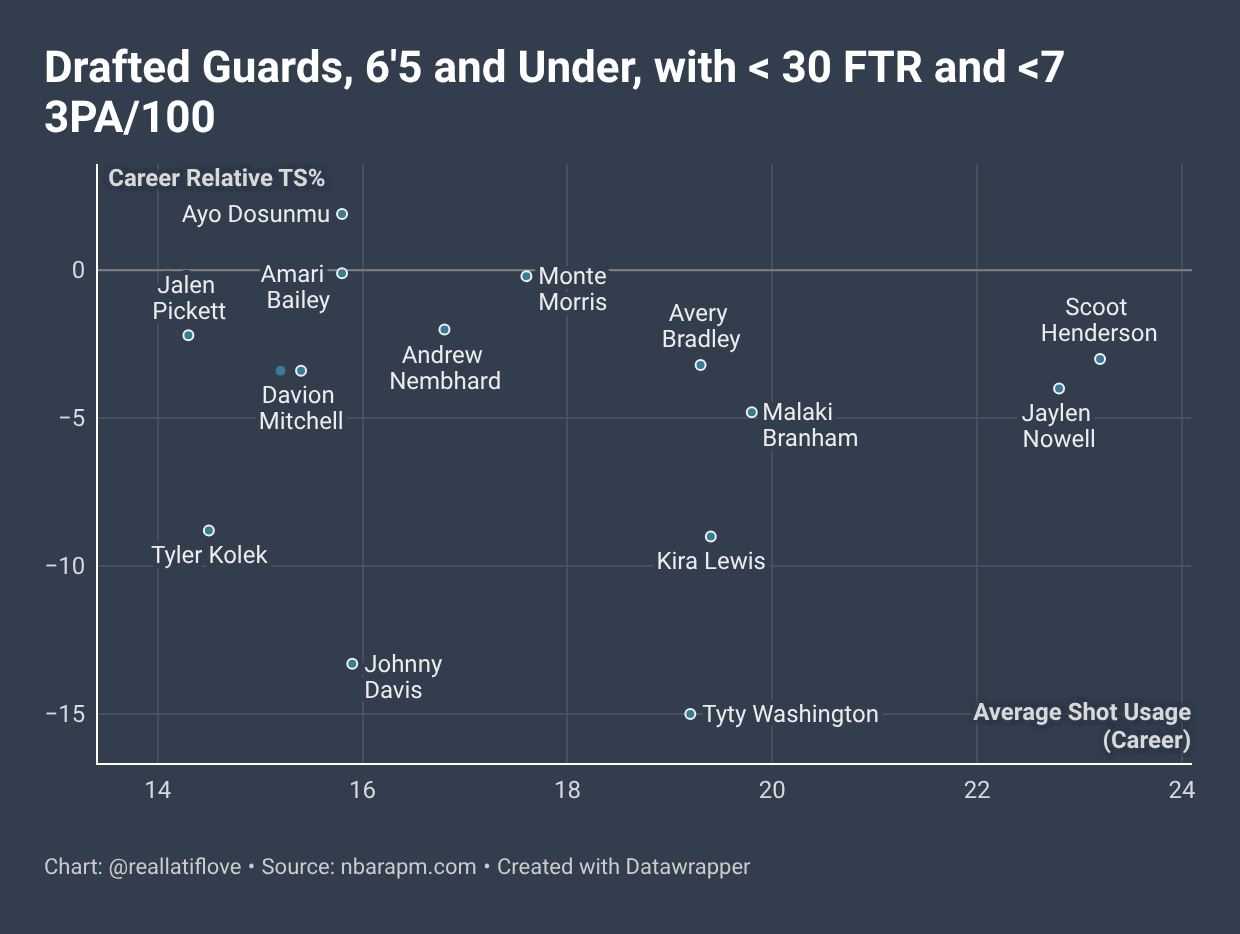
The reason for the inefficiency of players who fall under this query is a simple concept — players who don’t get to the free-throw line at volume nor draw fouls at volume struggle to be efficient because of their sub-optimal shot diet.
Many will point to the fact that no one in Houston draws fouls (6th percentile in FT attempts per game according to CBB Analytics) as a reason to look past Fleming’s inability to get to the line, which is a fair point, but this issue started much earlier than his arrival on campus.
According to Cerebro Sports, over a 156-game sample, encompassing high school and AAU, Flemings had just a 32.2 FTR, which would get him above the threshold but is not overly positive given how much he drives.
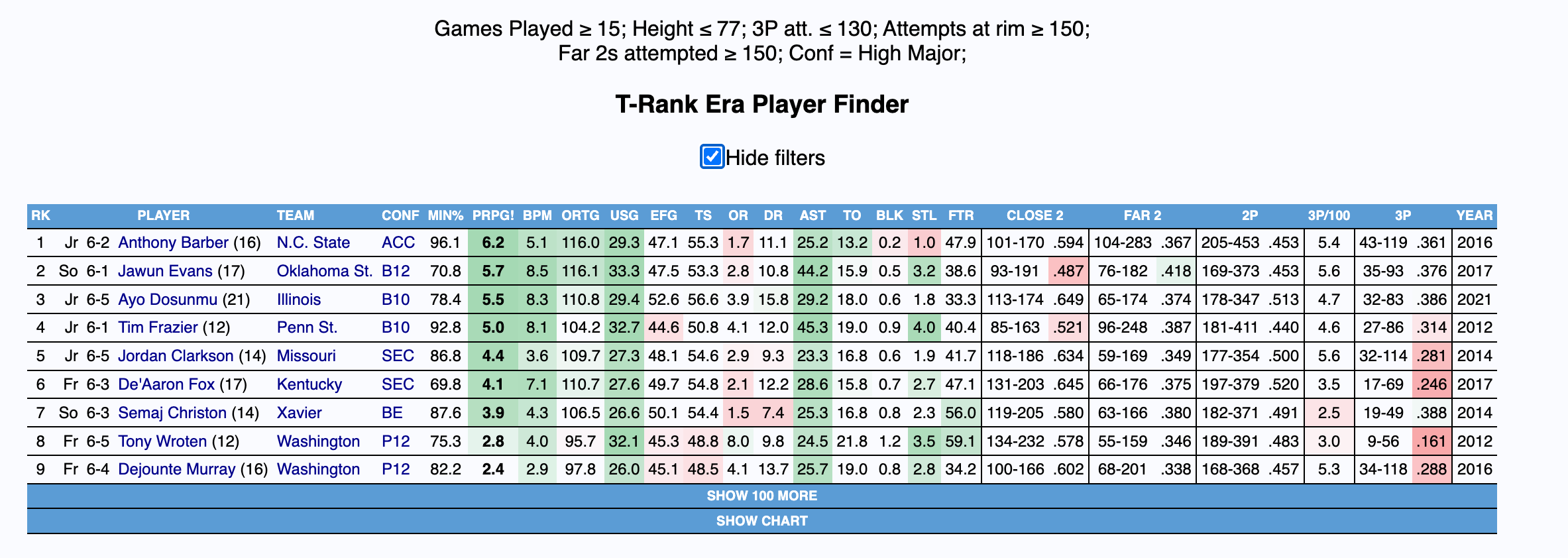
Flemings collegiate shot diet has historically pointed to an inefficient process in the NBA. Outside of the FTR and 3PR rate concerns, he has a 1.02 rim-to-non-rim two ratio. Extrapolating Fleming’s shot diet out to a 38-game sample (If Houston were to make the national championship) is on pace to take 170 rim attempts, 166 non-rim two attempts, and just 128 three.
That shot distribution would put him in line with the nine players listed below.
Despite Fleming’s suboptimal scoring process, I still find myself very high on his potential as an NBA player, and he has avenus to drive + value on both sides of the ball.
Somehwhat Ignoring the Red Flags…
Compared to the 16-player sample in the first query I pulled, Fleming has a lot going for him. He’s amongst the youngest, most efficient, highest-feel, and defensively impactful of the players that qualify for the query.
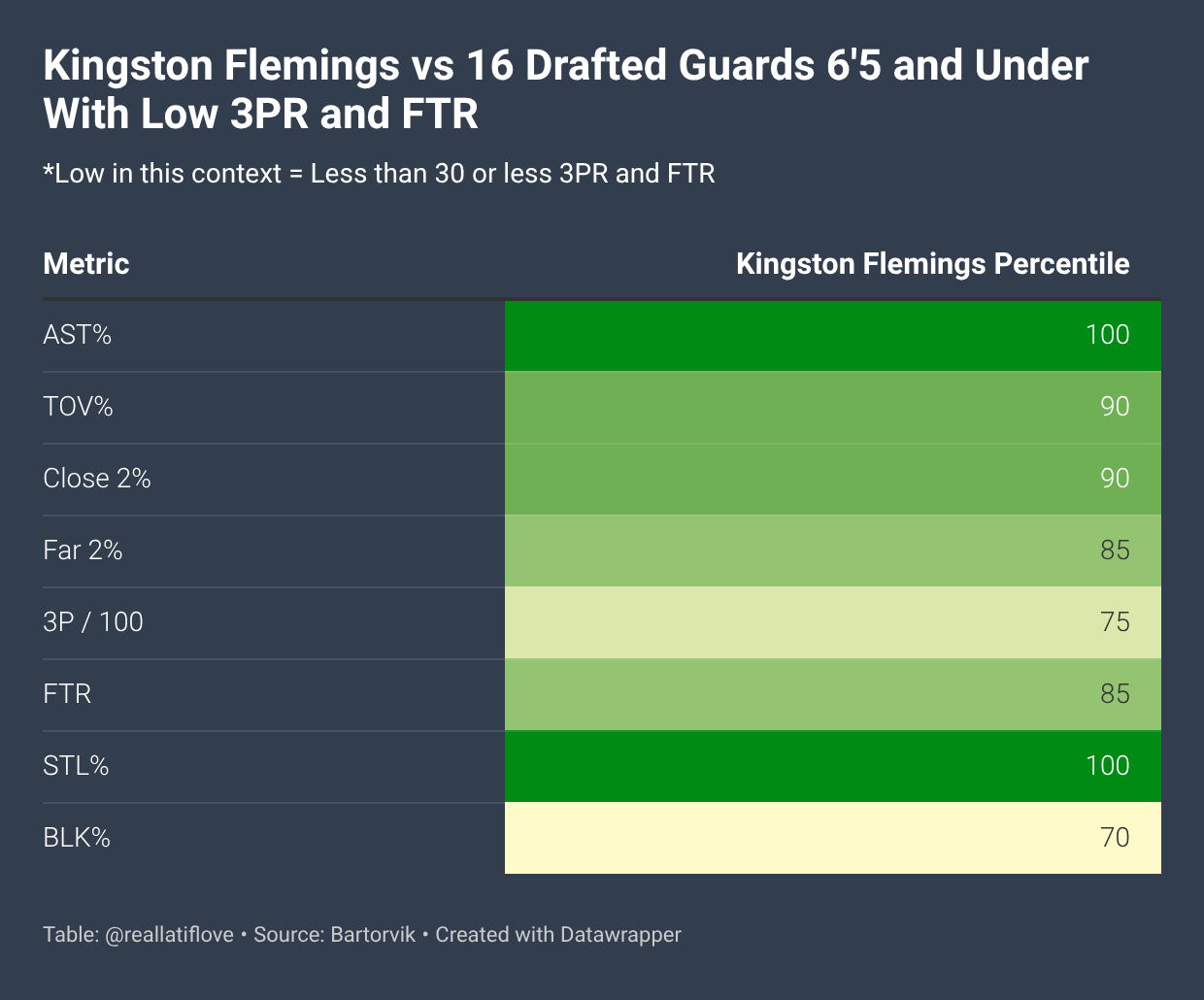
When evaluating the data, the first thing that stands out is Fleming's production in defensive playmaking. His 4.0 STL% ranks in the 100th percentile. Though Houston is one of the best contexts for getting steals and blocks because of its agressive defensive coverages (27.1% Hakeem Percent ~98th percentile), Fleming's films align with his impact.
Flemings’s feel on the offensive end shows up as an off-ball defender. He has a clear understanding of where his opponents want to go with the ball, frequently detonating pick-and-roll actions from the weak side. Flemings pairs this cognition with excellent timing and hand-eye coordination, leading to the cougars' steal percentage being 2.3 percent better with him on the court, per CBB Analytics.
Flemigs also does well at the point of attack. He has good screen navigation and moves his feet well, keeps his hips low, and beats opponents to the spot, though he’s not perfect by any means. His relatively light frame allows stronger ball-handlers to overpower him, and he does give up an occasional turnover, but his turnover creation and abilities on the ball signal that he’ll be at least passable on defense.
Secondly, while his three-point volume is low, all of his indicators of touch are great (44.6 on non-rim 2's + 80.6 FT%), and he is making his threes at a 39.1 percent clip with equity on and off the ball.
Despite his flaws as a scorer, Fleming’s intersection of playmaking, feel, athleticism, and defensive production is unrivaled in this class, making him a blue-chip prospect worth a top-five pick in the 2026 NBA Draft.
His pull-up game is insane, but does his lack of attempts at other shots cause any concern? I see some wild layup attempts ricochet off the backboard if he can't get all the way to the rim, and I can't recall him taking hardly any floaters at all, I feel like he's not confident in anything besides a 3 from just behind the line in rhythm, a mid range dribble pull-up or fadeaway, or a finish directly at the rim. Is that lack of finishing diversity a concern?