

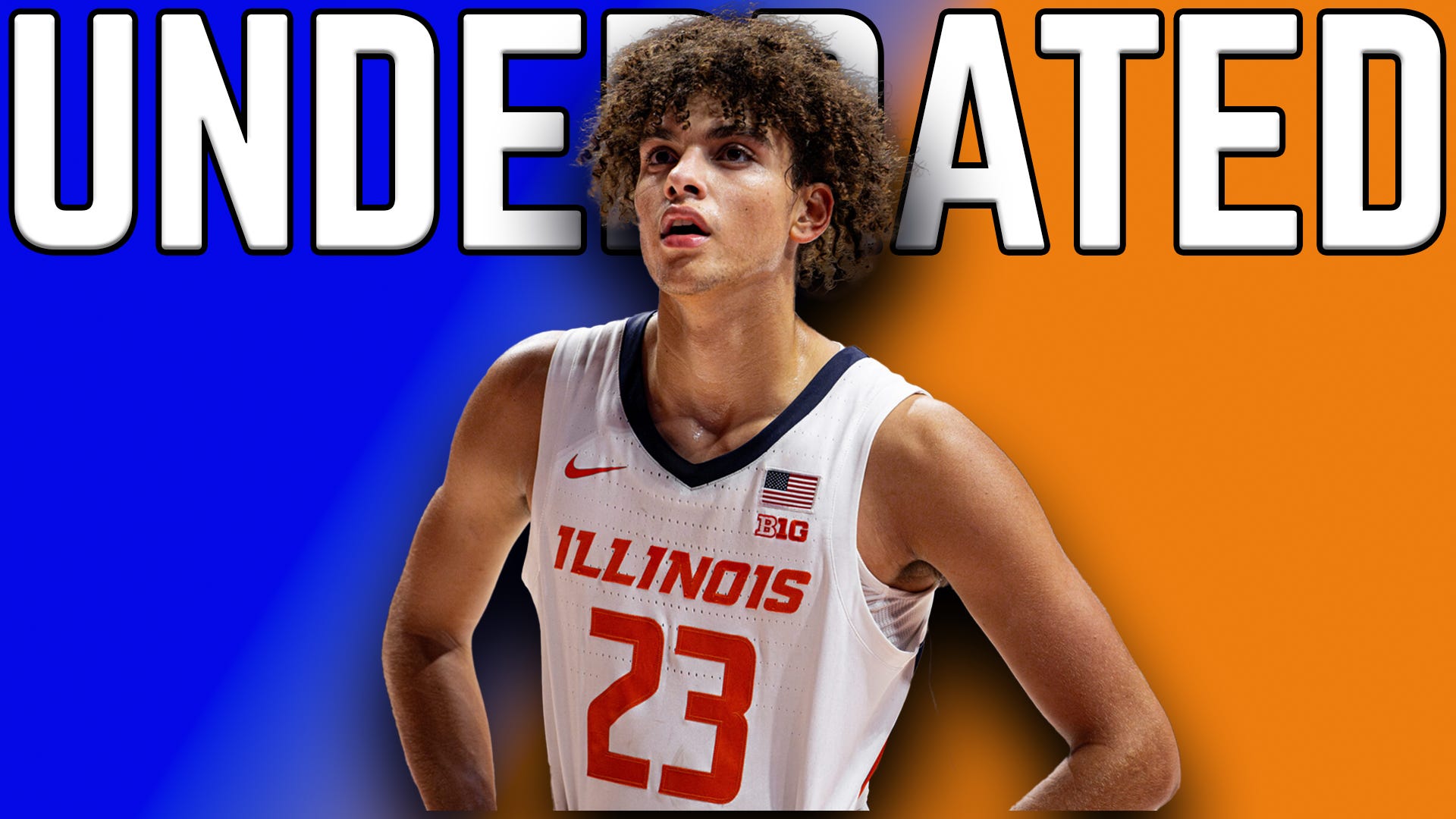
All the rave out of Urbana this offseason centered around Brad Underwood’s international recruiting prowess.
The Illini field a team with 36 percent of its players whose last names end in “ovic” or “isic”, and added another foreign player, Croatian forward Toni Bilic, a week ago.
Underwood has cited foreign players “caring more” and playing more “fundamental” as reasons why they fit what he wanted to build at Illinois.
But arguably, his best player, and arguably best NBA draft prospect through 12 games, is a former three-star recruit from Shawnee, Kansas, a suburb of Kansas City with a population just under 70,000.
Enter freshman guard Keaton Wagler, one of the most unique prospect evaluations that I’ve ever seen.
The NBA Draft space is no stranger to miraculous risers. Every year, there’s a player who plays extremely well in the first ten games of the season and finds themselves on scouts’ radar.
But transparently, I had no idea who Wagler was before his 18-point debut against Jackson State, as he had no accessible high-school priors and didn’t play on a major AAU circuit.
What did I miss?
Wagler was an unranked three-star recruit before 247 re-evaluated him and ranked him as the 150th recruit in the 2025 class.
In his senior season, he averaged 18.5 points, 6.6 rebounds, and 4.2 assists per game to help Shawnee Mission Northwest win its second consecutive state championship.
Wagler’s scoring, rebounding, and facilitating have translated immediately to the collegiate game. As I type into my keyboard, he’s averaging 15.7 points, 5.1 rebounds, and 3.3 assists on 63.1 true shooting percentage.
But maybe I should have expected this?
Before the season started, Underwood remarked that Wagler was in the same class of prospect as former Illini Freshman, and current NBA players Kasparas Jakucionis and Will Riley.
Ultimately, I still had to sit down and watch the film, because what coach wouldn’t speak highly of their players?
What I found has me intrigued by Wagler’s potential as a first-round pick, but it raised even more questions about his NBA translation.
A Case of Possession Maximization
The first thing that stands out on Wagler’s tape is his shooting ability. He has a relatively quick, fluid stroke and isn’t afraid to attempt shots well beyond the three-point line. He’s shooting 43.3 percent on 9.2 3PA per 100 possessions and has a 50.8 3PAR.
Wagler has shown the ability to shoot on and off the ball, often crossing into stepbacks to create space from his defender, or relocating off the ball into catch-and-shoot threes. The freshman is shooting a blistering 44 percent (8-18) on pull-up threes and 42.9 percent (18-42) on catch-and-shoot attempts.
When Wagler has handled the ball more for the Illini, he’s displayed a level of pace, poise, and control that’s rare for a freshman. It’s been quite difficult for defenses to speed him up. Wagler has been one of the best pick-and-roll handlers in the nation, converting ball screens into 1.250 points per possession, which ranks ninth among handlers with at least 30 scoring possessions.
As a driver in the pick-and-roll, he’s adept at using his intersection of size, balance, and footwork to carve out angles near the rim while being a below-the-rim athlete who lacks above-average speed or burst. He routinely punishes smaller guards and executes wrong-hand, wrong-foot finishes to keep his finishing somewhat unpredictable, and has shown a capability to play off of two feet.
The Illini have a system in which essentially all of their ball-handlers get to make decisions. When Wagler had the opportunity to run the show, he processed the floor exceptionally well.
Wagler has excellent synergy in the pick-and-roll with twin brothers Tomislav Ivisic and Zvonimir Ivisic, who both can roll and pop, routinely hitting the two in advantageous spots on the court. The guard is a gifted interior passer who can make deliveries with both hands and sports a 2.5 AST/TO ratio.
Through 12 games, Wagler has a 9.1 offensive rebounding percentage and leads the team in total offensive rebounds. At 6-foot-6, he combines his size with an excellent motor to grab boards over the smaller guards that are usually defending him. Wagle routinely crashes the glass and creates more possessions for the Illini, one of the country's best offensive rebounding teams.
Simply put, Wagler’s a possession maximizer. He does not over-dribble, turn the ball over, or take ill-advised shots. He routinely makes the extra pass, is an excellent decision maker in the pick and roll, and extends possessions with offensive rebounds.
However, my questions about his viability in the NBA start with his defense.
Potential Red Flags
At 6-foot-6, with what looks to be a plus wingspan, Wagler has the length to bother shots and guard both guard spots, but he can be a streaky defender. Right now, he sits at below two steal percentage and two block percentage, which isn’t the end-all be-all, nor does it rule out any future growth, but there aren’t many examples of a freshman with these defensive playmaking numbers grading out as good NBA defenders. Below is a query for lottery picks who meet this criteria.
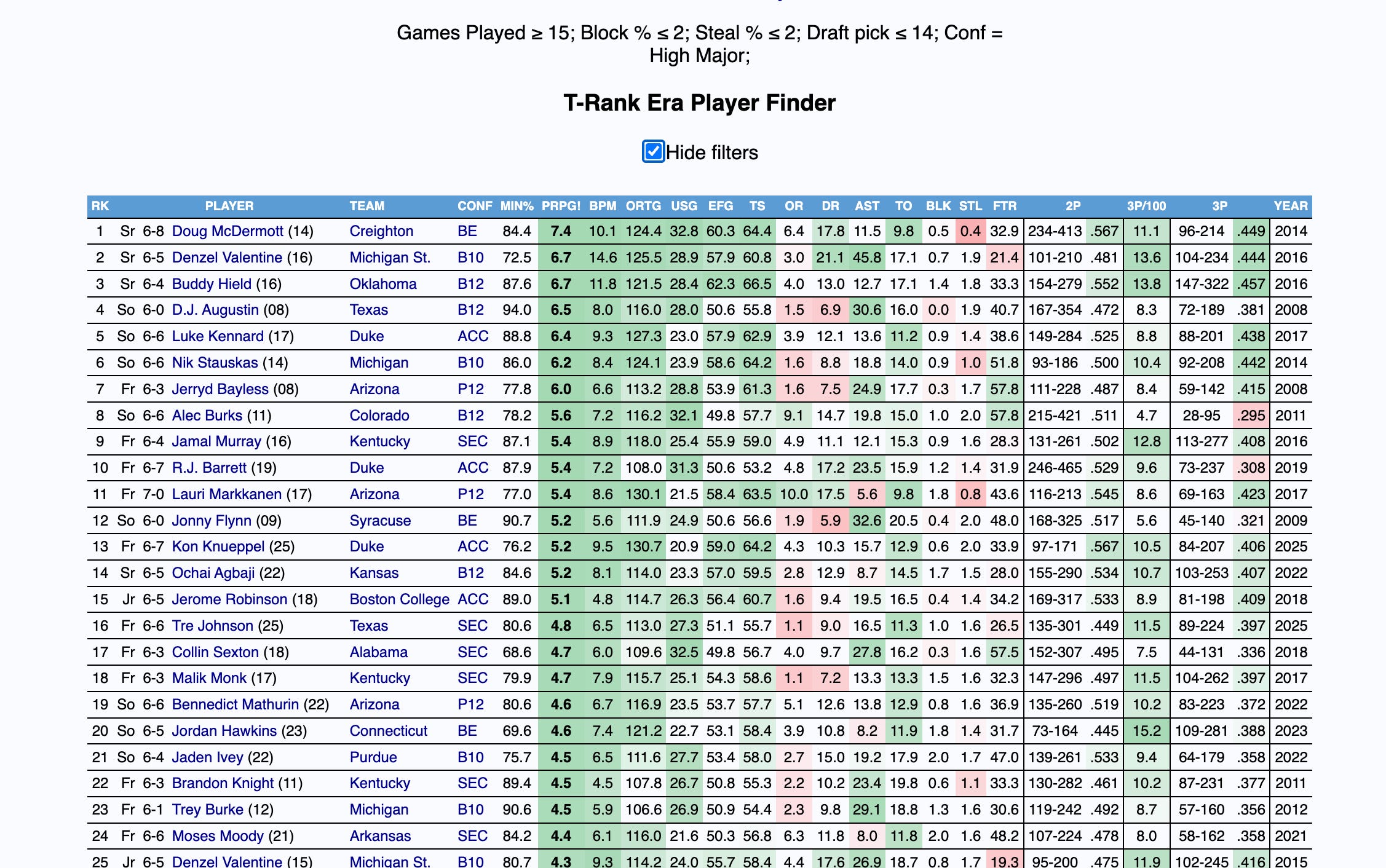
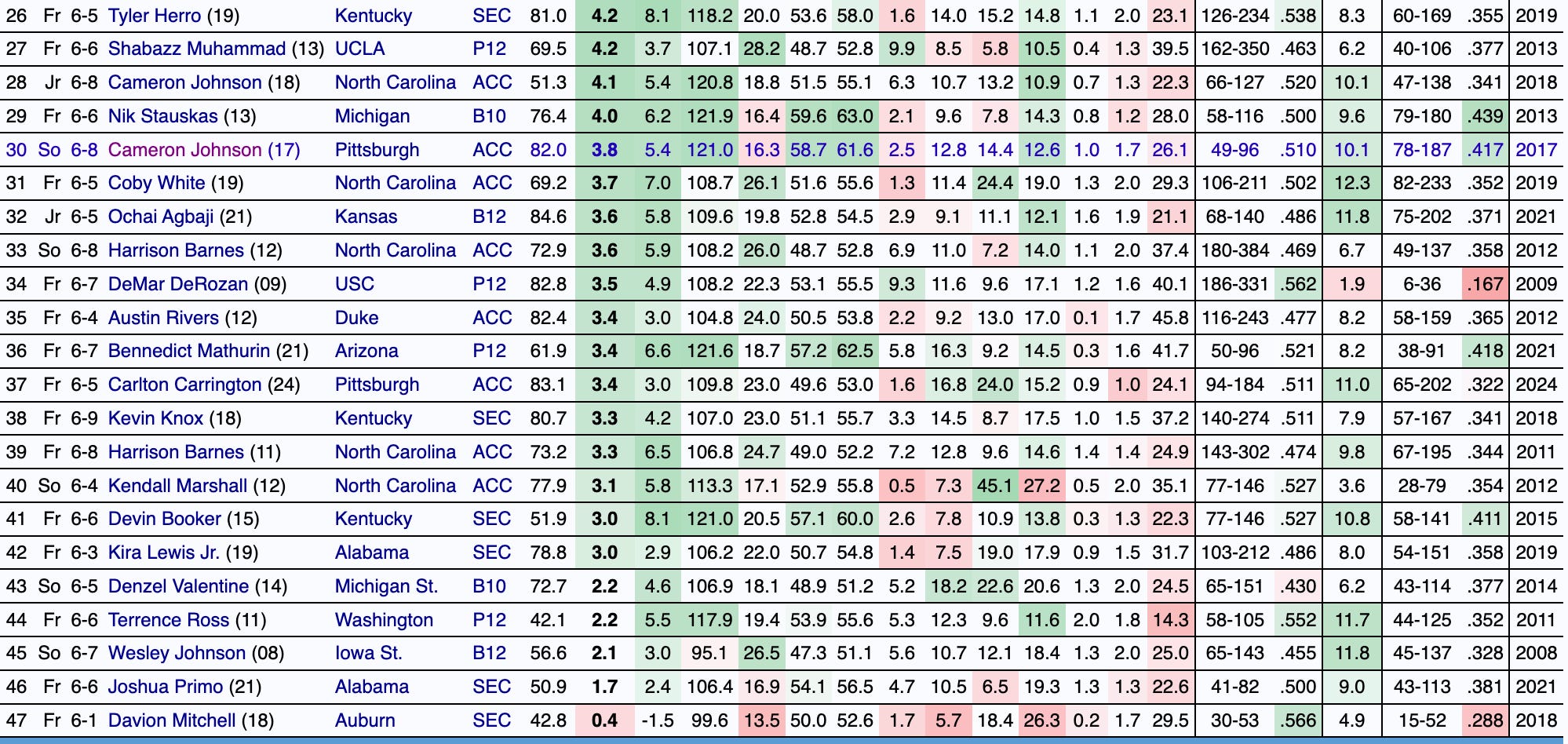
It is worth noting that the Illini, as a whole, don’t force many turnovers or get many steals or blocks—their 5.6 steal percent ranks as one of the worst marks in the nation, and their Hakeem percent (steal + block percent) ranks in the 52nd percentile. These low figures may be because the Illini run a ton of conservative drop coverage, without sending a lot of agressive help to force turnovers. Their defense focuses on limiting three-point attempts.
However, even with that added context, Wagler’s film does raise some concerns about his viability as an impactful NBA defender.
He’s had some excellent moments defensively, most notably his game against Missouri, where his effort, activity off the ball, and positioning were consistently up to par in Illinois’ blowout win.
At times, though, it’s been the inverse. Wagler can struggle to get around or through screens, recover on plays when he’s beaten, or fall asleep off the ball. The lack of attentiveness at times and the screen navigation are common issues for freshmen and contrbitue to his low steal and block numbers. But I find his lack of athleticism to be most damaging to his outlook as an NBA defender.
While he does have plus length for the position, he lacks strength, foot speed, and lateral quickness, so quicker, more athletic guards may be able to blow by him and force defenses to collapse at the next level.
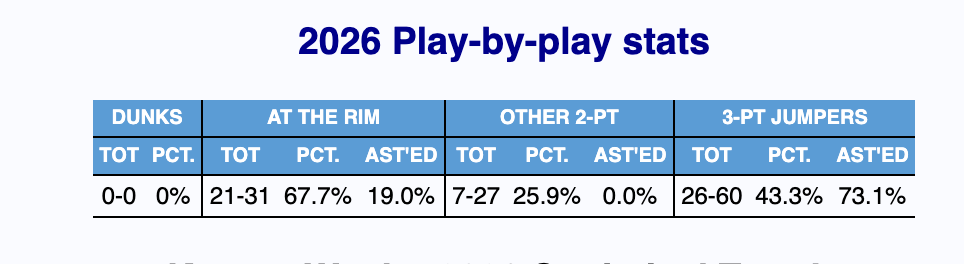
The lack of athleticism is apparent on the offensive end as well. Despite his size, Wagler has zero dunks on the season and has shot 29.4 percent on 2-pointers on his drives this season. The guard lacks the burst or strength-creation to cleanly create advantages consistently when getting downhill. He somewhat makes up for his straight-line speed with his aforementioned creativity and footwork, but when he can’t carve out a clean look, he tends to settle for tough short mid-range twos.
Wagler’s interior-scoring shot diet has been quite concerning to this point. Through 12 games, he has a 1.1 rim-to-non-rim two ratio and is shooting 25.9 percent on non-rim twos. In short, he’s not getting all the way to the rim a lot, and his counters in the mid-range haven't been an efficient shot. The short mid-range looks he’s attempted or been forced into by the defense have dragged his half-court two-point percentage down to 47.2.
Wagler’s athletic shortcomings and struggles as an interior scorer to this point cause me to question his viability as an on-ball or high usage guard in the NBA, but that’s not to say he can’t carve out a role as a secondary ball-handling guard that offers lineup versatility.
Closing Remarks
It’s still early, but based on his play so far, Wagler is deserving of a selection in the mid-to-late first round.
The shooting is real, and his innate decision-making and overall feel for the game are excellent. Players who maximize possessions offensively the way Wagler does—by taking care of the ball, extending plays on the glass, and consistently making the correct read—tend to find ways to provide at the next level, even if they don’t fit traditional athletic thresholds.
That said, there’s still meaningful room for growth. A larger sample will help validate the shooting numbers, especially off the dribble. Improving his efficiency inside the arc—either by getting all the way to the rim more often or improving his efficiency on short mid-range counters—would go a long way toward solidifying his offensive projection. Defensively, consistency will be the key factor.
If Wagler’s track record tells us anything, though, it’s that he has a habit of outperforming evaluators’ expectations. I wouldn’t be surprised if, once again, Wagler forces evaluators—including myself—to rank him higher.