

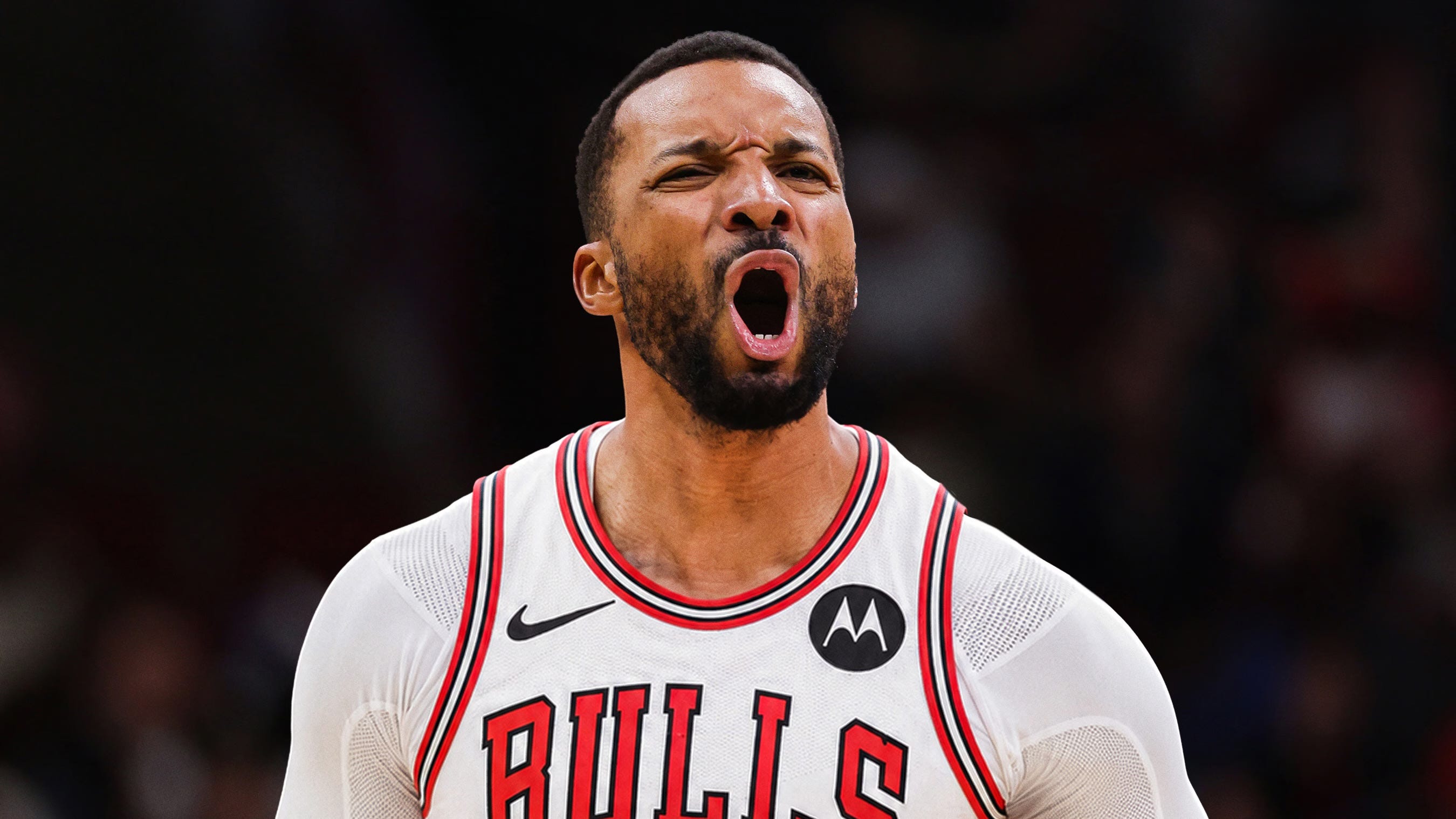
Sunday evening, the lowly Bulls showed signs of life.
For just a second, the dark clouds that have blanketed the Windy City this season parted, and fans caught a glimpse of light.
For the first time this season, the Bulls competed with a team with a pulse for the full 48 minutes.
Josh Giddey looked like the wizard who’s chasing the franchise triple-double record.
Matas Buzelis looked as decisive and confident as he has all season.
Caleb Wilson challenged a goat that’s still kicking, and failed, a few times, but it’s the audaciousness to try that matters.
Jalen Smith continued to flash why he should be a valuable asset for a contender, Nix Claxton looked solid in his return from injury and Noa Essengue and Isaac Okoro continue to look like the Bulls only hope at stopping anyone on the perimeter.
It was the time of moment Chicago’s rebuild needed. A step in the right direction.
Sure they’re approaching ten straight losses and three-point shooting and defensive rebounding continue to be a struggle.
But it was fun?
Amid all the positives from Sunday evening, one absence stood out like a sore thumb.
Norman Powell, who was out with right shoulder inflammation and soreness.
And Bulls fans wasted little time addressing the elephant in the room.
After watching Chicago put together arguably its most encouraging performance of the season without Powell in the lineup, many were quick to suggest that the veteran guard should be relegated to the bench.
And on the surface, it’s not hard to understand why.
But while Sunday’s performance may have added fuel to the fire, the early-season data suggests Bulls fans might want to slow their roll before calling for Powell’s removal from the starting lineup.
Additive or Authoritarian?
There’s been a lot of chatter about the Bulls potentially benching Norman Powell after Josh Giddey and Matas Buzelis had their best games of the season in his absence.
I don’t know if there’s any correlation or causation there, but I get the sentiment.
Powell has forced some shots this year, and his grifting has gotten frustrating when he’s not drawing fouls.
However, if the Bulls want to avoid draft regulation, early statistical trends suggest keeping Powell in the starting lineup.
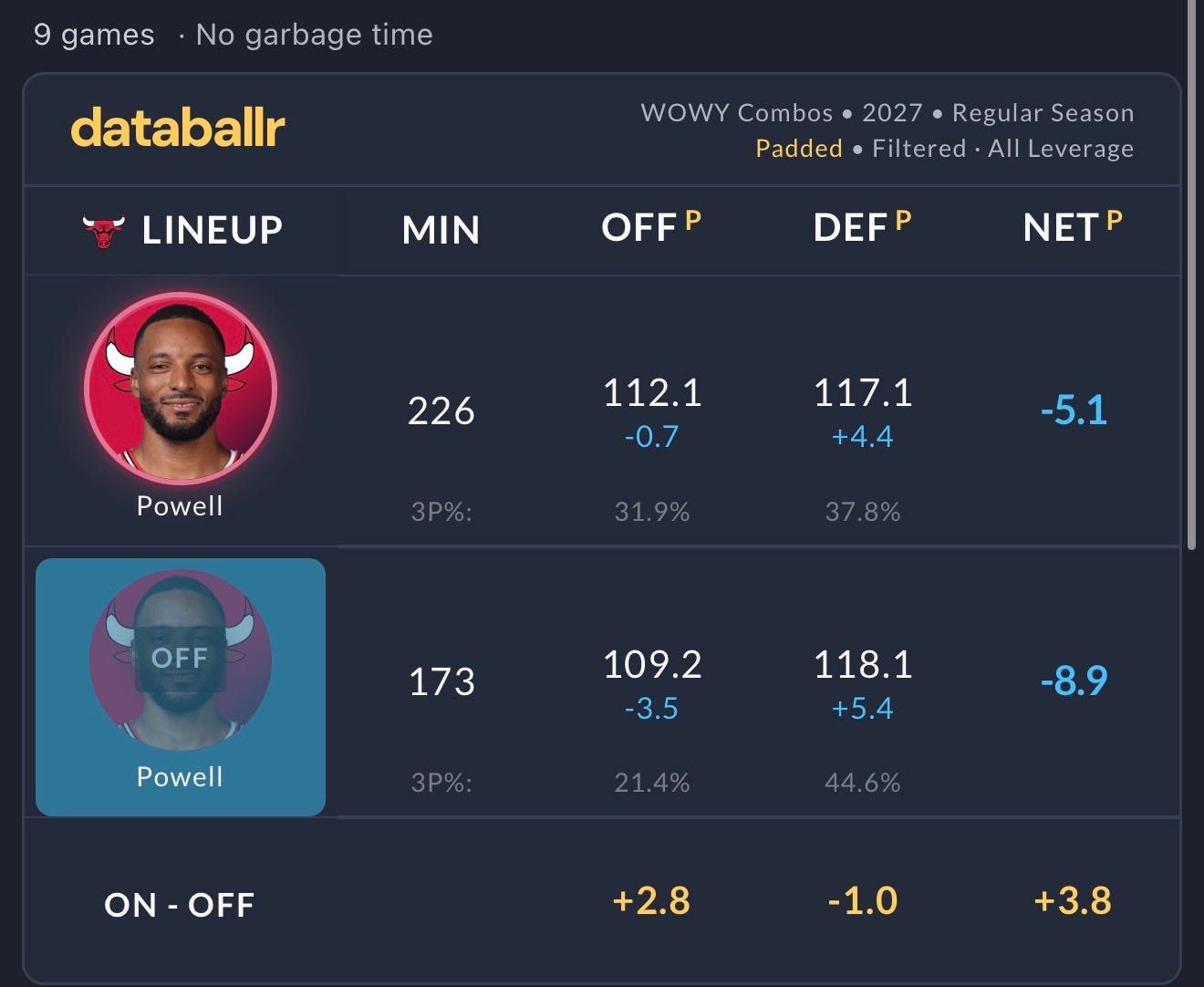
Because of Powell’s 3PT volume, foul drawing, and ability to avoid turnovers (mostly because all he does is shoot), Chicago’s offense has been much more efficient when he’s on the court compared to when he’s off, even when adjusting for shooting variance.
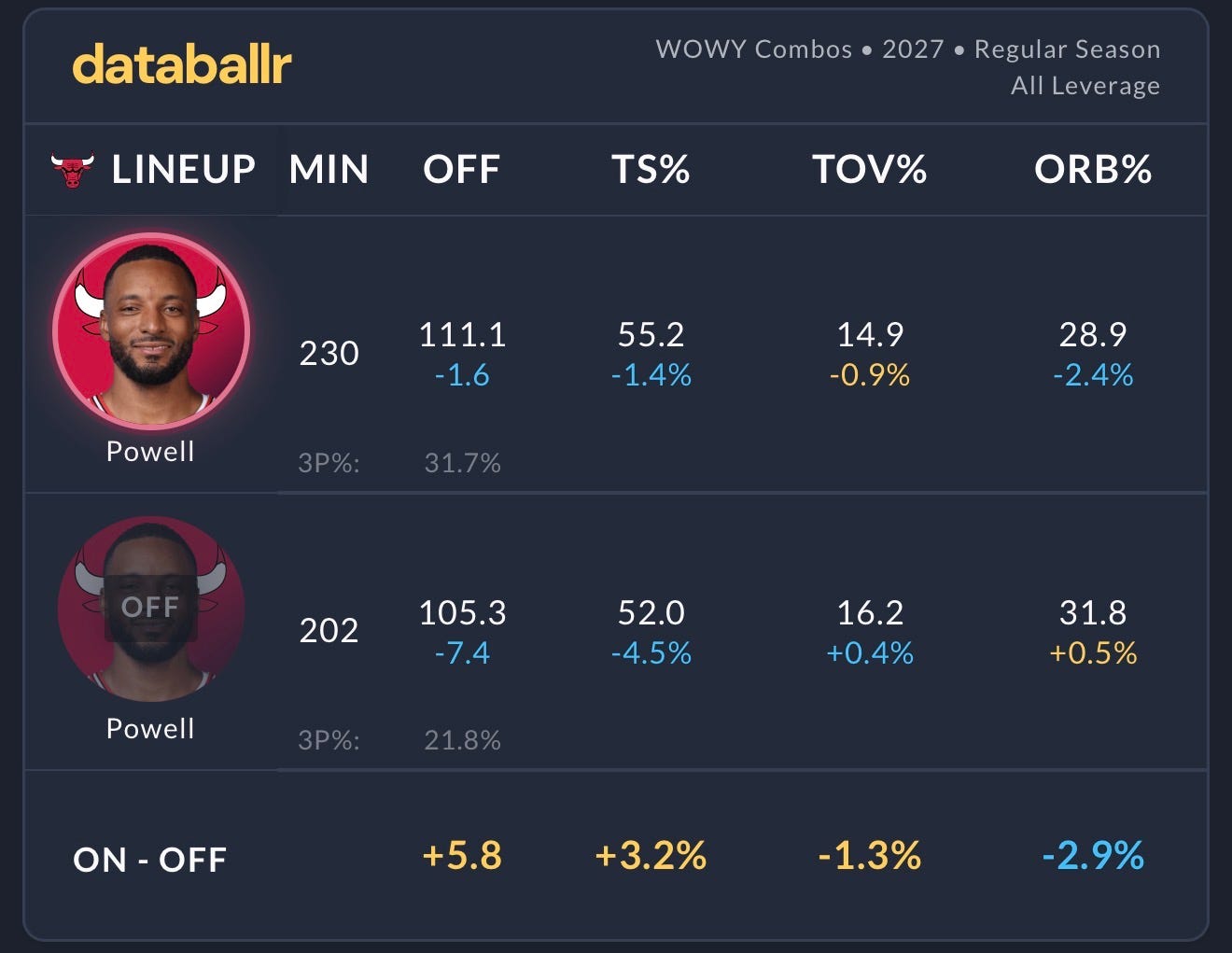
Chicago’s padded offensive rating with Powell on: 112.1
Chicago’s padded offensive rating with Powell off: 109.2
The Bulls have seven positive lineups with at least 10 possessions played. Powell is in five of them.
More importantly, Caleb Wilson has been much more effective with him on the court compared to when he sits:
Wilson with Powell on (195 mins):
28.9% USG, 27.5 PTS, 3.5 AST (3.8 TOV), 54.6 TS%
Wilson with Powell off (97 mins):
34% USG, 26.5 PTS, 1.9 AST (4.2 TOV), 44.1 TS%
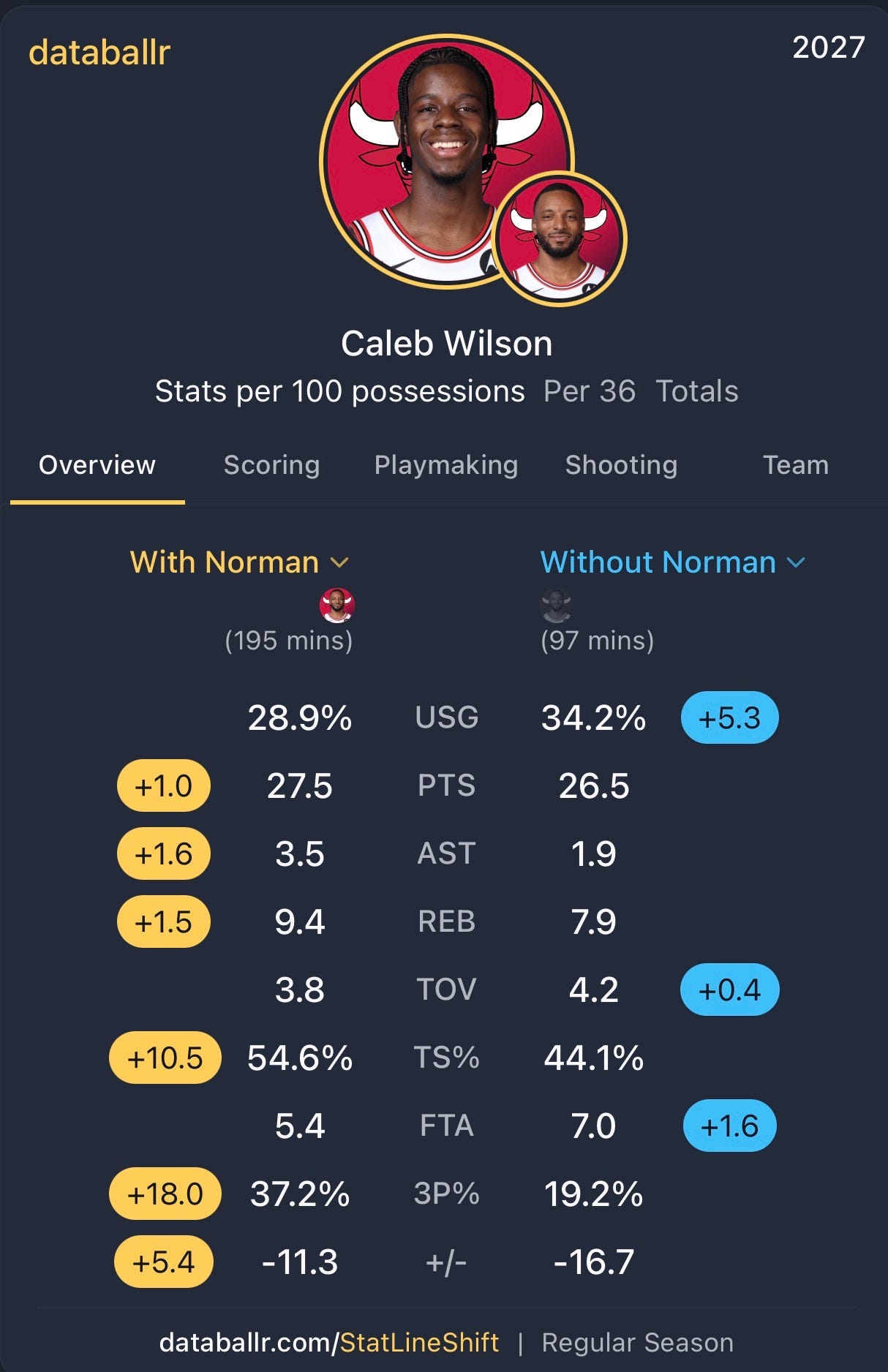
It’s way too early to establish causation, especially for a singular player’s impact on Wilson, and the drop in effiency is certainly affected by Caleb shooting 19% from three with Powell off the floor. Still, it’s a data point worth monitoring in the future.
I’d agree that there needs to be a process change. Powell needs to be more additive than authoritarian in his offensive process.
He can’t get in the way of the young players Chicago is trying to develop, but benching him isn’t the answer. On a roster that lacks shooting and scoring, the Bulls need what Powell provides, especially if/when his shooting positively regresses to the mean.
Maybe the Bulls do need to make a lineup change at some point. Okoro, who replaced Powell Sunday evening is also featured in four of Chicago’s most positive lineups. But he shares this minutes in three of lineups with Powell.

If Bulls fans want to jump to make lineup changes less than ten games into the season, then they should look elsewhere. Especially if the goal is to avoid the relegation zone.