

I don’t think much of what I’m about to say is profound or groundbreaking. In my opinion, it should be the consensus thought.
At its core, it’s actually pretty simple.
I hate the term role player.
At least, I hate the way we most commonly use it to describe—and often underrate—basketball players.
The main reason is simple: every player on the court has a role. Everyone is a role player.
Some players are tasked with roles that are viewed as more difficult, more valuable, or simply rarer than others. Those players typically carry the bulk of the offensive burden, draw the most defensive attention, and become the focal point of an organization’s team-building efforts. Those are the players we label stars.
The problem is that we’ve come to define a star almost exclusively by offensive responsibility. Within the basketball community, a “star” is generally understood to be someone who can serve as the No. 1 or No. 2 offensive option on a good team.
That framework largely ignores players whose value comes from elite defense paired with enough offensive utility to make them some of the most impactful players in the sport.
It also causes high-usage offensive players to become overrated relative to players who contribute more to winning in lesser usage roles. The common justification is that the so-called “role player” couldn’t scale up into a larger offensive role.
That’s true in many cases. But we rarely ask the inverse question: how many stars have complementary skills to scale down into a smaller offensive role while maintaining the impact these “role players” provide?
Furthermore, the term star is arbitrary. It has no universally accepted definition or meaningful cutoff, so it exists in basketball discourse permanently shackled to ambiguity.
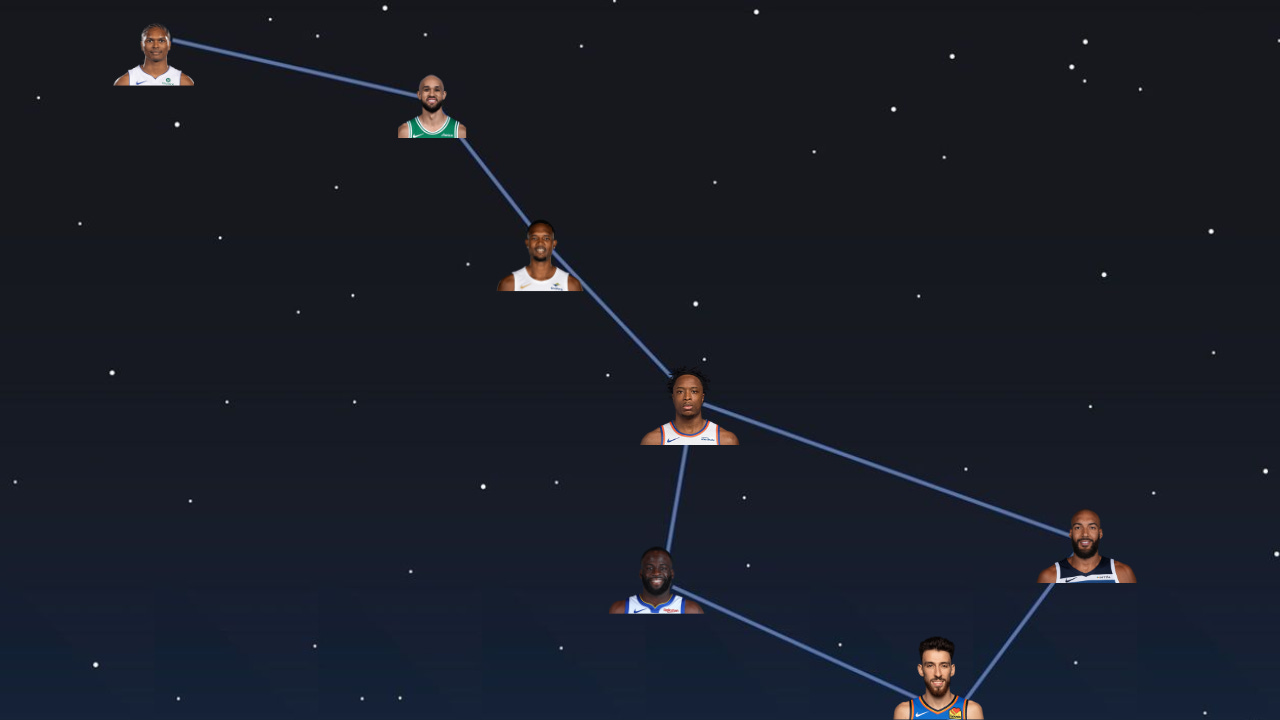
The biggest victims of that mindset are players like Rudy Gobert, Draymond Green, Chet Holmgren, and Evan Mobley. Soon, it’ll be Ausar Thompson.
I’ll focus on Rudy Gobert because he’s one of the most disrespected “stars” in NBA history.
Gobert has long been viewed as a role player because he has never averaged 20 points per game and hasn’t created his own offense. But that ignores how he actually impacted winning.
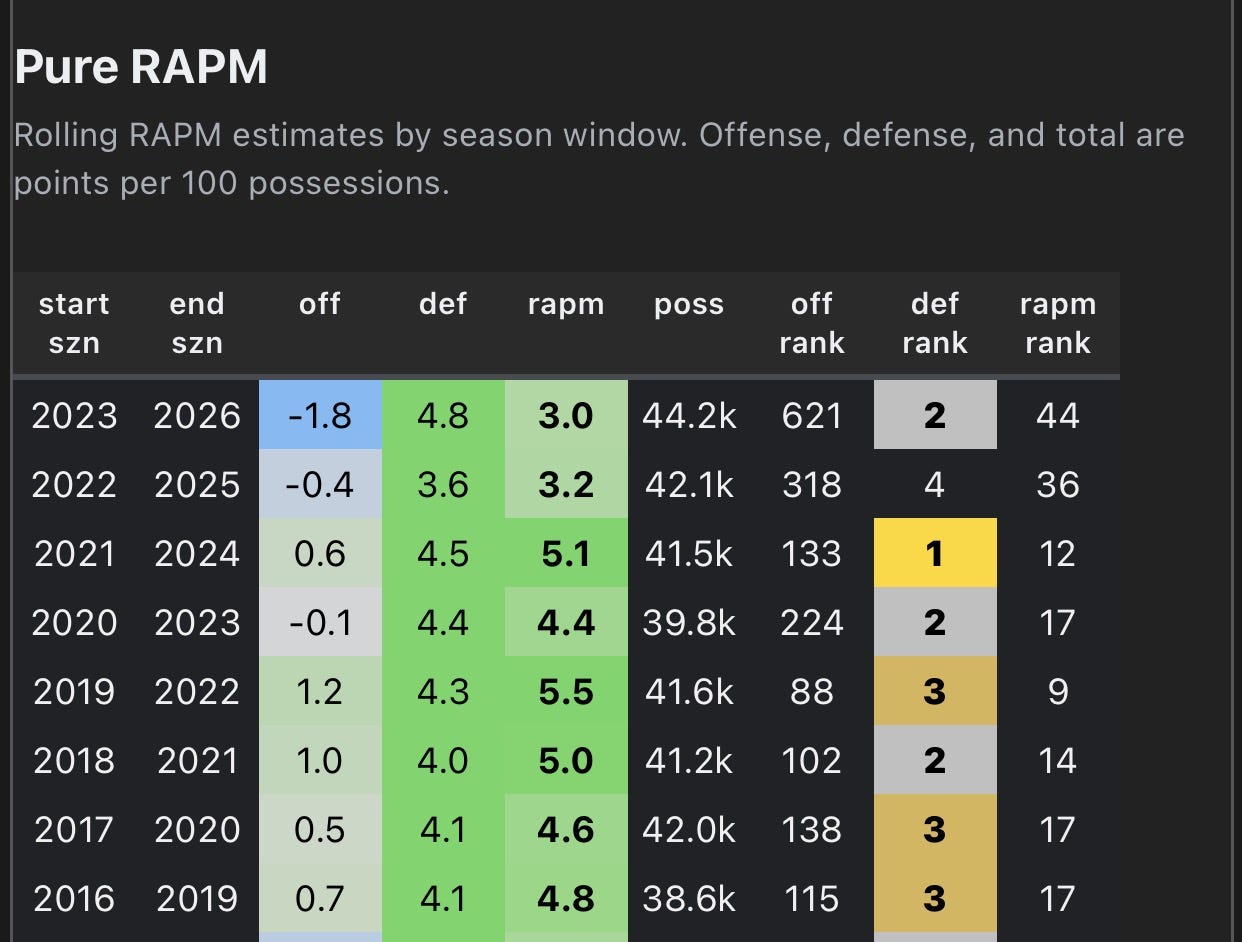
At his peak, Gobert was very clearly one of the most impactful players in basketball and comfortably a top-20 player in the league. I can easily argue for him to be higher.
His offensive limitations have been criticized for years, and he definitely has his shortcomings(most notably poor hands and turnover issues), but scoring wasn’t where he created value. In his prime, he was one of the league’s best screeners, offensive rebounders, and play finishers. From 2018-2022, he routinely had positive impacts on OTS% and OREB%.
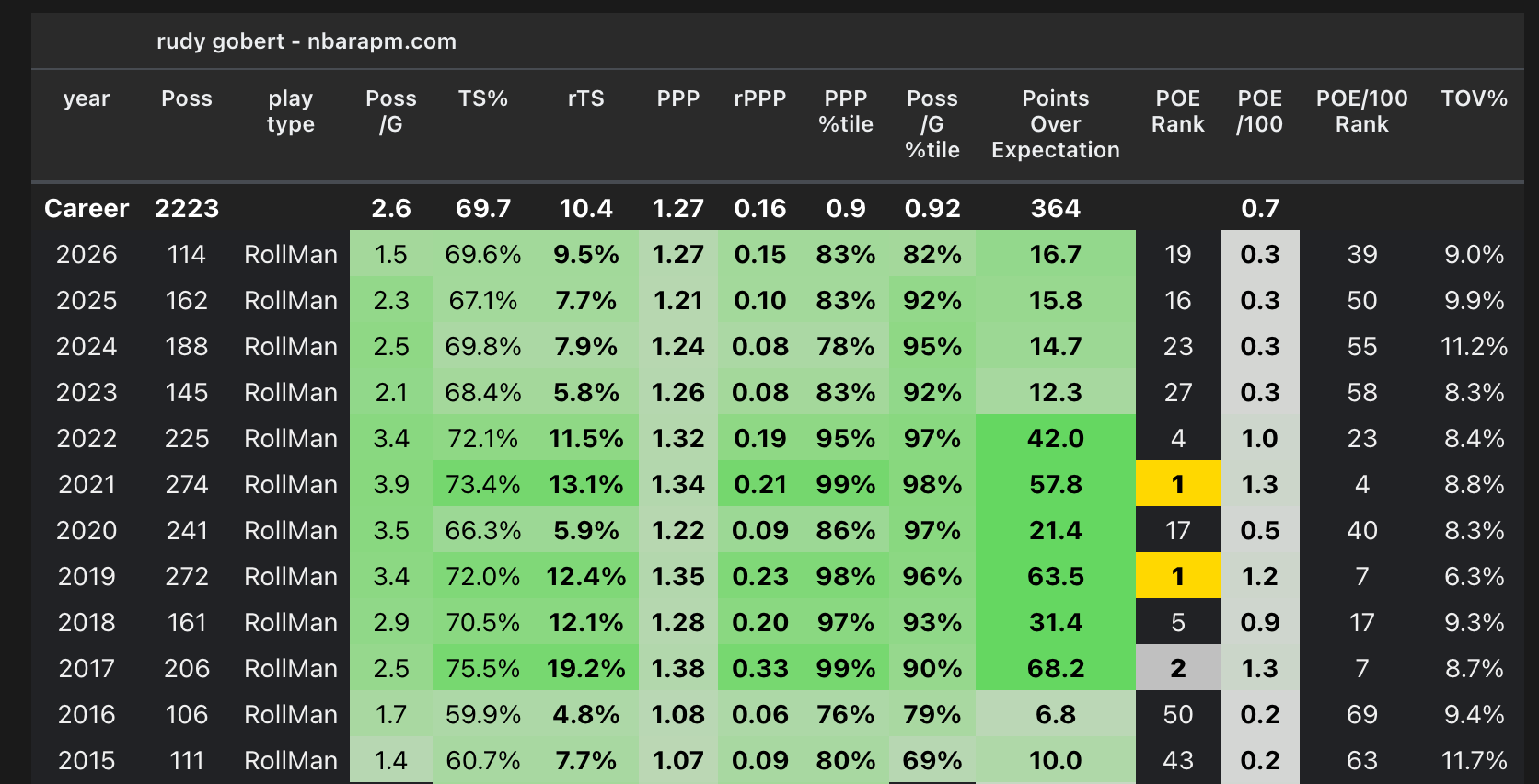
The idea that he was some one-way player has never really held up, and both the eye test and the numbers—from Utah to Minnesota—reflect that.
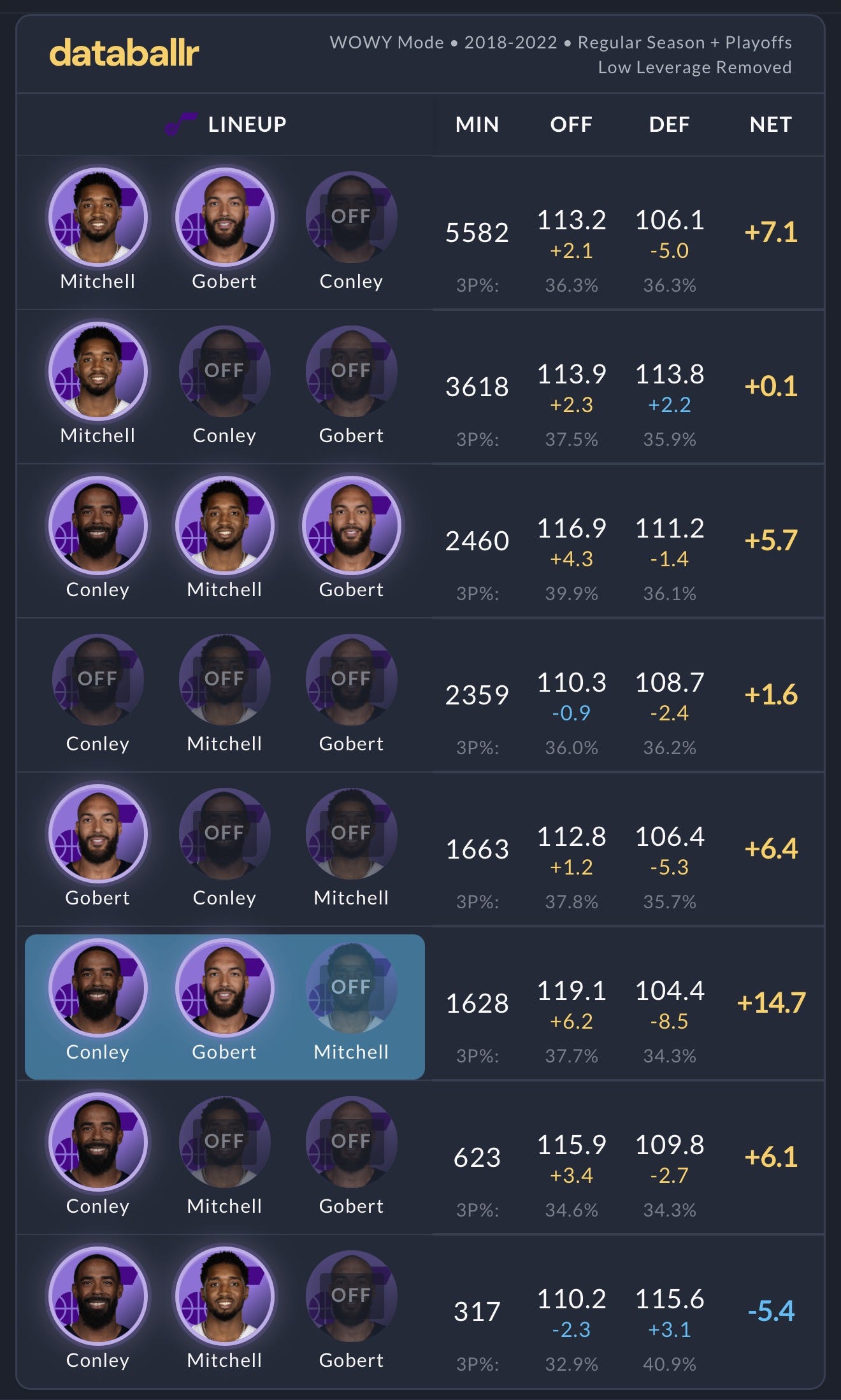
Because Donovan Mitchell carried the offensive load, attracted the most defensive attention, and scored at a high volume and efficiency, he was widely viewed as Utah’s star and best player.
Yet there were thousands of possessions in which the Jazz performed better with Mitchell off the floor and Gobert on the floor. Utah consistently fielded elite defenses despite mediocre defensive personnel around Gobert. His impact was every bit as real (and superior) to Mitchell’s—it just wasn’t measured by the statistics people tend to value most.
In my basketball utopia, “stars” would be the most impactful players in the game. We’d be better at recognizing impact beyond points, rebounds, and assists.
In my basketball utopia, it wouldn’t be difficult to understand why a player like Draymond Green reached a higher peak than someone like Jaylen Brown, even though Draymond never carried the offensive burden of the No. 1 or No. 2 option on a 50-win team.

The most common response to this argument is that players like Rudy Gobert or Draymond Green aren’t stars—they’re just stars in their roles.
But how is that any different from the players we traditionally call stars?
Nikola Jokić’s role is to orchestrate an offense. Shai Gilgeous-Alexander’s role is to carry an enormous scoring and playmaking burden without turning the ball over. Stephen Curry’s role is to warp defenses with his shooting and off-ball movement.
Those are roles, too. And those players star in said roles.
Yet when another player’s role is anchoring an elite defense, quarterbacking a scheme, while creating advantages through screening, creating extra possessions for an offense or consistently making the connective plays that elevate everyone around him, we suddenly feel the need to qualify it in a deprecating way.


That distinction exposes the underlying bias. We’ve decided that offensive burden x production is the default path to stardom, while every other form of value is treated as complementary and, in turn, less valuable towards winning basketball games.
But if two players produce comparable impact through entirely different means, why should only one of them receive the unqualified label of “star”?