

University of Washington forward Hannes Steinbach came into the season as one of NBA Draft Twitter’s favorite players to rank above consensus and place inside the top ten — and it made sense.
Steinbach was fresh off a season in which he’d produced in Germany’s A and B leagues (BBL) and then dominated the FIBA U19’s, averaging 17 points, 13 rebounds, and 1.3 blocks en route to a championship appearance.
When he touched down in Seattle, the production continued — Steinbach recorded a double-double in his first six games of college — and he looked well on his way to living up to all of the preseason hype.
Then, somewhere in December, things went radio silent.
The forward kept producing, but it began to be overlooked and underdiscussed by consensus and the faction of draft Twitter that heralded his talent heading into the season.
Whether it was because there were a ton of other freshmen and upperclassmen producing at a high level, which made the masses realize how strong the class could be, or because the Huskies were one of the worst teams in the Big Ten, Steinbach didn’t get a typical amount of recognition for a player who averaged nearly 19 and 12 on 63.6 true shooting percentage.
But, despite the hype around Steinbach being low relative to his blanket production, I think he has pathways to providing value—even in a deep class.
Below, I’ll discuss his strengths, areas for improvement, and NBA outlook.
Midas Touch
Stein\bach is unique in that, unlike most prospects, his strongest trait is his great hands. Steinbach has one-of-a-kind ball skills, hand-eye coordination, and a strong motor, which make him one of the best rebounding prospects of the last decade.
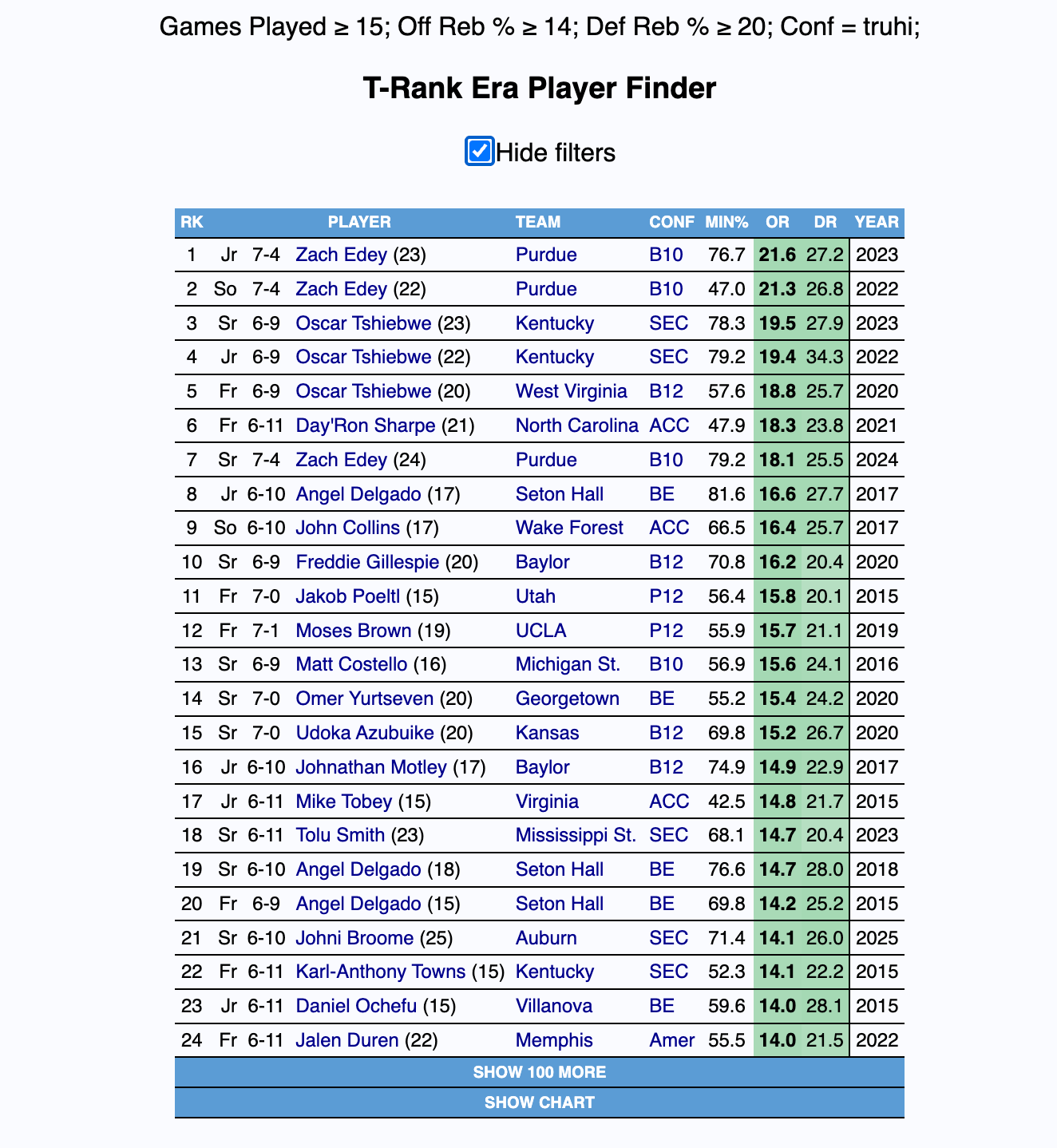
Since 2015, 24 NBA players (in their underclassmen seasons) have played at a high-major school and have an offensive rebound percentage of at least 14 and a defensive rebound percentage of at least 20. When Steinbach is inevitably drafted, his freshman season will rank 20th in offensive rebounding and 13th in defensive rebounding. This feat is even more remarkable when you consider that the freshman has spent a large percentage of his minutes with another big man on the floor.
Steinbach’s offensive rebounding is particularly impactful for Washington, a sub-optimal first-shot offense that’s able to tread water thanks to being one of the best offensive rebounding teams in the country.
Steinbach’s suction cups for his hands enable him to score as well.
He resembles a tight end in the red zone in the way he can box players out, make a catch in traffic, and score a touchdown — or in this case, a bucket. The forward has a knack for doing a lot of the work needed to score before he gets the ball. His understanding of leverage is pristine. Once he gets a player on his hip, he uses his size to seal them and create easy looks around the rim.
On pure creation reps (in the post), Steinbach is excellent as well. He has an array of post moves, including drop steps, hooks, and fades. Steinbach’s intersection of post feel, footwork, and great touch has led him to generate 1.047 points per post-up (79th percentile).
Steinbach’s ballerina-esque footwork, balance, coordination, and mobility also help him score as a roller despite average vertical athleticism.
These skill intersections have enabled him to be a high-level finisher in the half-court, even with inconsistent guard play and limited spacing. According to CBB Analytics, Steinbach is finishing 69.7 percent at the rim and 50.9 percent on non-rim paint twos.
Additionally, Steinbach is also a force in the open court. While the Hustkies have struggled mightily at times in the half-court, they rank in the 90th percentile in both transition points per game (7.4) and transition points as a percentage of total points (10.1). The Huskies’ freshman star is a big reason for this. He’s great at beating other bigs down the floor or can trail the play and take them off the dribble in semi-transition.
According to Hoop Explorer, with Steinbach on, Washington runs in transition on 17.2 plays per 100 possessions and generates 1.35 points per play, compared to 14.9 plays per 100 possessions and 1.12 points per play with him off.
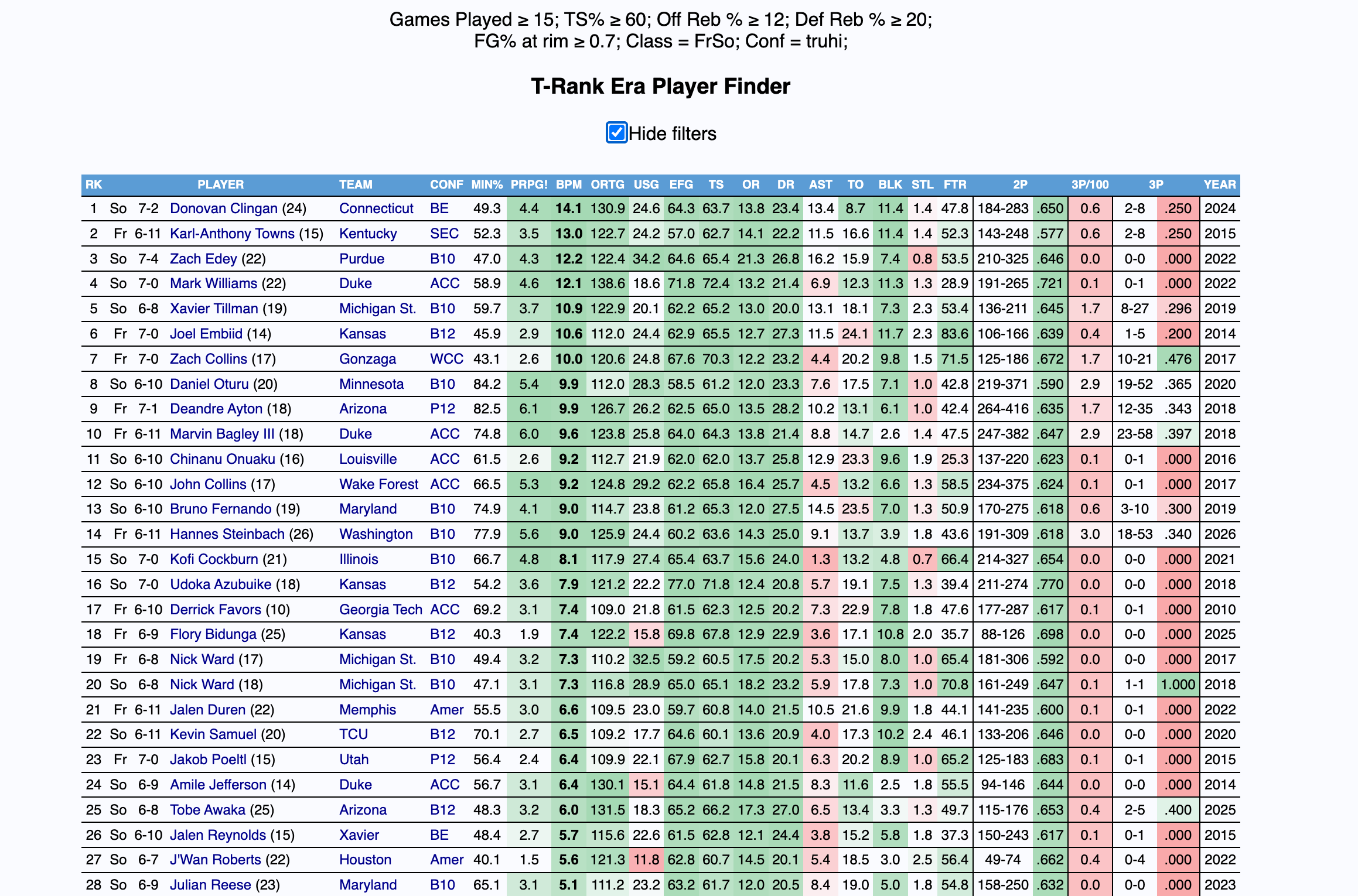
The forward’s rebounding, rim finishing, and overall effiency at this age in a high-major conference have not only made him extremely impactful for Washington’s offense but also put him in company with a ton of successful NBA players. The query below features outcomes from future Hall of Famers to quality backup big men. The goal of the query is not to directly compare those players to Steinbach, but to identify a trend in his skill set that leads to league-level productivity.

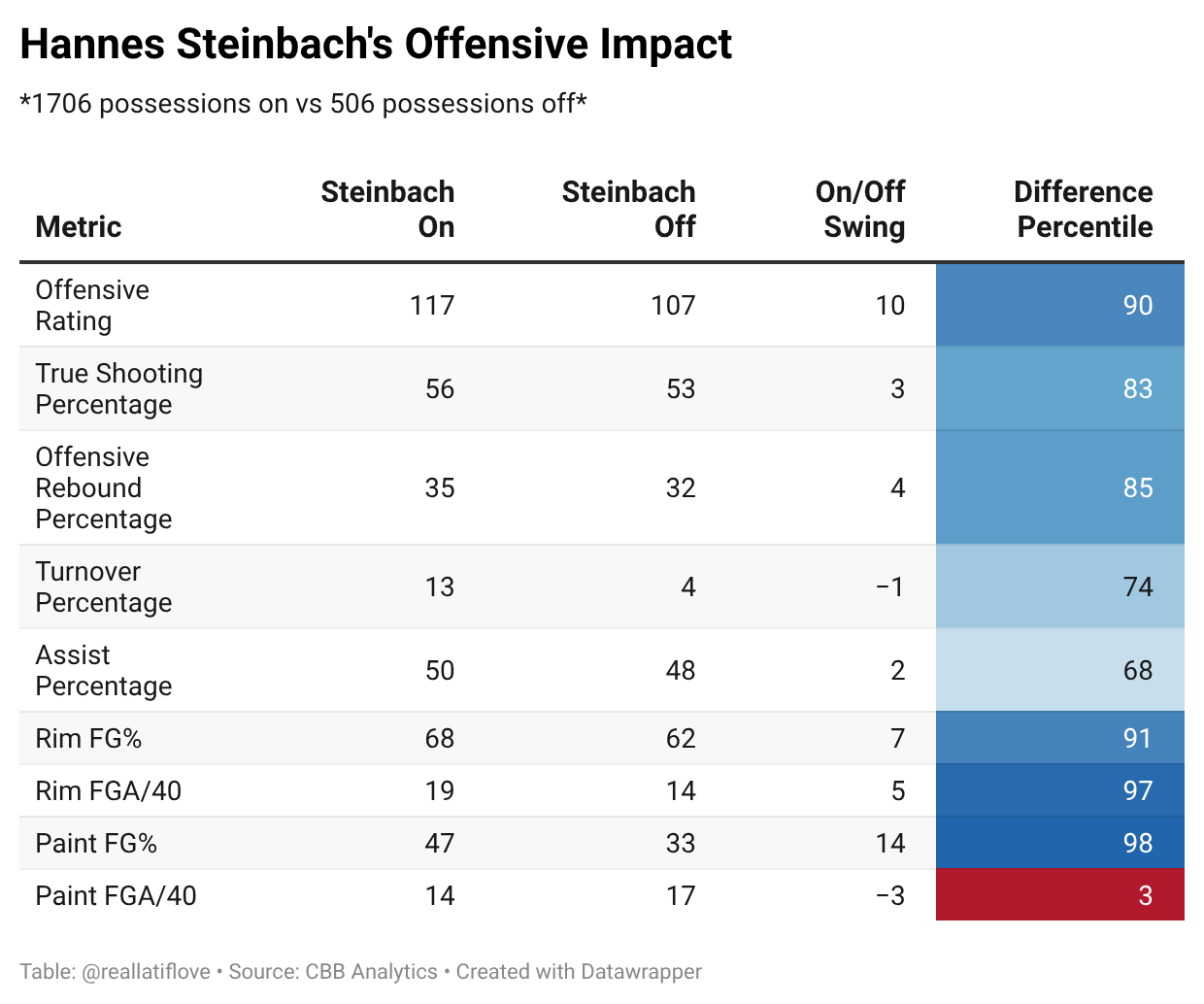
I believe that Steinbach has the potential to positively impact linueps by helping his team win the possession battle, one of the foremost aspects of winning a game. A quick look at his impact on the Huskies’ offense depicts how his offensive rebounding, rim finishing, and propensity to run the floor and create easy offense will aid NBA teams.
However, I don’t believe Steinbach has slipped on draft boards because of major qualms about his offensive game. It’s the other side of the ball that has drawn the most concern.
To be a tweener or not to be
Steinbach’s biggest area of improvement, and main reason for his “fall from grace,” is his rim protection. He played most of his minutes at the four this season, which sparked questions about his viability as a center in the league. Those questions were answered whenever the fellow big man Franck Kepnang was off the floor, and Steinbach was forced to anchor the defense.
As the graphic below shows, teams attacked the rim more when Steinbach was at the five and scored at an extremely high rate compared to when he was off the floor entirely or playing the four next to Kepnang.
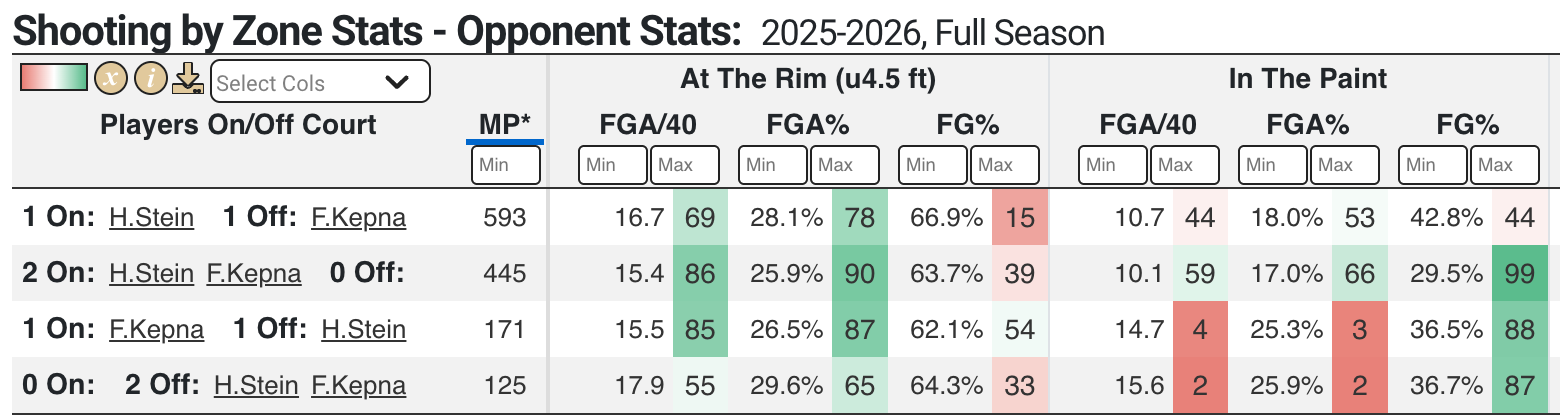
Individually, Steinbach can struggle to affect shots around the rim and is vulnerable on the perimeter when guarding in space. In order for him to play the five, he’d need to see major improvements in his timing on contests and positioning when guarding in drop to make up for a lack of elite vertical pop.
While not completely hopeless on the perimeter — due to the aforementioned mobility that helps him be so dangerous offensively — Steinbach struggles to stay in front of quicker and more dynamic guards and wings when placed in a switch. There are also a fair number of plays where his 6’11, 220lb frame isn’t big enough to stop true centers. Sequences in his matchups versus Michigan’s Aday Mara and UCLA’s Tyler Bilodeau come to mind as to what it could look like against larger bigs.
Steinbach finished the season with a modest 3.9 blocks and 1.8 steals per game. While these numbers are not the end-all, be-all, they have trended towards underwhelming defensive impact in the NBA. Below is a query for drafted players of Steinbach’s size with similar defensive playmaking figures.
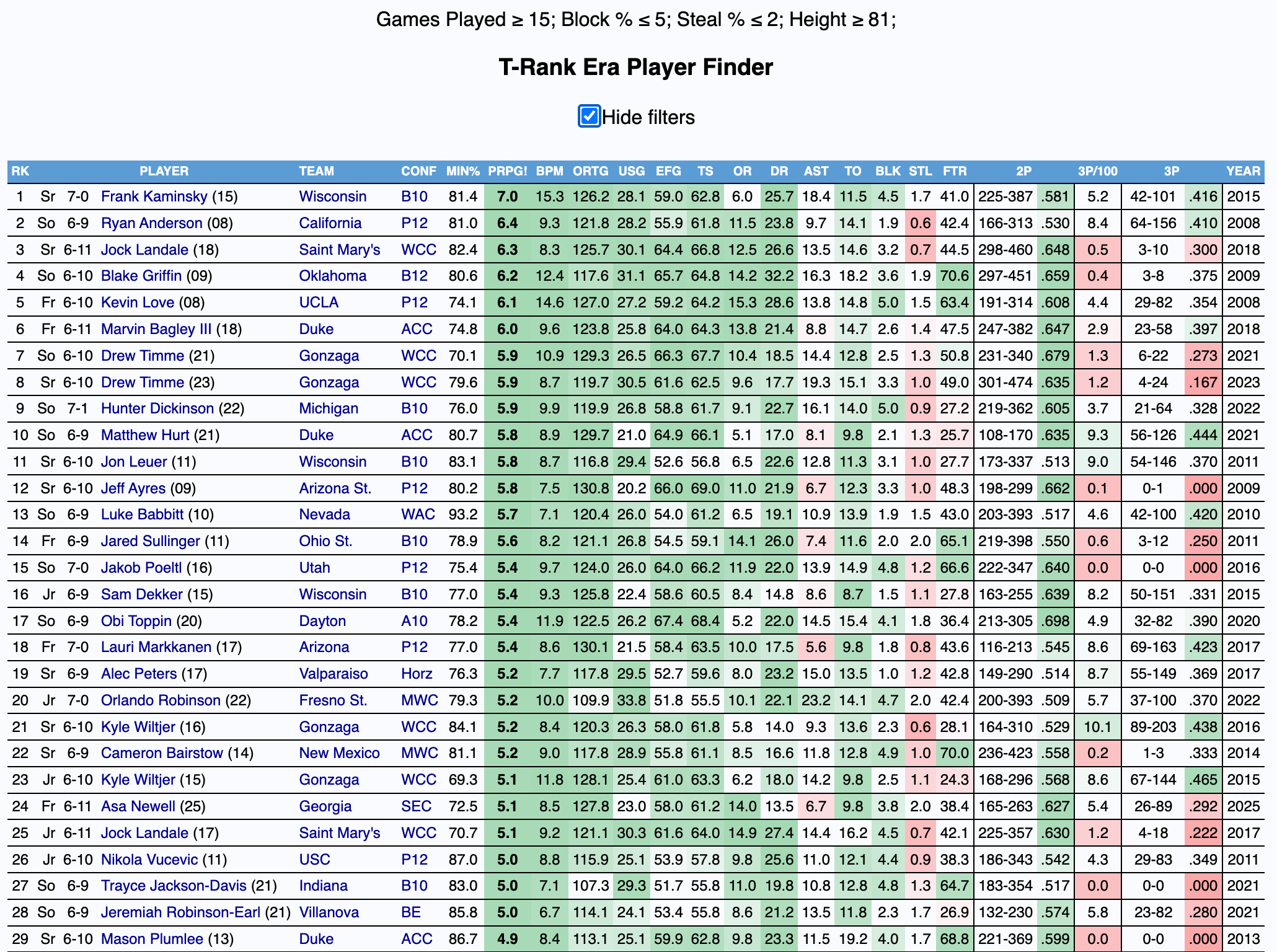
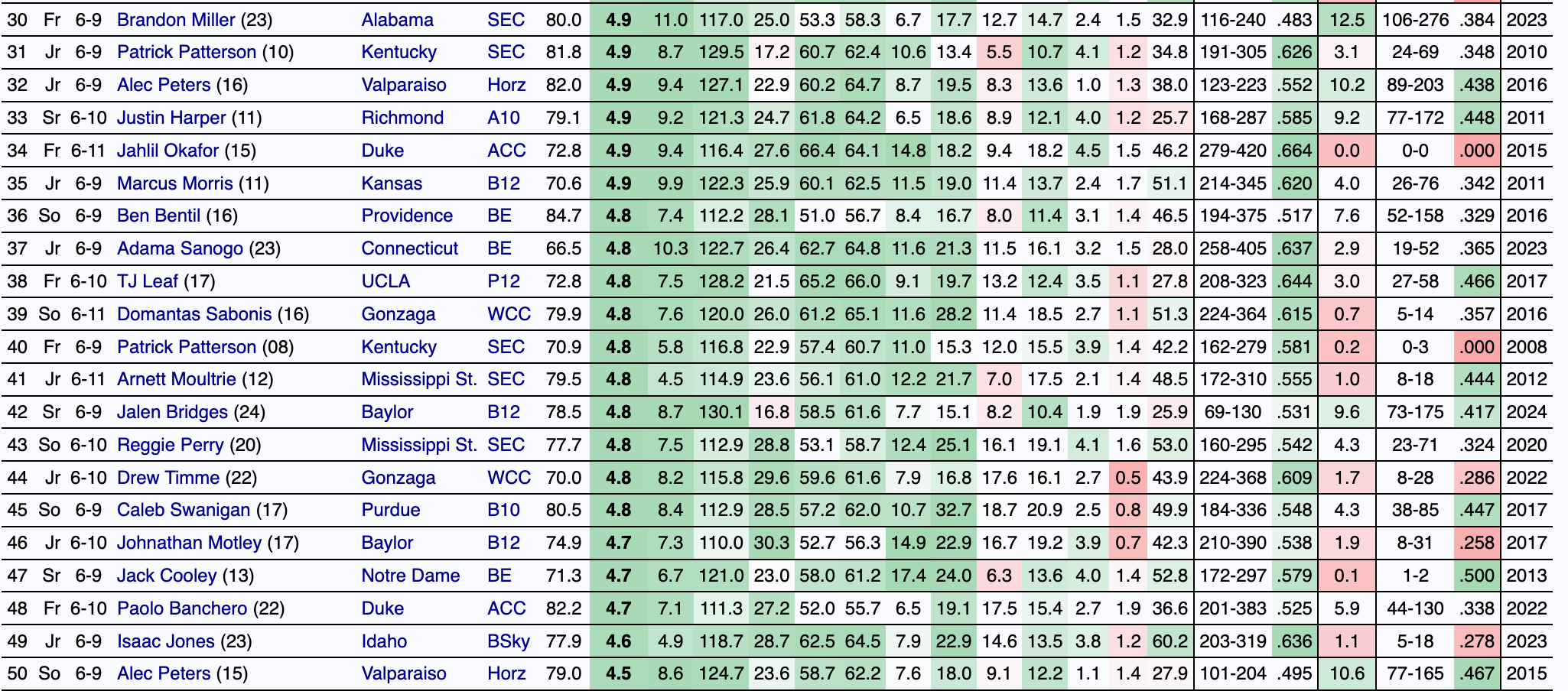
Because Steinbach tends to struggle on defense and is likely not viable as a center, there’s more pressure on his offense to be special in order to warrant starter-level minutes. Currently, Steinbach is a tweener — stuck between operating as a five on offense, with the bulk of his scoring playtypes coming from pick and rolls, post-ups, and put-backs. However, he’s most optimal defensively with a rim-protecting center in the lineup to cover for his deficiencies.
This justaxposition puts a strain on team-building and lineup construction, especially deep in the playoffs. To ease these concerns, Steinbach needs to either space the floor or be paired with a center who can, while simultaneously defending the rim. And, unforutnately those are a dime a dozen.
Fortunately for Steinbach, he does have the potential to shoot the ball. This season, he shot 34 percent from behind the arc on three attempts per 100 possessions, 44.8 percent on far twos, and 75.9 percent from the charity stripe. Below is a query for players 6’9 and above who attempted fewer than 5 3PA per 100 possessions, made 40 percent of their far twos, and shot 75 percent from the free throw line.
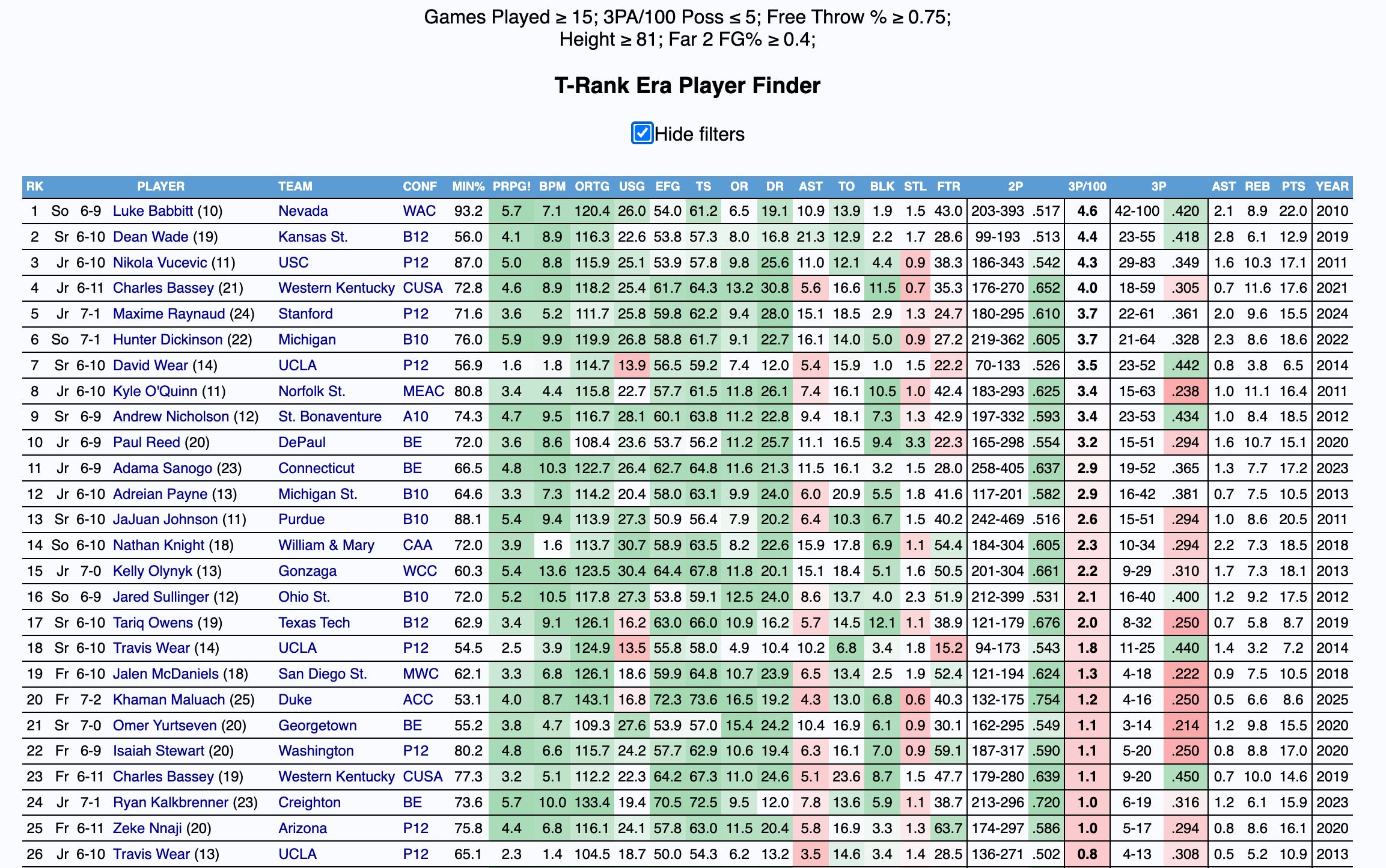
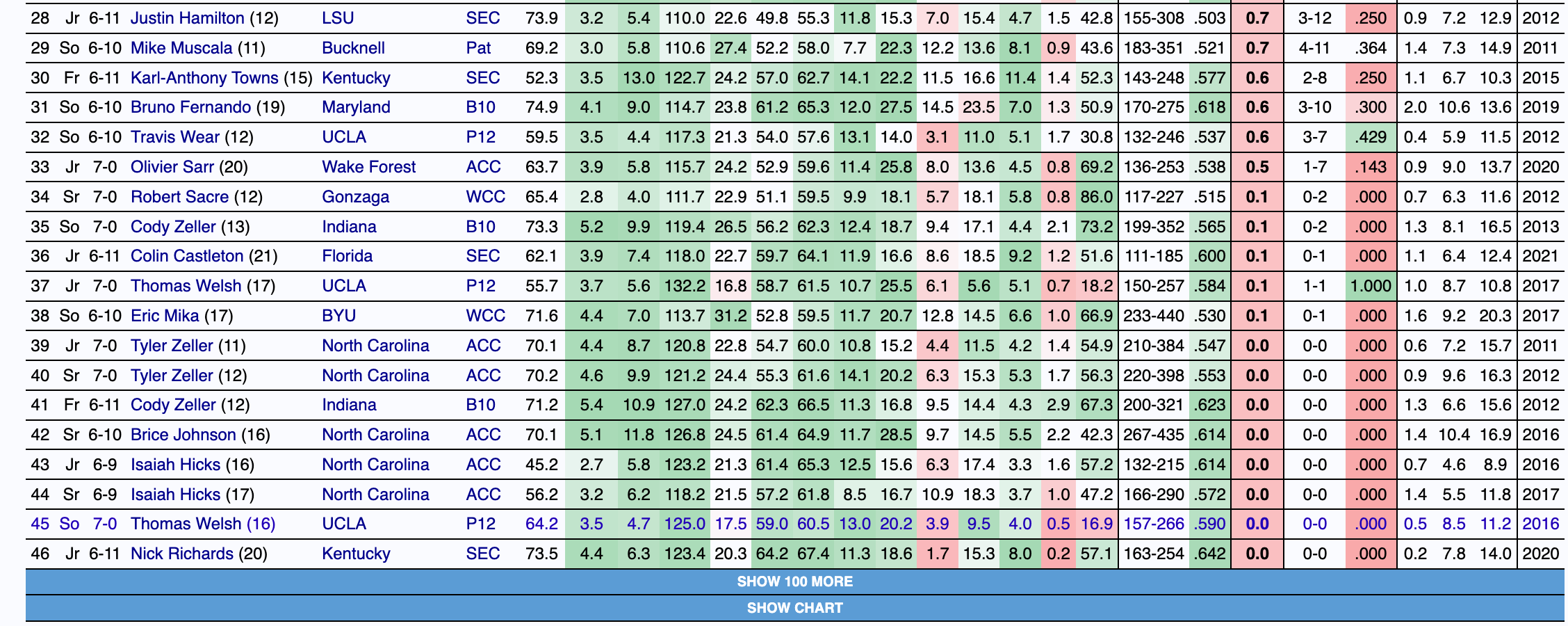
The hit rate for players in this query who have translated into meaningful three-point shooters is low, but players such as Dean Wade, Nikola Vucevic, Kelly Olynyk, Karl Anthony Towns, and Mike Muscala have.
Steinbach looks most comfortable and confident as a shooter when he’s able to set a screen, pop, and catch the ball in rhythm before his shot. According to CBB analytics, he is shooting 35.6 percent on above-the-break 3’s, which ranks in the 73rd percentile for bigs. He oddly struggles the most in the corner and on wide-open shots.
The murky shooting projection and rim protection worries would be more palatable if you could project him as a legitimate post hub with plus passing, a la Domantas Sabonis, or an outlier advantage creator, such as what Derik Queen profiled last cycle.
At the moment, Steinbach seems to be neither. He’s been an efficient post scorer this season, but on over 50 percent less volume than Sabonis had in 2016. Steinbach has also been an efficient driver, averaging 1.175 points per drive, but he drives on just 8 percent of his team's possessions, compared to 26.8 percent for Queen.
Additionally, he has the passing chops of neither. Steinbach is a good passer with a solid feel for a big man (9.1 AST%, 0.8 A: TO). He often makes quick decisions in the short roll, can pass out of double teams from the post, and has flashed a few high-level skip passes, but needs to improve his accuracy and ability to make advanced reads more consistently to project him as a secondary or primary creator.
But, Steinbach doesn’t need to be in either of those roles in order to find a role on an NBA team. If drafted to a team with a need for his strengths and the personnel to equalize his weaknesses, Steinbach has the potential to return lottery value in this class, as so many of his benefactors thought heading into the season.
NBA Outlook + Ideal Landing Spots
Steinbach’s median outcome is a rotational big man who can come off the bench and dominate the glass, play finish, run the floor, and move the ball within the flow of an offense. Defensively, he’ll be best at the four next to a competent rim protector, allowing him to operate as a help-side presence where his length, mobility, and hand-eye coordination can generate blocks and steals.
Though it’s an area he needs to improve, I feel that Steinbach’s defensive woes have been somewhat overstated. The vast majority of his value will come from being a dominant defensive rebounder, but there are plenty of reps where he’s held up on the perimeter or created turnovers in passing lanes. Over the final two months of the season, his block percentage improved to 4.9 while maintaining a 1.8 steal percentage. While not eye-popping numbers, they are a vast improvement from where he began the season.
If he can continue to improve as a passer and/or shooter, his higher-end outcomes could resemble players like Domantas Sabonis or Nikola Vučević—talented offensive bigs who lack rim protection at the five, which can limit championship equity, but still return top-ten value in their class.
The best landing spots for Steinbach are teams like the San Antonio Spurs, Oklahoma City Thunder, or Washington Wizards—organizations that either already have ( more in theory for Washington) a rim-protecting, floor-spacing five to complement him. He’d also make sense on teams like the Golden State Warriors or Philadelphia 76ers, who are starving for his rebounding and have the defensive fives to cover for his limitations (especially if Porzingis can stay on the floor).
In the end, Steinbach profiles as a situational prospect due to his limitations, and that rightfully caps his draft stock below players who don’t carry the same lineup constraints—especially in playoff settings. However, his consistent production across multiple levels at such a young age is too strong to overlook at a certain point, and I’d be comfortable selecting him in the late lottery to mid-first round.
No surprise. He did well in Bundesliga. Saw significant minutes and was able to generate impact. Let’s see if he can follow other Germans to NBA.