

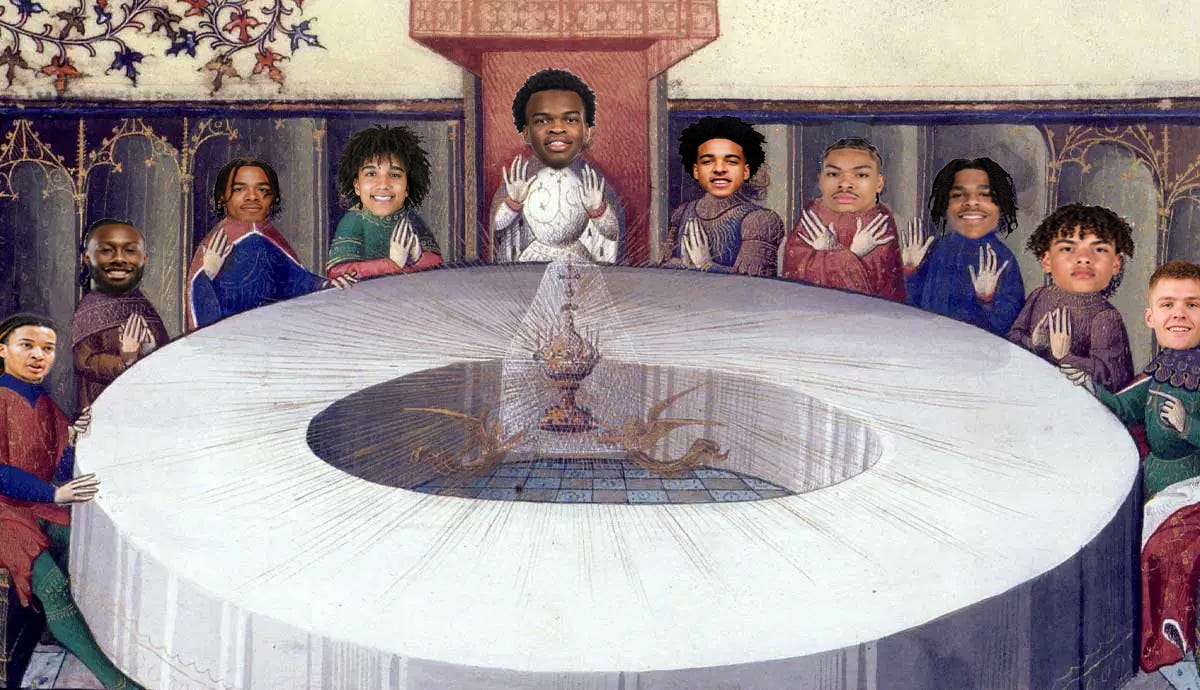
In medieval times, the Knights of the Round Table were considered the most noble men in the land.
King Arthur created the Round Table to promote equality amongst his barons, but of course, history rarely honors equality.
We remember the tales of the stars: Sir Lancelot, Sir Percival, and Sir Tristan.
The 2026 NBA Draft point guard class feels like its own Round Table.
It’s a group scouts have been raving about for the last six months and touting as a potentially historic collection of lead guards. In June, we could see half a dozen selected in the lottery, and up to ten selected in the first round.
Despite the talk of depth, a hierarchy has unquestionably formed amongst consensus.
Darius Acuff, Keaton Wagler, Kingston Flemings, Mikel Brown, and Labaron Philon have received the loudest acclaim as the draft’s defining floor generals.
However, I find that despite his production, Stanford point guard Ebuka Okorie goes under-discussed and overlooked in these conversations.
He not only deserves a seat at the table, but has an argument to be at its head.
And when it’s all said and done, he could go down in history as one of the knights we tell stories about.
When Aesthetics Marries Impact
The basis of any star bet for Okorie is his ability to carry high usage while maintaining relatively positive effiency and minimizing turnovers. This season, he posted the lowest turnover percentage of any high-major freshman player with 30 percent usage since 2008 — a feat that puts him in company with the top three consensus players in the class.
Though unlike Peterson, he was on-ball more with much more playmaking usage, and unlike Dybantsa and Boozer, he didn’t share the court with other future NBA players.
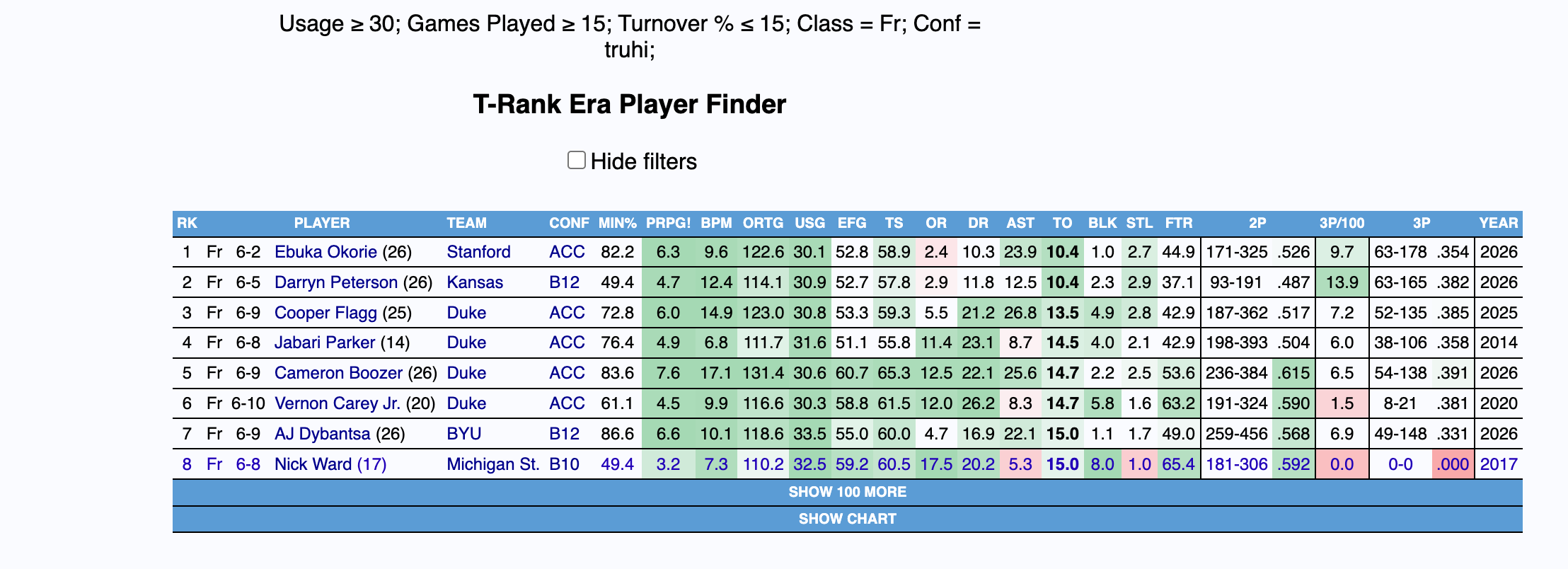
A quick additional filter to adjust for initiators that saw significant playmaking volume puts into perspective how teflon of a creation season Okorie put on wax this year.
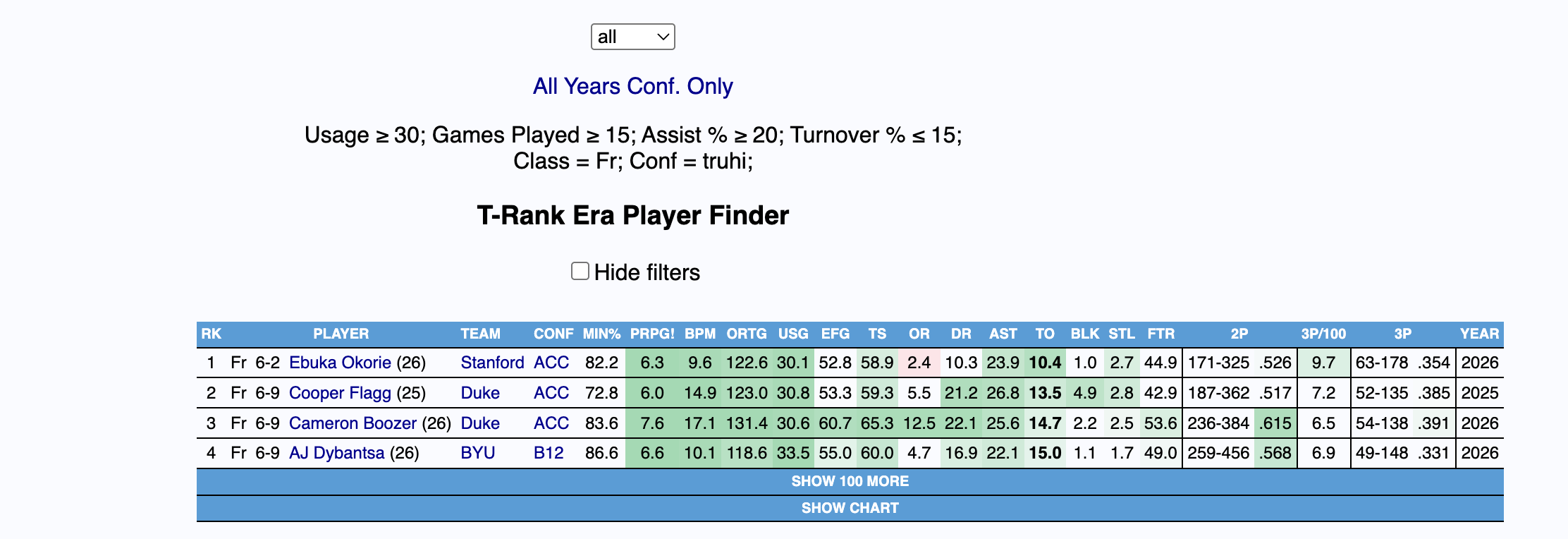
The ability to be an innings-eater while limiting individual and subsequently team turnovers is one of the prerequisites for potential primary initiators, and Okorie has passed that benchmark with flying colors.
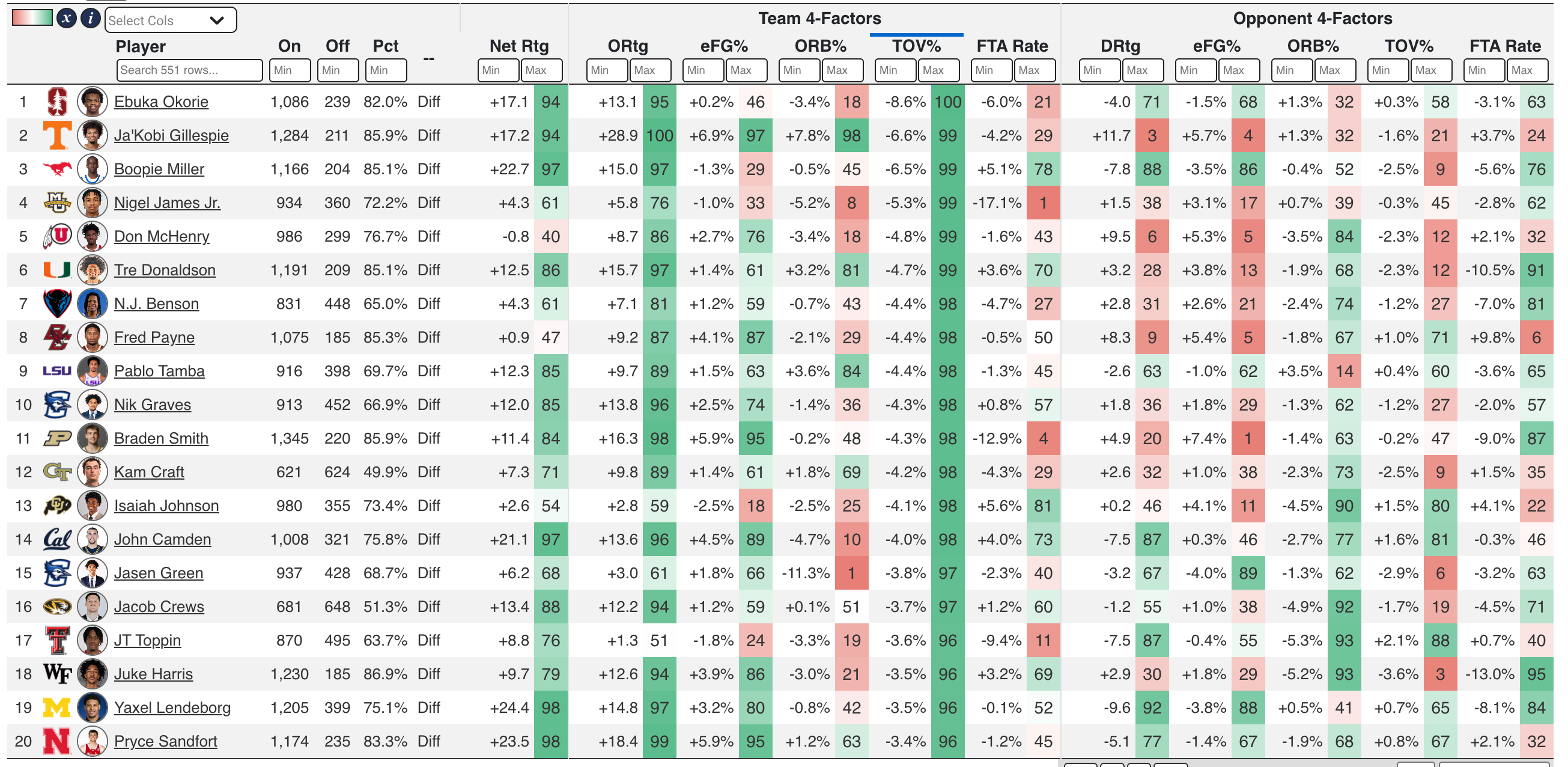
According to CBB Analytics, the freshman had the greatest impact on team turnover percentage in the country. With Okorie on the floor, the team had an 11.9 turnover percentage (94th percentile) compared to a 20.5 turnover percentage with him off the floor (1st percentile).
Okorie was the sun for the Cardinals, and teams guarded him like it. He was often face-guarded, blitzed, or flat-out doubled in pick-and-roll actions, yet he still got downhill and to his spots.
Despite all of the attention from defenders, he used his speed, change of pace, dynamic handle, low center of gravity, and excellent contact balance to generate 0.992 points per drive, a 47.4 rim rate, and 6.4 unassisted rim attempts per 100 possessions.
As much as I am against aesthetic bias when evaluating basketball players, Okorie does have the “look” of a star guard going against competition he’s too good for. For my money, he is one of the five best advantage creators in the class.
He was often driving into a cramped paint, as the Cardinals routinely played two non-spacing bigs, which forced him to finish amongst the trees a ton. He was able to find success because of his ability to embrace contact, finish with either hand, and draw fouls (45.9 free-throw rate).
Okorie was also one of the most dynamic players in transition in the country last season, which was integral to keeping Stanford's offense afloat amid a lack of ball-handling and playmaking talent.
According to Hoop Explorer, 15.9% of the Cardinals’ plays were in transition (45.2 percentile), and they scored 1.36 points per play (96th percentile) with him on the court. Whenever he sat, their transition production plummeted to 12.3 plays per 100(6th percentile) and 1.16 points per possession (37th percentile).
Okorie’s first inclination is to get downhill and put pressure on the defense, but he routinely hurts defenses as a shooter, finishing the season shooting 35.4 percent from three on 9.7 attempts per 100 possessions.
Those figures aren’t great on their face, but far more palatable considering that he created nearly 59 percent of his three-point makes and shot 35.3 percent on above-the-break attempts (70th percentile).
Okorie’s efficient shot creation, turnover avoidance, and transition influence are the driving factors of why the Cardinals’ offense is 13.1 points better with him on the court compared to when he’s off (95th percentile swing).
But, there’s always a level of opportunity cost when investing in a small guard who is best with the ball in his hands.
The number of viable primaries of Okorie’s size (6’2, 186 LBS, 6'7.75 wingspan) that command heavy usage is dwindling by the season, and the barometer for offensive brilliance is higher than ever before. I believe Okorie to be one of the better star bets of the vaunted guard group, but his profile is far from bulletproof.
The 1.5 Guard Conundrum
The biggest issue with Okorie’s profile is that, though he soaks up so much usage without turning the ball over, he’s not a great passer or playmaker.
Without improvement, he could be this class’s example of a “1.5 guard”. A “1.5 guard”, not to be confused with a combo guard, is a score-first guard who is point guard-sized (6’5 and under) but doesn’t have the playmaking ability required of a primary initiator without diminishing returns.
However, said players are also too small to play at the two without a high risk of defensive issues in the backcourt.
A few examples of this idea in the league are Donovan Mitchell and Tyrese Maxey, or on a lesser scale, Coby White and Collin Sexton.
As previously mentioned, Okorie handled 30% usage but posted just a 23.9 assist percentage. His 0.80 AST/USG ranks in the 29th percentile for guards in the country.
My initial inclination was to grant Okorie some bail because his circumstances are poor. He played with two bigs that weren’t very athletic, nor good pick-and-roll partners, nor quality two-point scorers. Stanford, in general, was one of the worst two-point scoring teams in the country (241st in 2PT% and 277th in 2PT Rate), and none of its players generated rim assists.
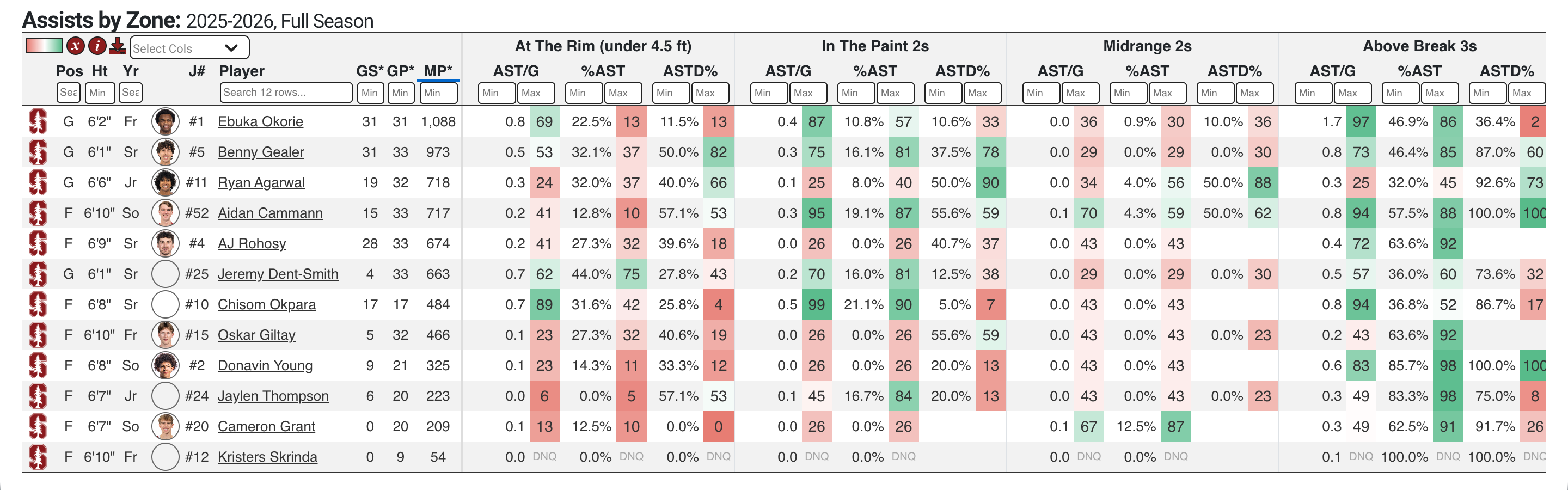
However, this issue has been present in Okorie’s profile since before he arrived on campus. During his junior AAU season and his final season at Brewester Academy, he posted a 1.1 AST/USG rate and an assist percentage of just 19.
So sure, he gets a bit of slack for operating in a poor context, but he’s never profiled as a high-volume playmaker.
Though Okorie isn’t a black hole whatsoever.
He’s a willing passer and pretty comfortable making simple reads, such as drive-in kicks or punishing the low man for tagging rollers.
He does have plays where he probes well in the pick-and-roll and manipulates the defense with his eyes, but the vast majority of his playmaking is reactive, taking advantage of defenses that sell out to limit him as a scorer.
Where Okorie needs to improve is making more advanced interior reads, especially when passing on the move. He struggled at times to get the ball to his rollers in advantageous spots, and his size limited passing angles, most notably against double teams and aggressive ball pressure.
The lack of high-end playmaking puts more pressure on his scoring to be flawless, yet there are some concerns.
Okorie is elite at getting to the rim, but his finishing was subpar in the half-court. The guard finished just 50 percent at the rim (17th percentile) and shot 45.2 percent from two in overall (27th percentile).
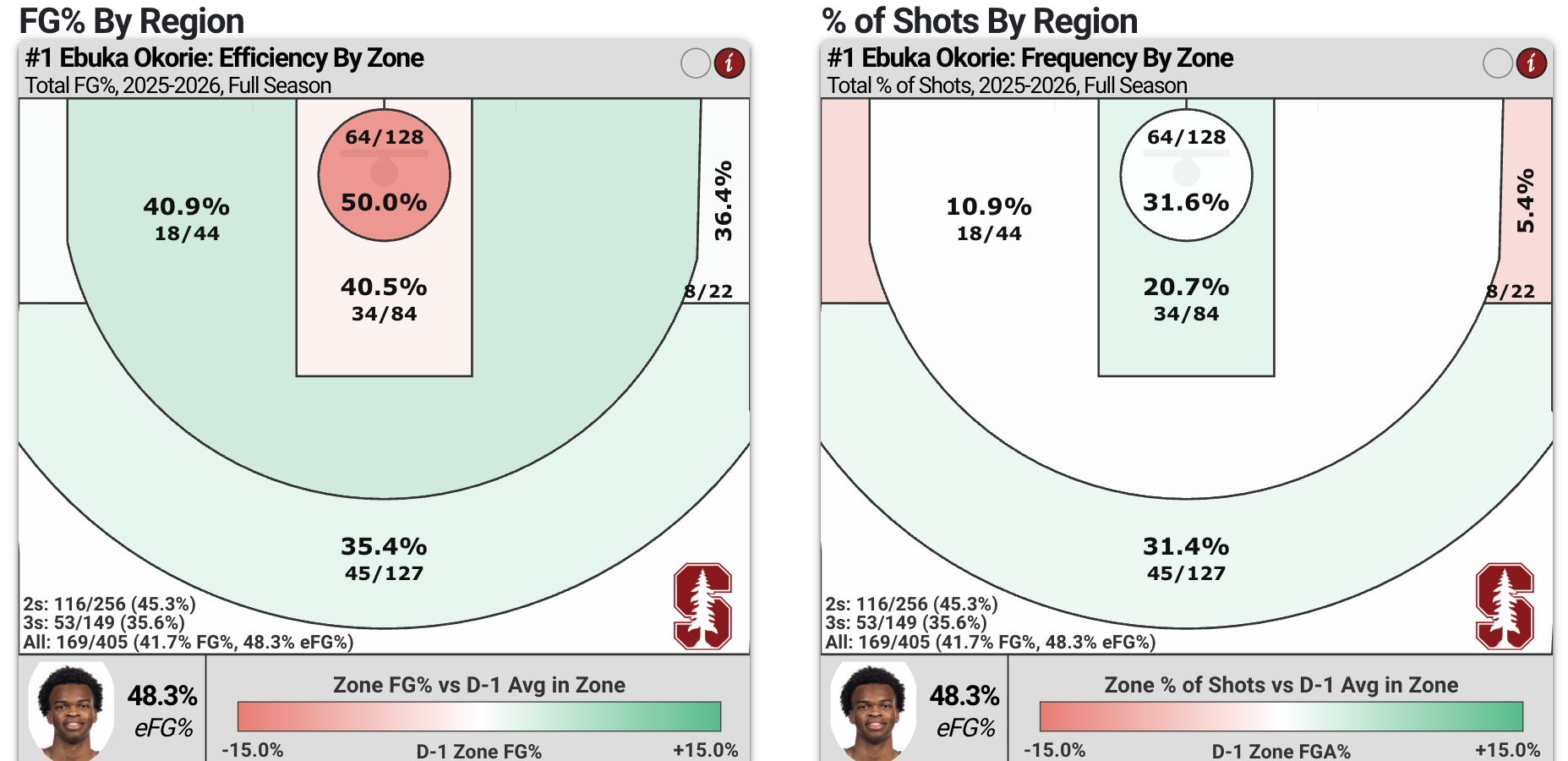
Furthermore, his volume of rim attempts relative to his non-rim attempts is concerning for his scoring outlook in the NBA, where he will face much better rim protection than he saw in the ACC.
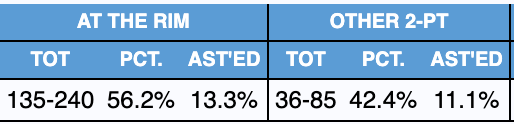
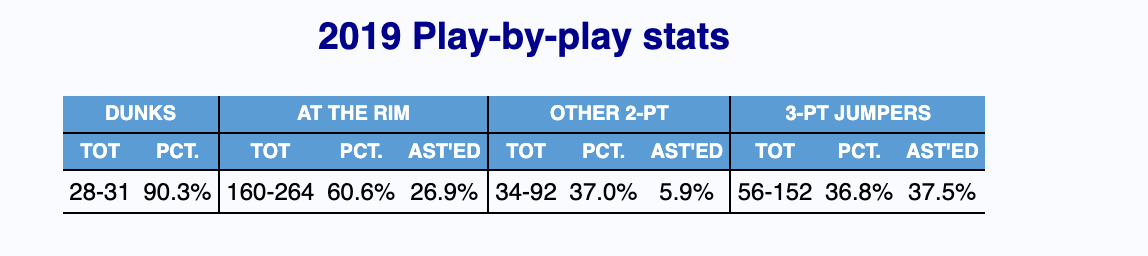
A year ago, my mutual Laz, who does great work, conducted a preliminary study on suboptimal shot diets for guards with a three-point rate below 40 and a rim-to-non-rim ratio above 1.5 (Okorie’s ratio is 2.8:1).
Essentially, too much of anything can be a negative. Getting to and finishing the rim (especially as a small guard) is much harder in the league, so guards without a viable mid-range counter or high three-point volume struggle to score efficiently.
He has a shot diet pretty similar to Ja Morant’s when he played at Murray State, except without the 40+ inch vertical.


I believe some of Okorie’s finishing struggles stemmed from being tasked with creating everything and driving into crowded lanes, but the bigger issue is that he needs to work on his deceleration and get to his floater more. A ton of his failed drives are plays where he’s not creating quality rim attempts, launching his body into a bigger player, and trying to finish tough layups.
The second facet of the “1.5 guard” teambuilding dilemma is that they’re too small to guard most twos and wings, and ideally need to be paired with a bigger backcourt mate who can.
Okorie put in a ton of effort on defense this season, especially given his usage. His core strength, low center of gravity, and speed on the offensive end also translated to the other side of the ball, allowing him to cut off drives and absorb contact in the paint. His wingspan also came in handy, as he used his length to get into the paint and into the passing lanes, posting a 2.7 steal percentage.
But even with consistent effort, his size was limiting. Bigger guards were able to finish over the top of him, even if he was in a decent guarding position. A prime example is the play below, where he’s matched up against Virginia’s Davin Hall.
Despite Okorie’s current flaws, I’m still buying him as a lottery-level talent and believe he should be one of the first point guards off the board because many of his issues feel more malleable than inherent — particularly as a scorer.
This idea is largely based on his priors, which suggest that positive regression is a realistic possibility in a more favorable context.
The Importance of Priors
For Okorie to thrive, he nees needs to build a more optimal shot diet. His efforts there should be twofold.
First, he needs to get to his floater and mid-range game more often, because when he actually leveraged those counters, they were productive looks. He shot 16-of-31 (51.6 percent) on runners this season and 40.9 percent on mid-range attempts in the half-court.
That matters because right now, too many of his possessions exist in binary form: rim attempt or three.
In theory, that sounds like an analytical dream (pour your liquor out for Darryl Morey). In practice, a smaller guard without elite vertical pop can lead to inefficiency if too slanted towards the rim.
A reliable in-between game would give Okorie another way to punish drop coverage, weaponize his change of pace, and preserve his body from the repeated collisions that currently define too many of his drives.
Second, he needs to push his three-point attempt rate closer to 45-50 percent.
I think that’s entirely obtainable once his offensive burden scales back a tick.
At Stanford, necessity forced him into a style of play that prioritized creation volume over shot optimization. There weren’t enough secondary advantages being created elsewhere for him to play off the ball at all, and defenses blitzed and trapped him so much that it kept him from accumulating enough three-point volume.
But in his final season at Brewster, we saw a more scalable version of his profile. Okorie shot 34.5 percent from three (38 percent on catch-and-shoot threes) while posting a 50 3PAR, and, more importantly, he displayed significantly more comfort operating without the ball.
Okorie displayed excellent floor sense, relocating in the flow of the offense, and ran off screens to create looks for himself. As a senior, he generated 1.085 points per spot-up (87th percentile) and 1.077 points per possession coming off of screens (72nd percentile).
In a better context at Brewster, with better talent around him relative to the opposition, and better spacing, Okorie was able to be more efficient, especially at the rim (63.4 percent) when he wasn’t tasked with creating everything.
Ultimately, Okorie’s standing amongst consensus will likely cause him to land in a better developmental environment than some of his peers — and that may be the best thing that could happen for him.
If he were selected in the high lottery and immediately handed the keys to a dysfunctional offense, he may survive it. This season proved he can shoulder absurd responsibility without the wheels completely falling off.
But survival and development are not the same thing.
That path likely means early inefficiency, bad habits, and the kind of statistical ineptitude that can test organizational patience.
Instead, Okorie could land in a situation (Timberwolves, Hawks, Pistons, Raptors) where he begins in a secondary or tertiary role alongside other creators.
Think of the case of Tyrese Maxey, during his first few seasons in Philadelphia, where his speed, downhill pressure, transition dynamism, and scalable shooting provided immediate value without forcing him into a role he isn’t fully ready for.
Then, as his shot diet crystallizes, the burden can gradually increase.
That’s why I remain bullish.
The flaws are real. The archetype concerns are real. Betting on smaller guards is always risky business.
But so are hand-waiving players who consistently generate advantages, protect possessions, collapse defenses, and produce despite adverse conditions.
I’d advise teams to bet on Okorie’s age-adjusted production, or risk becoming a slain villain in fables told to the end of time.
He is fascinating. He is the one guy I will be watching most closely on Tuesday night for his landing spot.