

It’s a well-known fact that head coach John Calipari is the best collegiate coach in the country (and maybe ever) at finding and developing guard talent for NBA success.
Shai Gilegeous-Alexander, Derrick Rose, John Wall, Tyrese Maxey, Devin Booker, and De’Aaron Fox are just a few of the names that have learned under the tutelage of coach Cal.
In short, there aren’t many better wagers in life than betting on a Calipari guard to earn multiple contracts in the NBA, and his best one, since Wall, from a blanket production standpoint, has been one of, if not the best, point guards in the country this season.
That point guard is Darius Acuff, who, despite leading the Southeastern Conference (SEC) in both scoring and assists as a freshman, has become the most polarizing prospect in the class.
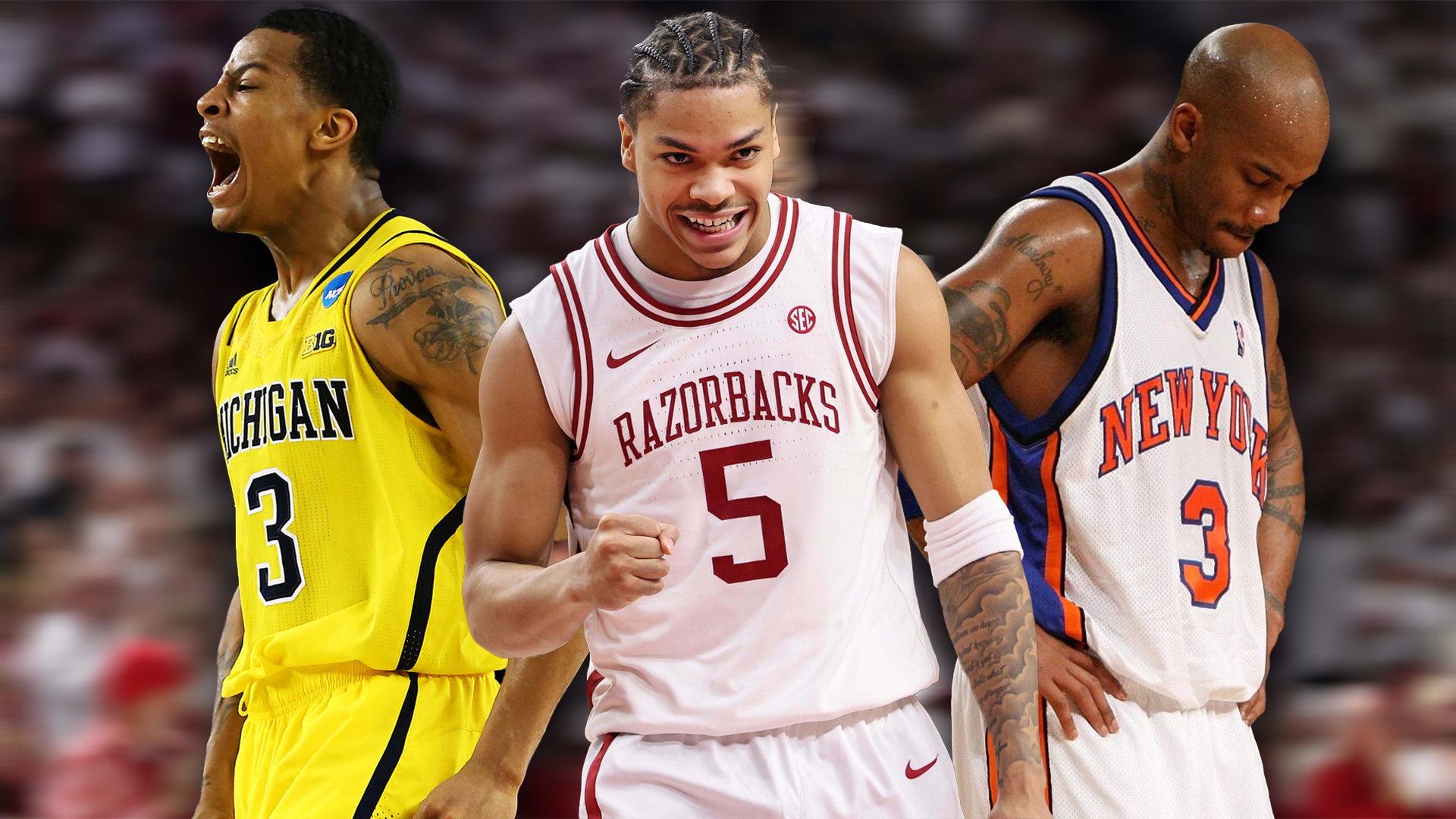
His proponents, mostly passionate Arkansas fans, say he’s the next coming of Stephon Marbury, destined to be an offensive superstar in a game that has begun to move away from smaller point guards. In contrast, his skeptics say he’s more akin to Michigan’s Trey Burke, who, despite having a legendary career at Michigan, couldn’t find nearly the same success in the NBA.
Amongst consensus boards, he’s a lock to be a top ten pick, but there are plenty amongst amateur scouts that have him as a late first round pick or completely out of the first round.
I say that when two sides of an argument are so extreme, the truth often lies somewhere in the middle, and in my evaluation of Acuff, I’ll try to find that truth, with a healthy blend of film and analytics.
He looks the part
Under any post critiquing Acuff’s translation to the NBA using analytics, a comment or quote tweet saying some iteration of “watch the games” will follow close behind.
My favorite is the meme with a calculator and the message “time to watch some basketball.”
Though I don’t agree with the anti-intellectualism that often coincides with the abrasion to analytics, especially because you can make a good case for him using numbers, after re-watching all of Acuff’s games, I kinda get where they’re coming from.
He’s an entertaining watch and one of the more aesthetically pleasing players in the class, who looks the part of an NBA guard.
His standout trait on tape is decision-making. Acuff is undoubtedly one of the best processors in the class. He has a knack for finding the best-quality shot for Arkansas’s offense, whether that’s for himself or his teammates.
As a scorer, Acuff is primarily looking to get downhill, whether in transition or the halfcourt, and uses his intersection of strength and handle to score at the rim.
The guard is a weapon in transition. While he doesn’t usually start the break with a steal, block, or rebound, more often than not, he’s creating his opportunities for himself; they’re not cherry-picked handouts. Acuff’s 1.200 points per possession in transition ranks 42nd in the country amongst players with at least 85 possessions.
His willingness to push the ball on the break is a trait he shares with his teammates, but I don’t think he’s a product of the system he plays in. He maximizes it, as Arkansas ranks third in the country in transition points per possession.
In the halfcourt, he has to tame the aggression he displays on the open floor and play with more pace. Acuff has a strong propensity to explode in and out of dribble moves, keep his dribble alive, and use an understanding of leverage, keeping his shoulders below his defender’s waist to generate angles towards the rim.
When he can’t get all the way to the rim, Acuff is equipped with counters in the mid-range. He’s adept at using his pull-up jumper or a floater when attacking against drop coverage, which he’s hitting at a 40 percent and 47 percent clip, respectively.
Acuff’s driving ability is his biggest strength, but his most significant development as a scorer this season has been tied to his three-point shooting.
Coming out of high school, Acuff’s shooting indicators — 33 percent from three, 39.4 3PAR, and a 77 percent free-throw percentage — were middling and cast doubt over his shooting projection.
Nearly 30 games into the season, his jumper, on and off the ball (47.5% on catch-and-shoots, and 36.5% on pull-up threes), has been a legitimate threat to defenses, and due to improvements in his process, I’d lean towards the side of growth as a jumpshooter than a random 30-game hot streak.
Acuff is shooting 43 percent from behind the arc on 9.0 3PA per 100 possessions, though 73.5% of them are assisted (more on the significance of assisted % later).
The Detroit native blends his scoring and passing ability harmoniously, supplemented by a cast of excellent athletes and playmakers up and down the lineup.
He has a clear feel for the game and poise in the pick-and-roll. He reads coverages in an instant, doesn’t over-dribble, and consistently takes advantage of low-hanging fruit within the offense. He’ll punish a low man's indecisiveness or a center who hedges too hard.
It’s within the pick-and-roll that I find him to be the most dangerous as a creator, and the numbers reflect it. Ball screens that he’s involved in are generating 1.102 points per possession, which ranks third in the country for players with at least 300 pick-and-roll possessions.
Acuff has a variety of passes he can access (pocket passes, dump-offs, skip passes, lobs), and he rarely is off target, which leads to excellent shot quality for Razorback’s offense.
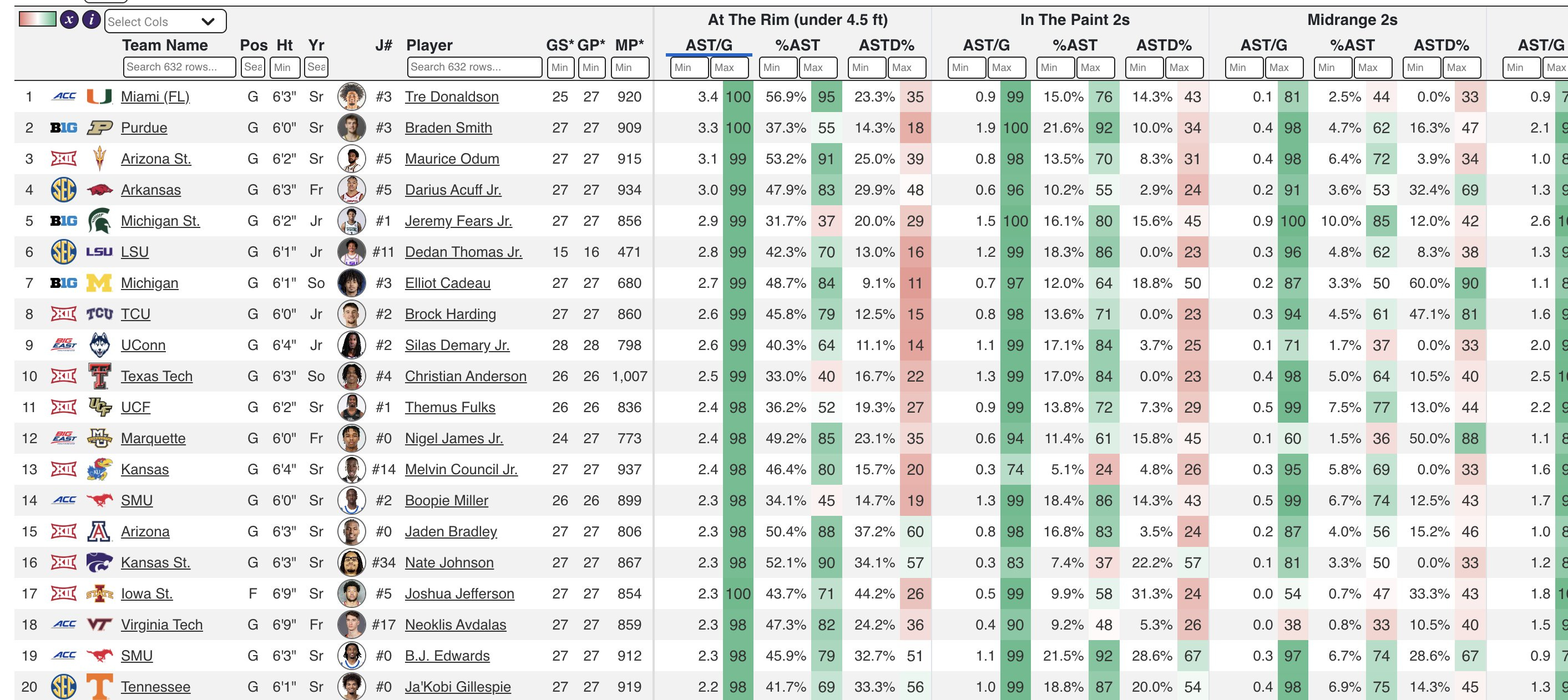
According to CBB Analytics, Acuff ranks fourth in the country in rim assists per game, which is widely viewed as the most risky yet most efficient type of assist.
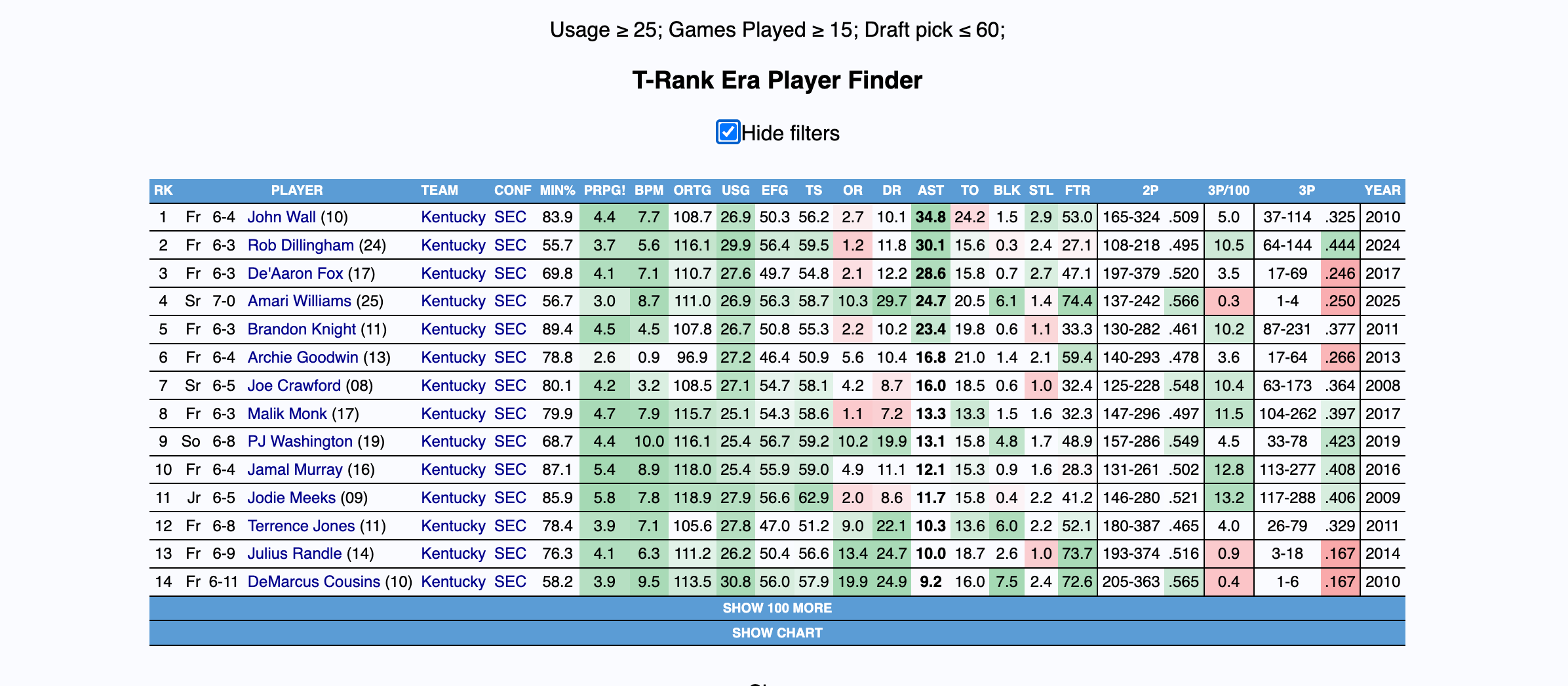
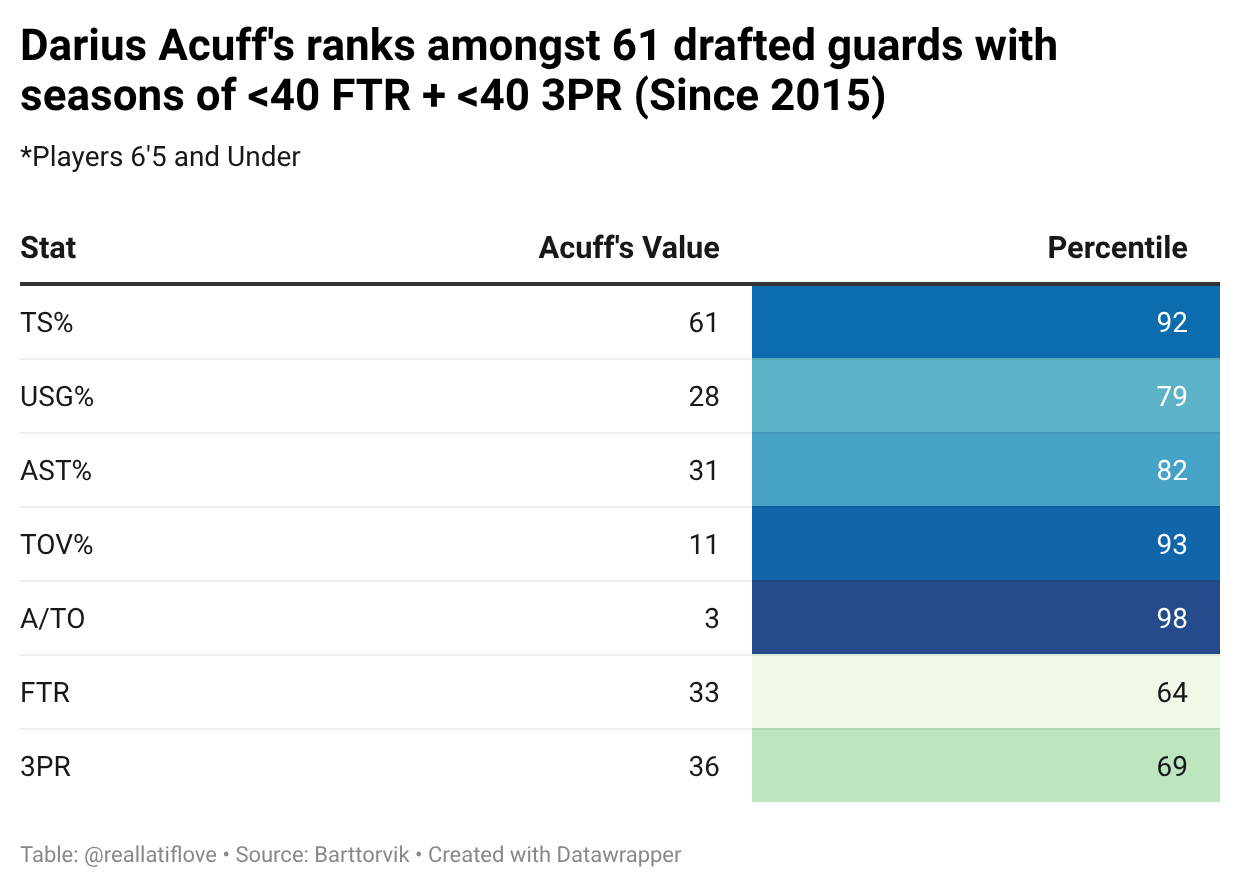
Given the guard’s usage, both as a scorer and playmaker, and the amount of attention he draws from a defense, it’s remarkable how well he takes care of the ball. He currently boasts a 31.3 AST% with a 3.2 AST/TO ratio, and his 11.2 turnover percentage would be the lowest of any drafted Calapari guard with a 25 percent usage rate.
For context, it's worth noting that turnovers are down across the country. However, Acuff’s turnover aversion, given his usage, is still outlier-good relative to other guards this season. Because of that, Arkansas has been the best team in the country at avoiding turnovers.
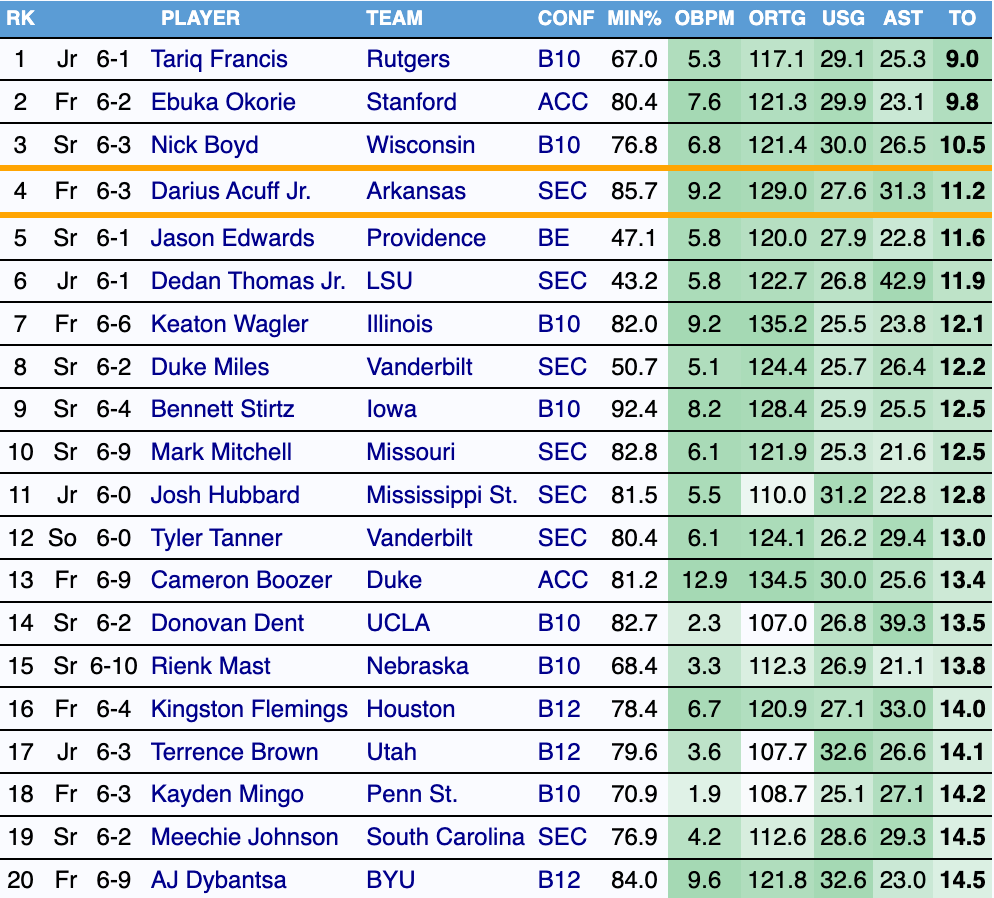
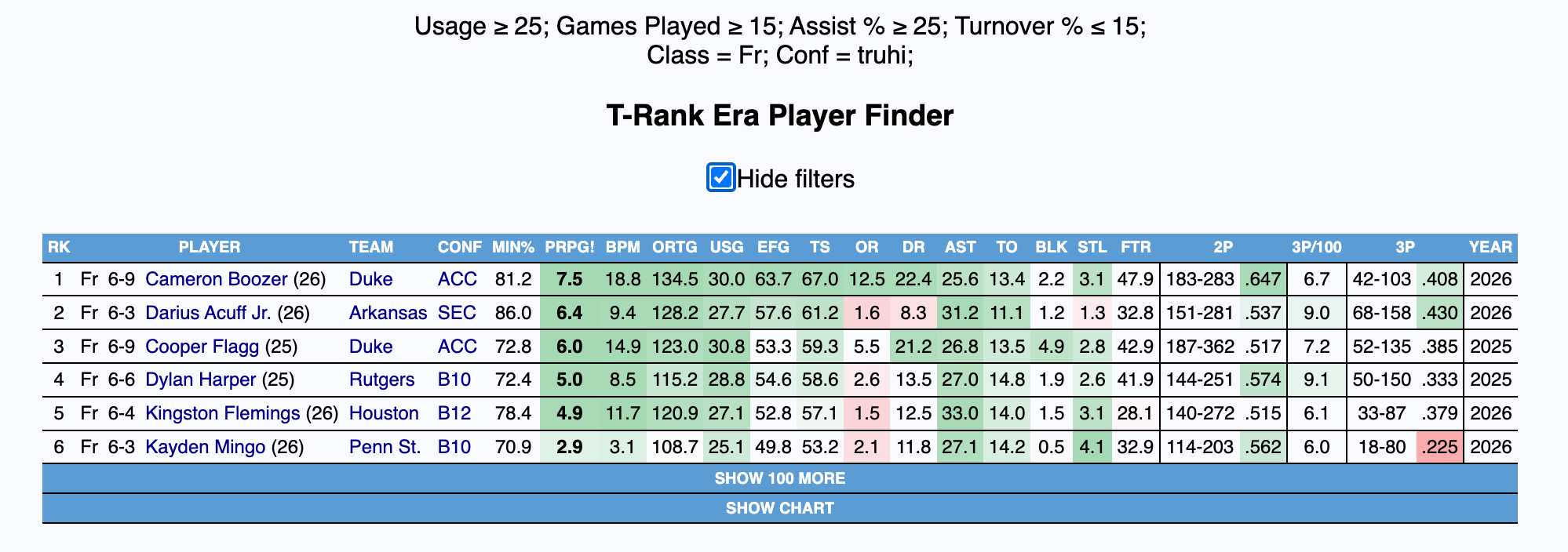
Acuff’s intersection of three-level scoring, efficiency, playmaking, and turnover aversion builds the framework of an excellent offensive prospect. Below is a query for high-usage creators who pass the ball at a high level and mitigate turnovers, highlighted by the top two picks in last year’s NBA Draft, Cameron Boozer, my top-ranked player in the class, and Kingston Flemings, another player I view as a top ten pick.
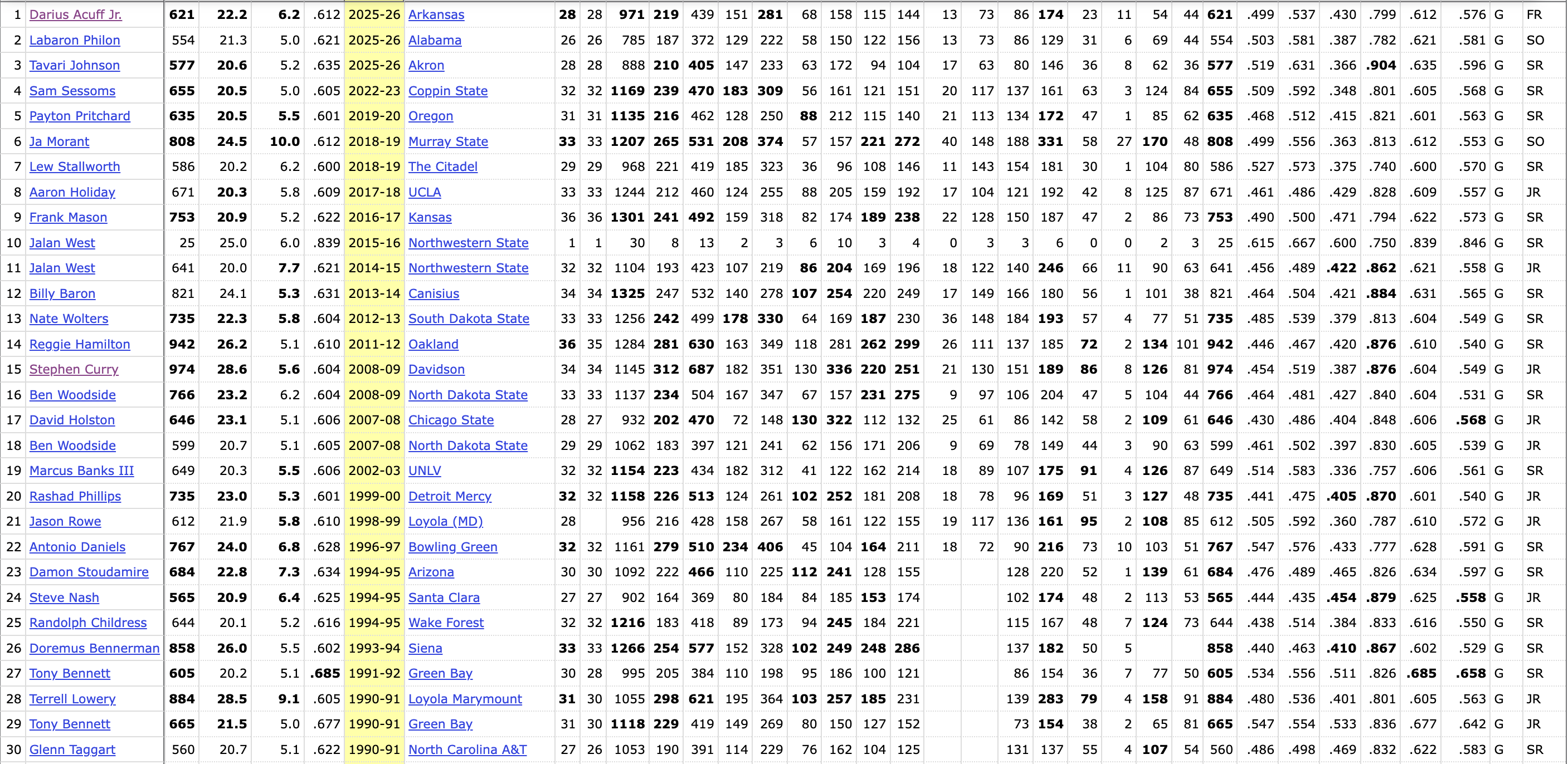
Acuff is averaging 22 points and six assists on a 61.2 true-shooting percentage, leading a top-three offense in the country in a top-three conference. His blanket production and effiency is rare to see in a freshman point guard, in fact, it’s only happened 39 times for any guard in NCAA history. Arkansas’s freshman sensation finds himself on a list with legends such as Steph Curry, Steve Nash, and even his uncle and agent, Rashad Phillips!
Yet, blanket college production doesn’t guarantee translation to NBA impact, and in a league where the margins for smaller guards are at an all-time high, Acuff has a few red flags.
If the “Nerds” are right, here’s why
The biggest hole in Acuff’s profile is undoubtedly his defense. He doesn’t generate steals, doesn’t block shots, or rebound the ball particularly well. I know some have grown tired of seeing the word “stocks” float across your Twitter timeline, but it is undeniable that the vast majority of players who generate steals and blocks in college have turned out to be capable defenders in the NBA.
In short, stocks are not what make you a good defender, but a strong signal that you are one. Defensive playmaking production is an indicator of cognition and defensive activity. Grabbing steals ends an opponent's possession and creates one for your team, which is paramount for smaller guards like Acuff to achieve neutral defensive value at the next level.
Acuff currently sits at an intersection of less than 2 steal percentage, 2 block percentage, and less than 10 defensive rebound percentage, and he is well below those figures. That places him in the list below, where you have to strain to find a net-neutral defender.
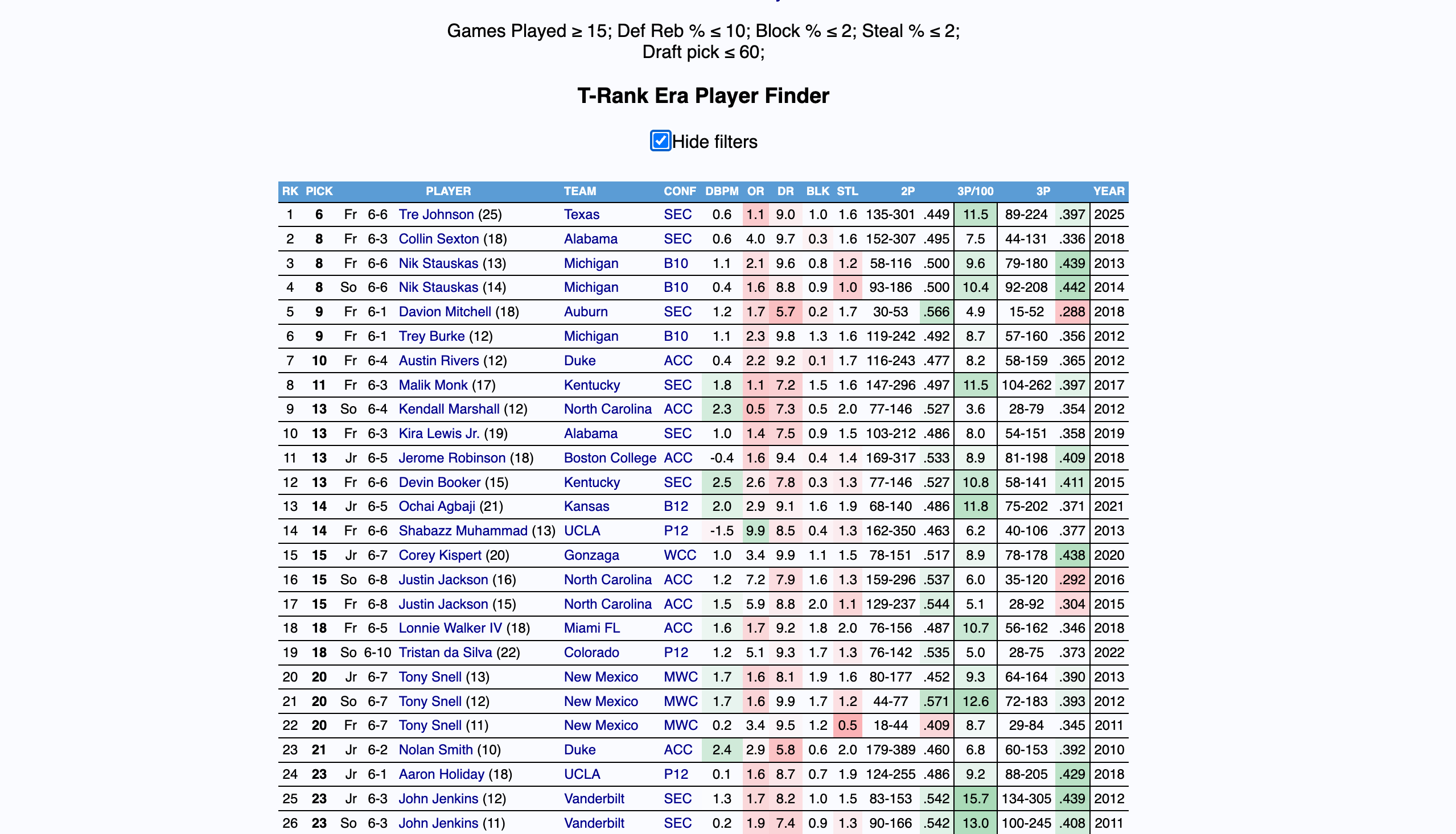
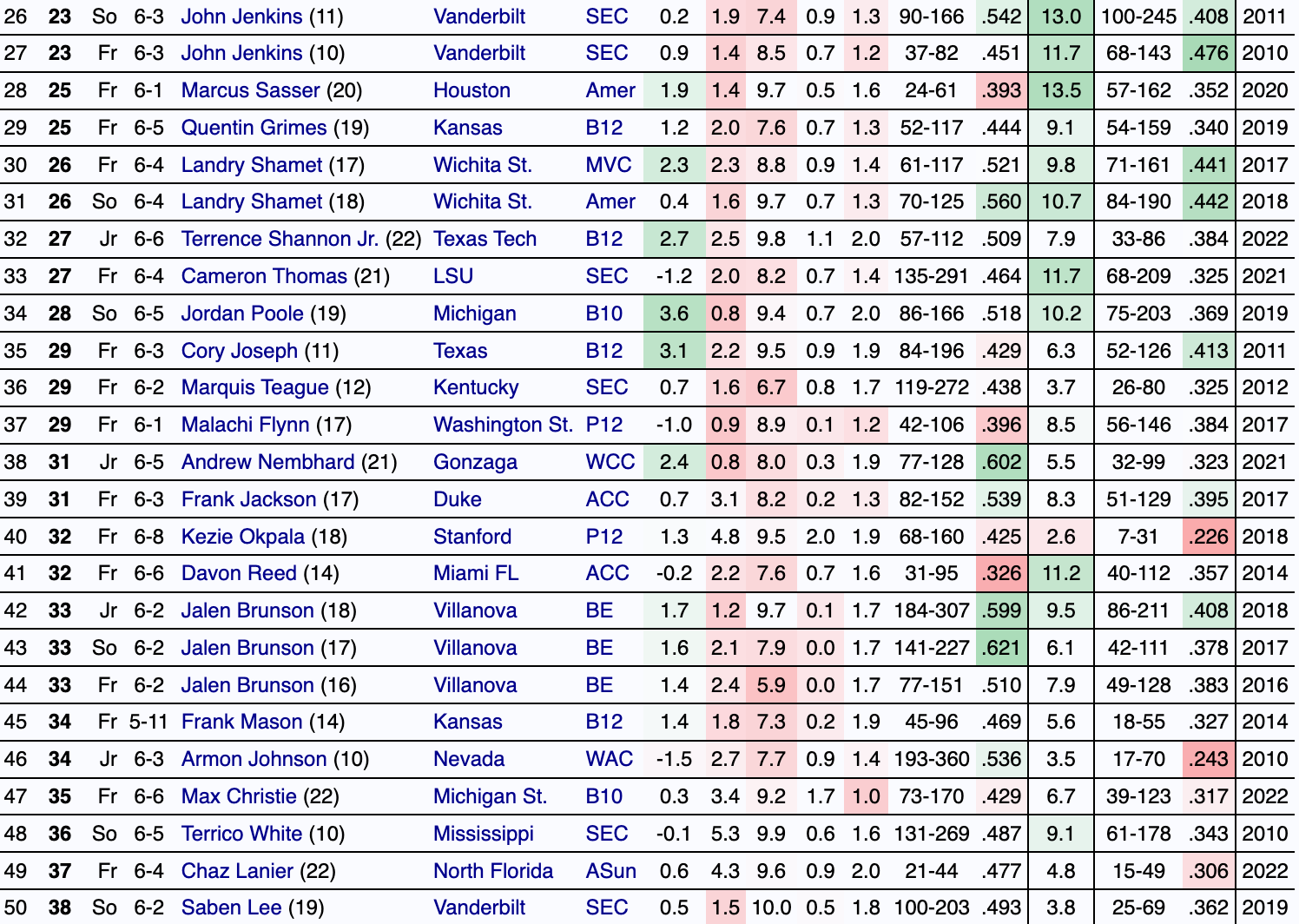
Even if you despise stocks and think this query means nothing, Acuff struggles to defend when put into action on film. He frequently concedes drives, falls asleep off the ball, or is just too small to contain his opponent. Additionally, he has poor screen navigation.
To make up for the defensive shortcomings that are generally synonymous with existing as a 6’3 and under guard in the NBA, Acuff has to clear an extremely high bar offensively to be a high-minute player in high-leverage situations, much less an all-star like his proponents think he can be.
In the chart below, you’ll notice that players such as Donovan Mitchell, Stephen Curry, Jalen Brunson, and Tyrese Maxey — a few of the best offensive players in the world — sit at the intersection of playing time and impact.
You’ll also notice that the vast majority of guards (with significant playing time) under 6’3 fall below a neutral estimated plus-minus (EPM).
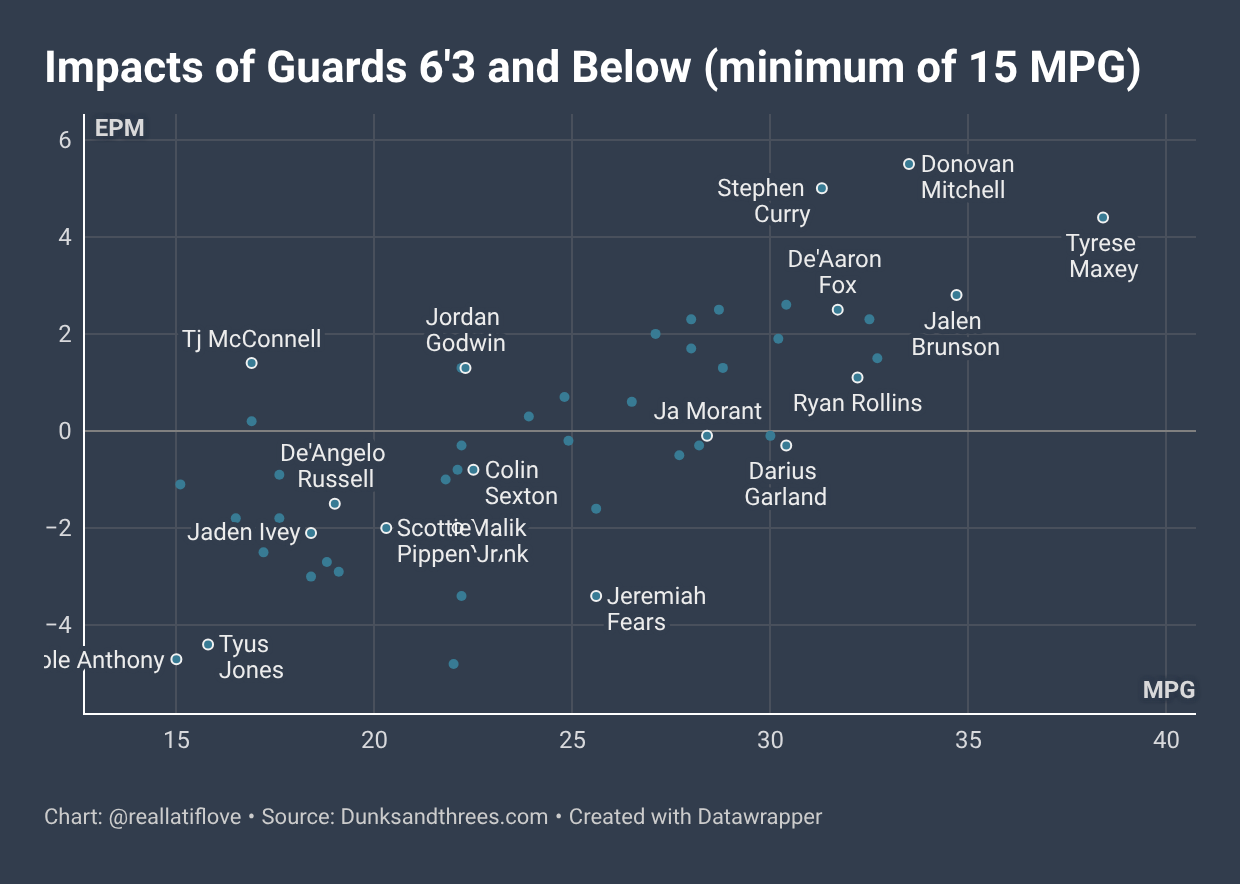
Acuff is talented enough offensively to have a shot at providing immense offensive value in the league. Still, a few of his statistical indicators raise some skepticism about his status as a high-impact lead guard.
One of Acuff’s biggest strengths — his ability to score in transition — doubles as a point of critique for him. Because he’s in transition so much, just 79.5% (29th percentile) of his FG attempts come in the halfcourt, and his 2P% when he’s not in transition falls to just 46.8 percent.

The question is, will he be able to maintain his transition production at the next level, considering he’s not directly creating the stops or turnovers, and if so, to what extent? Will he be in a system that emphasizes getting out and running as much as Arkansas does?
I think these are all valid questions and worth monitoring in the future. Still, I find myself higher on Acuff’s transition influence translating to the NBA because he’s often grabbing the ball, going end to end, and either scoring or getting the ball to his teammates.
However, he has room to grow in the halfcourt in terms of technique as a driver and overall process as a scorer. Acuff is shooting 58.7 percent at the rim in the halfcourt on the season, which is more than fine for a freshman point guard, but he is generating just 0.838 points per possession and shooting 41.6% from two on drives.
The guard can sometimes struggle against longer, more athletic defenders, and as a guard without great vertical pop, he isn’t able to get enough on some of his layup attempts. He also tends to fade away from the rim and shy away from contact on drives, which limits his ability to draw fouls on his drives and partially explains why he draws a free-throw attempt on just 37 percent of his drives.
Acuff can also refine his shot diet/scoring process a bit to maximize effiency in the halfcourt. As the graphic from CBB analytics shows, just 18.2 percent of his half-court shots are at the rim, which ranks in the 23rd percentile. He often opts for, or is forced into, non-rim 2’s, which he is pretty efficient at, but the volume in which he shoots them instead of a rim attempt drags down his 2-point percent to 47.0 percent in the halfcourt (34th percentile).
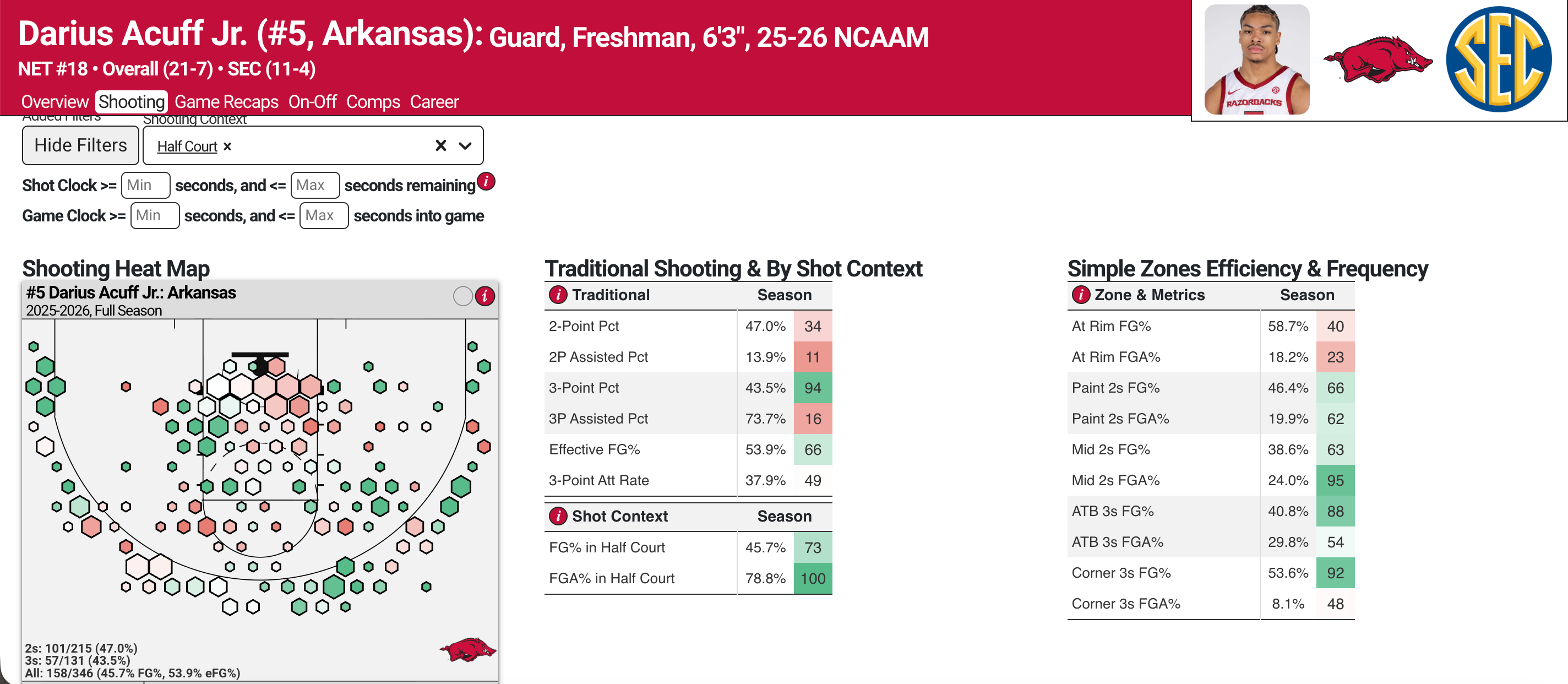
Though I recognize mid-range shots as the least efficient shot in basketball, I am fine with players taking them as a counter to their rim scoring, especially in pick-and-roll possessions against drop coverage, but for the sake of efficiency, Acuff can stand to cut out the mid-range shots early in the shot-clock, over two defenders or outside of the flow of the offense and it would help his inside the arc scoring tremendously.
As an average-sized guard who is a below-the-rim finisher if his goal is to be a lead guard and/or offensive engine, it is very important that he either take threes at a higher volume or draw fouls at a higher volume to maximize his effiency Acuff currently sits at a 36.0 three-point attempt rate and a 32.8 free throw rate, which is a dangerous intersection for guard prospects to sit and has historically trended towards lackluster effiency in the NBA.
Since 2015, there have been 61 drafted guards 6’5 and below to have an FTR and 3PR of 40 and below in a singular season. 24 of the players have failed to reach 1000 minutes in the NBA; the others are pictured in the chart below. The query and subsequent graphic aren’t meant to say he’ll be a bad player, or fizzle out in the league like some of these guys; it just explains why not drawing fouls or shooting 3’s at volume can limit a scorer’s ceiling.
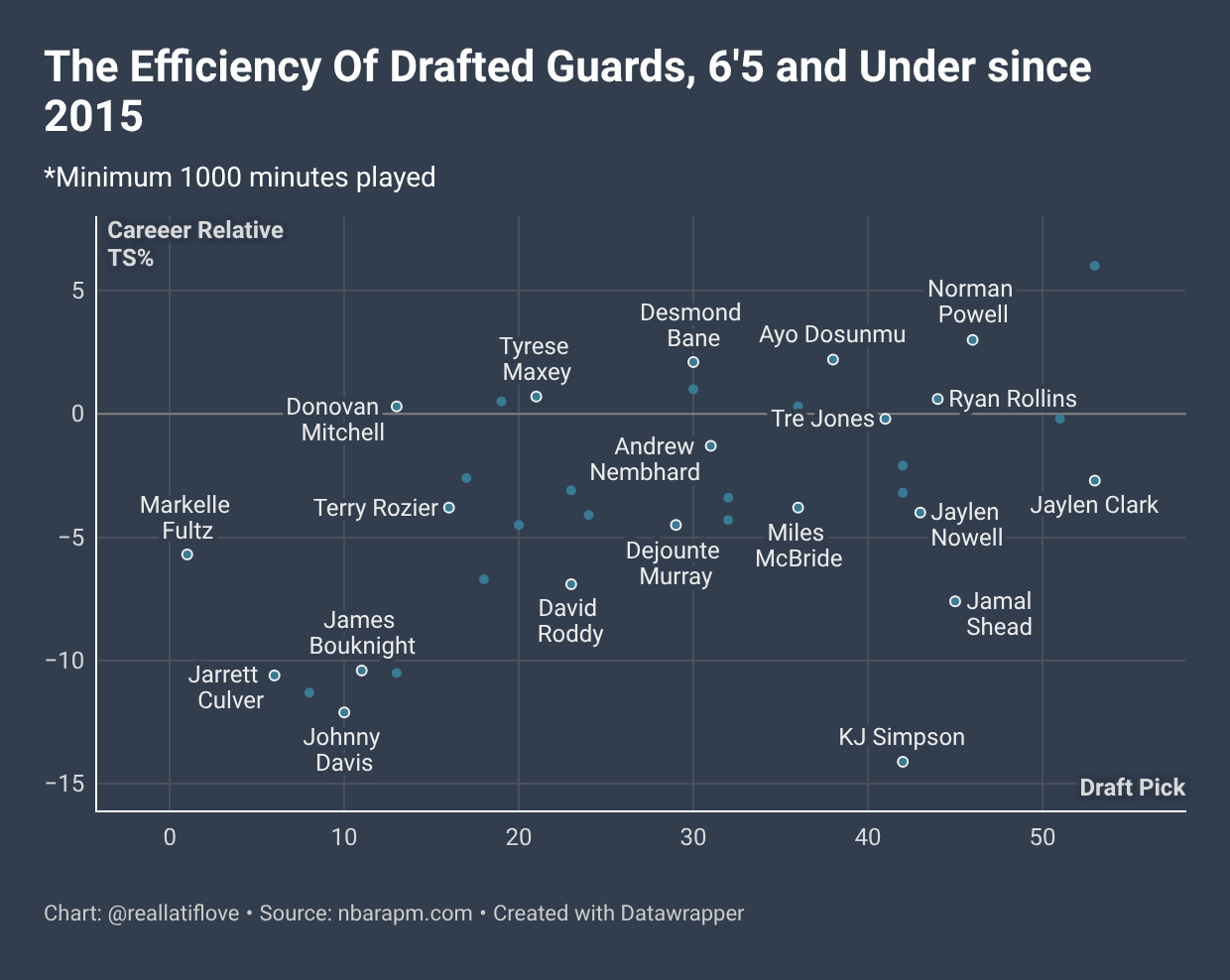
Despite Acuff’s flaws, I am not going to fade him out of the first round as some have. I respect everyone’s process, especially those who put a ton of thought and reasoning behind their work, but I think Acuff can have pathways to return lottery value in this class.
Finding Balance instead of Fading
Acuff’s scoring process/shot diet is a common concern amongst his skeptics, who rightfully point to the historical trends mentioned above, but it’s worth noting that he’s simply a much better offensive prospect than many of the players that pop up in said queries.
He’s younger, more productive, more efficient, and takes better care of the ball than the vast majority of players who fall within the trend, and I think that must be acknowledged more fully to paint the full picture.
Additionally, there’s a prevailing view that the only way Acuff can work or be effective in the NBA is by having the ball in his hands. While that is somewhat true, I don’t think he’s the typical high usage lead guard that’s useless without the ball. I’ve been incredibly impressed with his willingness to move off the ball, and I think that’s a part of his game that has untapped potential, ready to be unlocked by the right coaching staff.
This season, Acuff has generated 1.133 points per possession on spotups ( 105 possessions), 1.083 points per possession coming off dribble hand-offs (36 possessions), and 1.522 points per possession off of screens ( 23 possessions). Coach Calapari has found creative ways to get him involved with other guards on the floor, and what he’s shown this season speaks to potential scalability (offensively) next to other guards at the next level.
His ability to play on and off the ball and thrive in transition reminds me of Tyrese Maxey, who also found himself below the 40 FTR and 3PR intersection, yet has found a way to have a positive playtype-weighted relative true shooting percentage for the past five seasons. As a high-end outcome, I believe Acuff can mirror his 2024 scoring playtypes and efficiency with added playmaking.
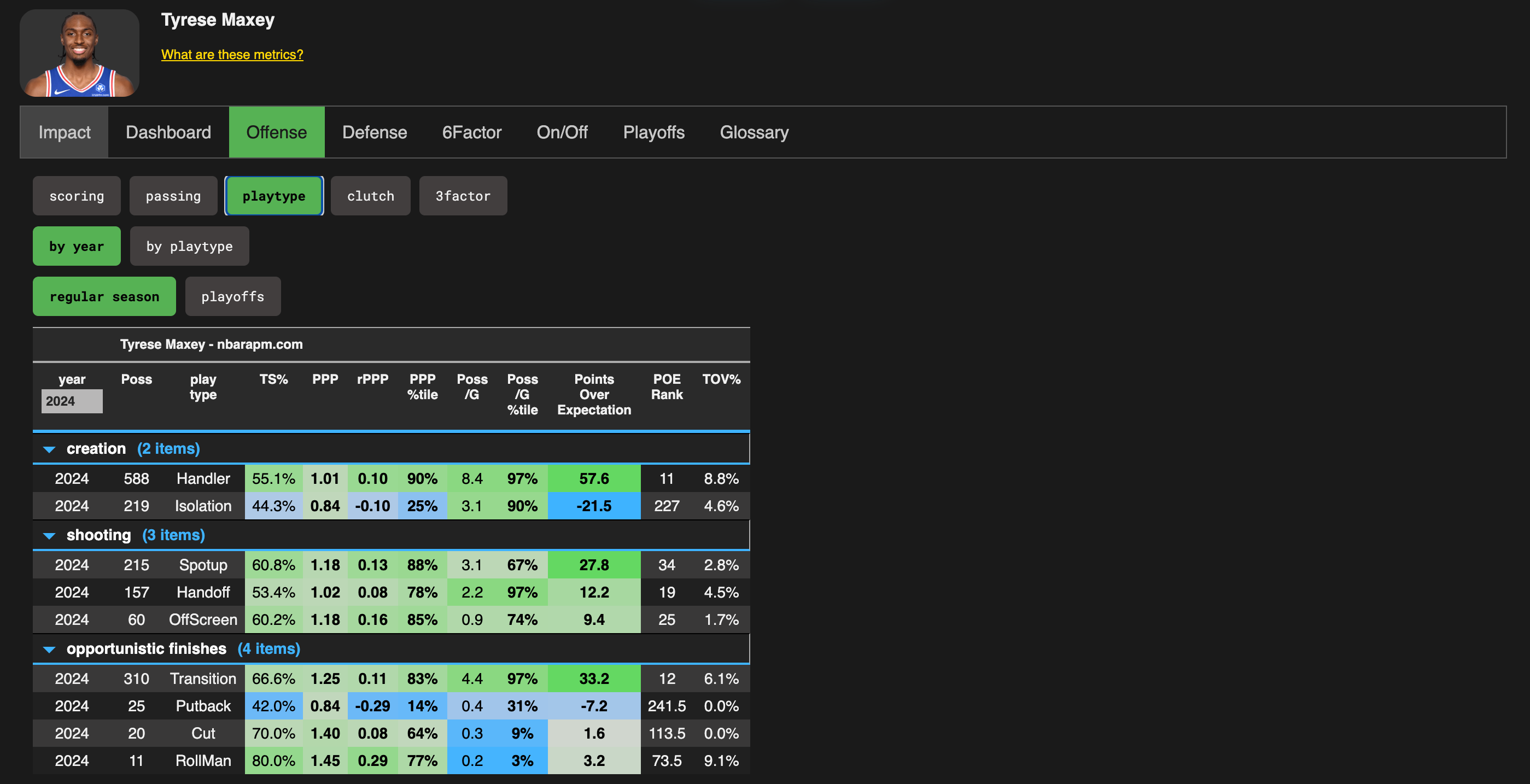
And there are even lessons in Acuff’s higher-end outcomes.
Two of the more successful smaller guards in the NBA — Tyrese Maxey and Jalen Brunson, who both fall under the >40 FTR +3PR Query (Brunson for his career at Villanova)— didn’t begin their careers with high usage. They played alongside all-world offensive engines, showed scalability, and eventually took the reins when the ecosystem made sense (Brunson in New York, Maxey post-2024).
Their ascension wasn’t rushed, and a process like that could matter for Acuff.
If he’s handed a 25+ percent usage rate, a rebuilding team from day one, and asked to manufacture offense against defenses without spacing or structure, there’s a world where he falls into the familiar trap: high box-score production, flashes of brilliance, but neutral (or negative) impact.
We’ve seen that movie before with small guards.
But that doesn’t mean the alternative outcome is failure.
Acuff doesn’t have to become a sure-fire All-Star guard to justify a first-round selection, nor is he doomed to become a ball-dominant empty-calorie player.
There is a very real and valuable archetype in between those extremes — the offensive-minded guard who can toggle on and off the ball, run second units, and provide a much-needed spark off the bench.
That’s closer to where I view his median outcome, and the pathway there is tangible.
Acuff’s age-adjusted production in the SEC is elite. His ability to handle usage while avoiding turnoverers and to get his teammates involved is valuable.
And if you don’t buy the numbers or don’t like his film, I get it.
Small guards are scary bets. The margin for error is razor-thin.
But a Calipari guard with this level of production?
I wouldn’t bet against it.
I just think he won’t be as good as an NBA player compared to Mikel brown and flemings. I have my reasons but it’s a long one. I still think Mikel is the best point guard in the draft, or 2nd, if Darrin Peterson is a PG.