

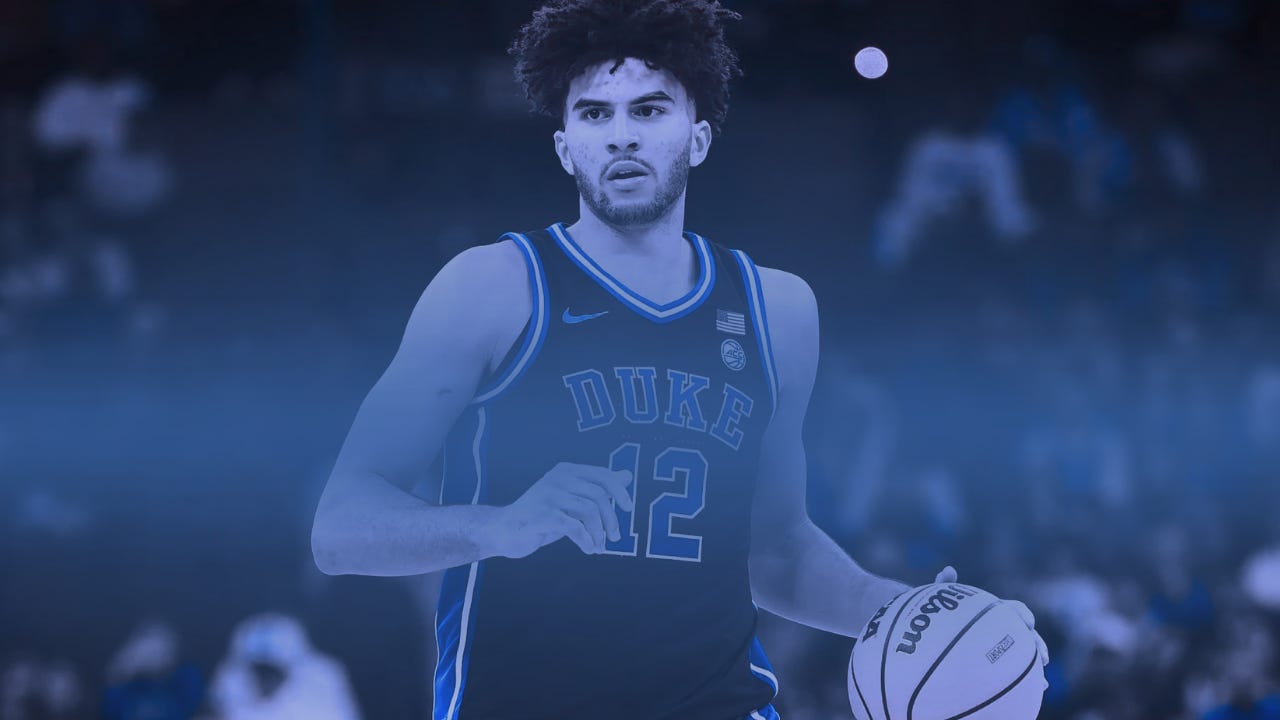
In the wake of Peterson v. Dybantsa volume 1, one of the most anticipated prospect matchups this century, my Twitter (or X) timeline was filled with tweets about how Peterson’s dominant first half had secured the talented freshman’s status as the clear #1 pick.
The hype around Peterson doesn’t surprise me — he’s one of the best guard prospects of the last decade, and had a ridiculous two-way performance in front of millions of fans.
However, the discourse that he’d somehow ended the #1 pick discussion after 18 minutes of play and the subsequent debate that we’d just watched the top two picks battling it out baffled me.
A few hours earlier, Duke’s Cameron Boozer dominated Virginia Tech, scoring 24 points on 84.5 true shooting percentage, while grabbing eight rebounds, and dishing out five assists in what felt like his fifteenth excellent game in a row.
Boozer’s excellence being overshadowed on Saturday is the continuation of a trend that has somehow disqualified him from top-pick consideration among the consensus.
In fact, 20 NBA scouts were polled on who they’d take #1, and Boozer did not receive a single vote.
In my confusion and some annoyance with the discourse, I posted the tweet below, which reached over 200,000 people and reminded me of the pros and cons of a somewhat viral tweet.
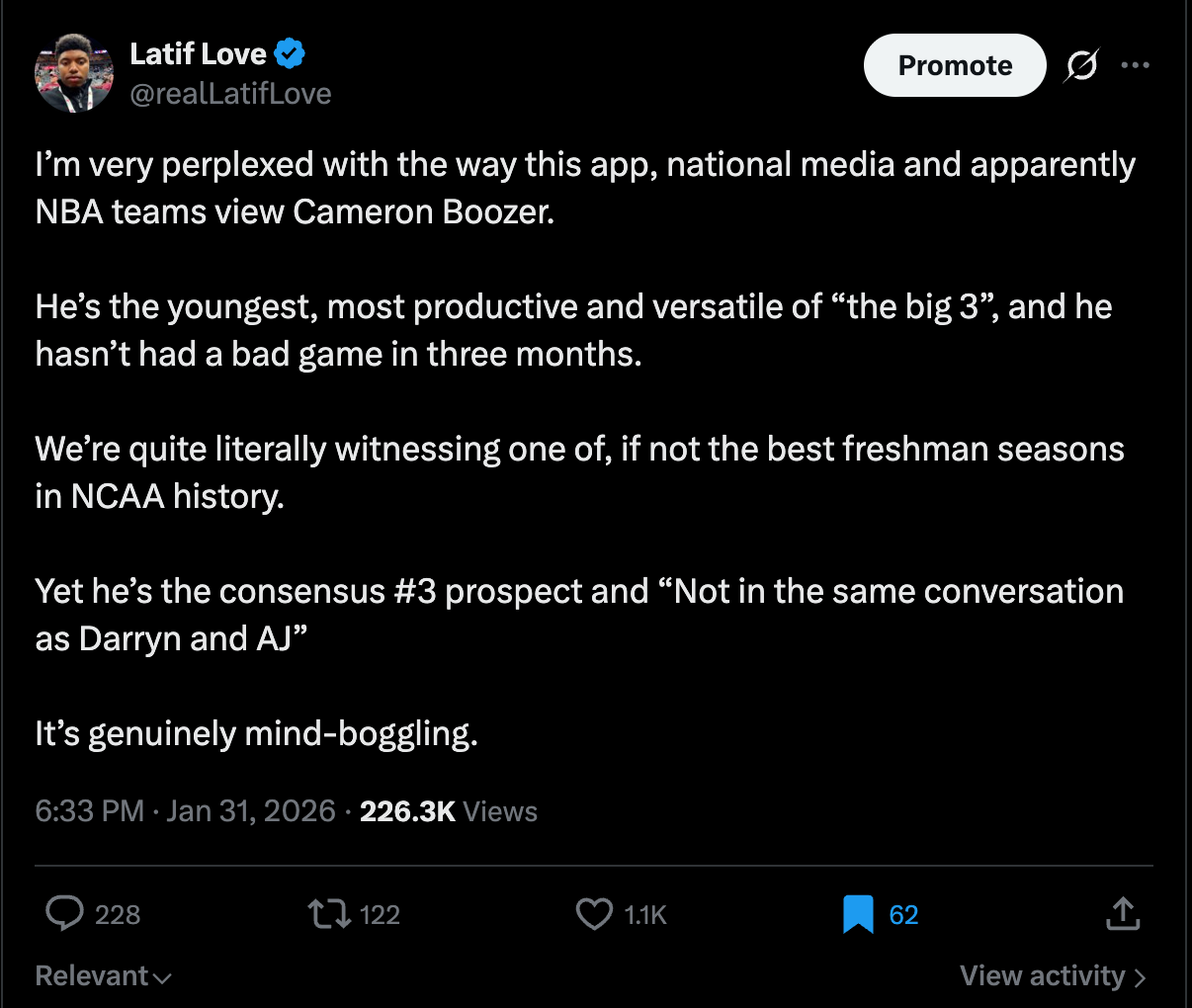
Dozens of people filled the replies with different iterations of player comparisons (mainly derogatory), comments about Boozer’s lower ceiling in comparison to Peterson or Dybantsa, or insinuated that his collegiate production wouldn’t translate to the NBA.
The responses to my tweet opened my eyes to how misunderstood a prospect Cameron Boozer is, so below, I’ll be countering the most common misconceptions that reared their ugly heads in my mentions last weekend.
Misconception 1: Boozer is Tyler Hansbrough
I decided to start with this misconception and will spend the least time on it because it was one of the most prevalent comments under my tweet and the easiest to debunk.
With all due respect to the legendary player, Hasbrough was at North Carolina; he doesn’t compare whatsoever as an NBA prospect. Both are listed at 6’9, 250lbs, physically imposing forwards who love to post and face up, but that is where the similarities end.
By the time Boozer reaches the age Hansbrough was as a rookie, he’ll be on his second NBA contract. Furthermore, Boozer’s 33 three-pointers in 22 games are more than Hansbrough made in his entire career, and his 89 assists nearly double Hansbrough’s highest total in any year of his collegiate career.
He’s not Hansbrough, and for good measure, he’s not Jahlil Okafor, Christian Laettner, or Luke Garza, either.
Misconception 2: He’s a traditional/ Undersized big
I was shocked to see several people under the impression that Boozer is a traditional and/or undersized player for his position.
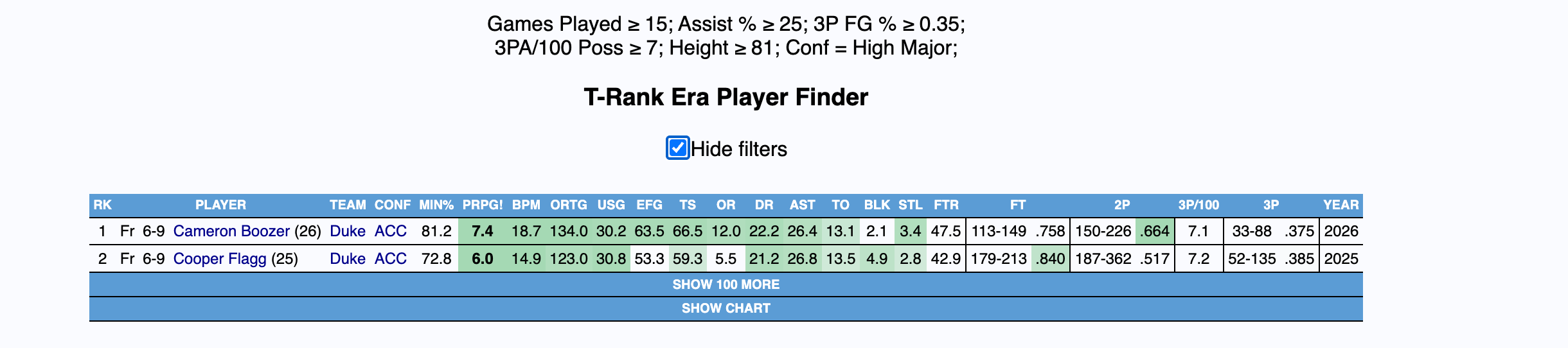
The truth is, he is neither. Boozer is closer to illustrating the evolution of basketball than to playing like a traditional big man. He’s one of two players, 6’9 or taller since 2008, to have an assists percentage above 25, shoot at least seven three-point attempts per 100 possessions at a 35 percent clip.
The other averages 31.2 points, 9.8 rebounds, and 4.4 assists, with a 59.2 true shooting percentage over his last five games. Boozer’s intersection of feel, touch, and ball-handling is about as far away from traditional as you can get.
The second misconception is that Boozer is an “undersized big”. Boozer is a forward and not a center. This misconception is flat-out objectively wrong, as the average height/weight of power forwards who play 15 minutes or more is 6’9 and 227 lbs. At 6'9, 250lbs, according to Duke’s website, Boozer clearly exceeds this threshold.
Misconception 3: He’s just a Bruiser
One of the biggest misconceptions about Boozer’s game is that he’s just a bruiser whose game won’t translate well to the NBA. The people who have this take either haven’t watched enough or don’t know what they’re watching.
Sure, Boozer is an excellent strength-creator who's adept at finding leverage and using his frame to score in the interior, but he’s not strictly a post-scorer whatsoever.
Below is a chart that illustrates Boozer’s most-used play types as a scorer. The chart shows how versatile Boozer is as an offensive player and how he maintains efficiency across different play types.
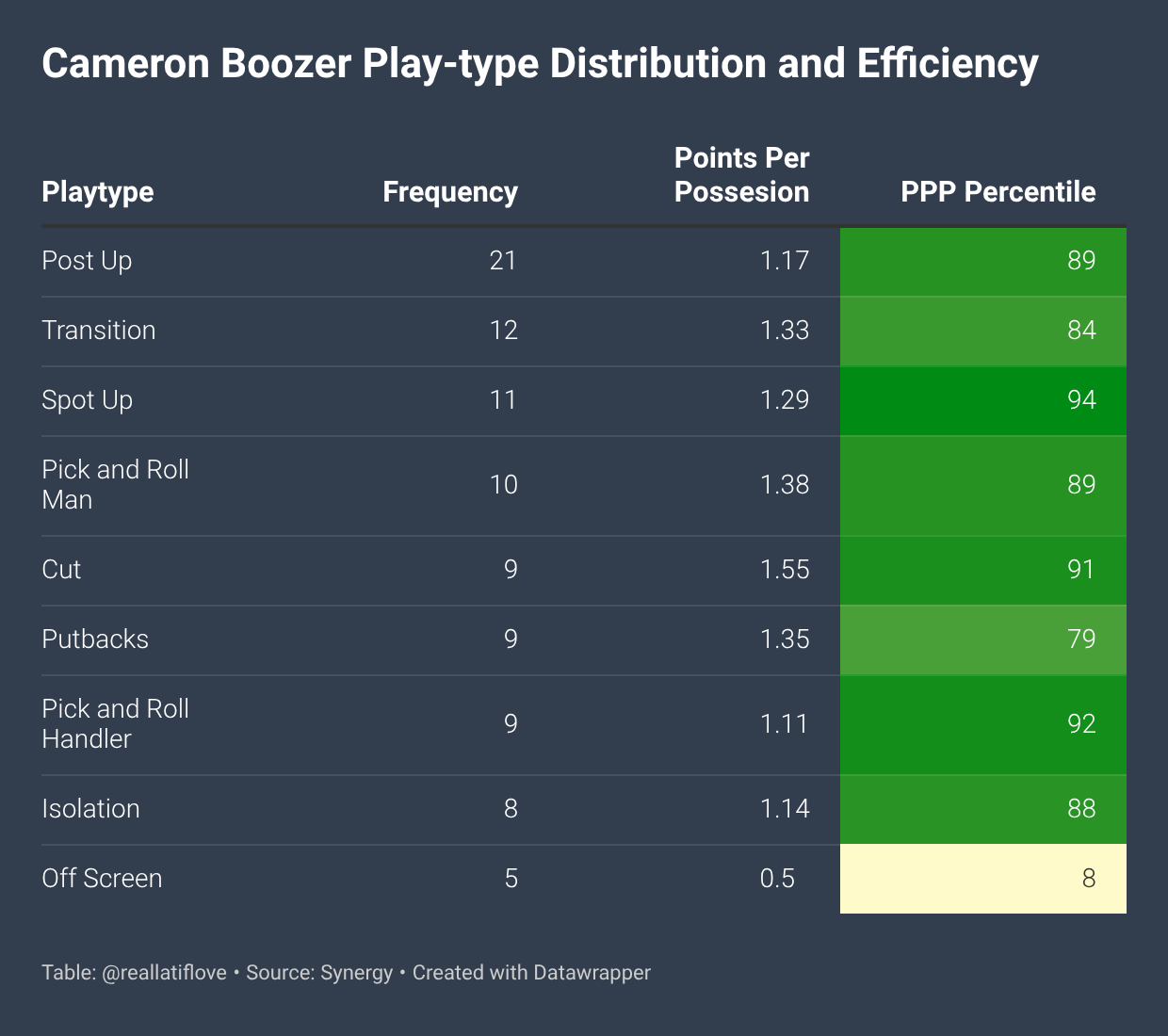
When watching him, it’s clear this isn’t just a player picking on kids he’s bigger and stronger than. He has legitimate skill as a scorer, and that’s before diving into his passing acumen.
I find it baffling that one could watch a player of his size function as the handler in ball-screen actions, drive from the perimeter, and take and make pull-up threes (41%), and the takeaway be anything other than he’s one of the most unique offensive prospects we’ve seen.
When evaluating Boozer, his skeptics cite that he’s too small/not athletic enough to be a post-scoring big, and that the NBA has moved away from that playstyle, but who's to say that will be Boozer’s most-used playtype and not simply a button he presses against a mismatch?
His history of play-type infallibility dates back to high school, when he completely transformed his game from freshman to senior year.

I firmly believe one of the key signals of being conducive to winning basketball, especially offensively, is being pliable across different contexts and playstyles while not needing to dominate usage. Boozer is the paradigm of this idea, but alas, we love our heliocentric, ball-dominant, and often flawed creators.
Misconception 4: He has College production, not Pro potential
In my tweet, I point out that Boozer is having one of the best freshman seasons in college history, and the most-liked comment said that means absolutely nothing about how he projects at the next level.
I believe that to be both untrue and a misunderstanding of what age-adjusted college performance says about NBA translation. Simply put, players this young who dominate much older players have an extremely high hit rate of becoming not only good NBA players but, more likely than not, all-star level players. Being the best player in the country before your 19th birthday is not the norm, but it is a significant indicator of future stardom.
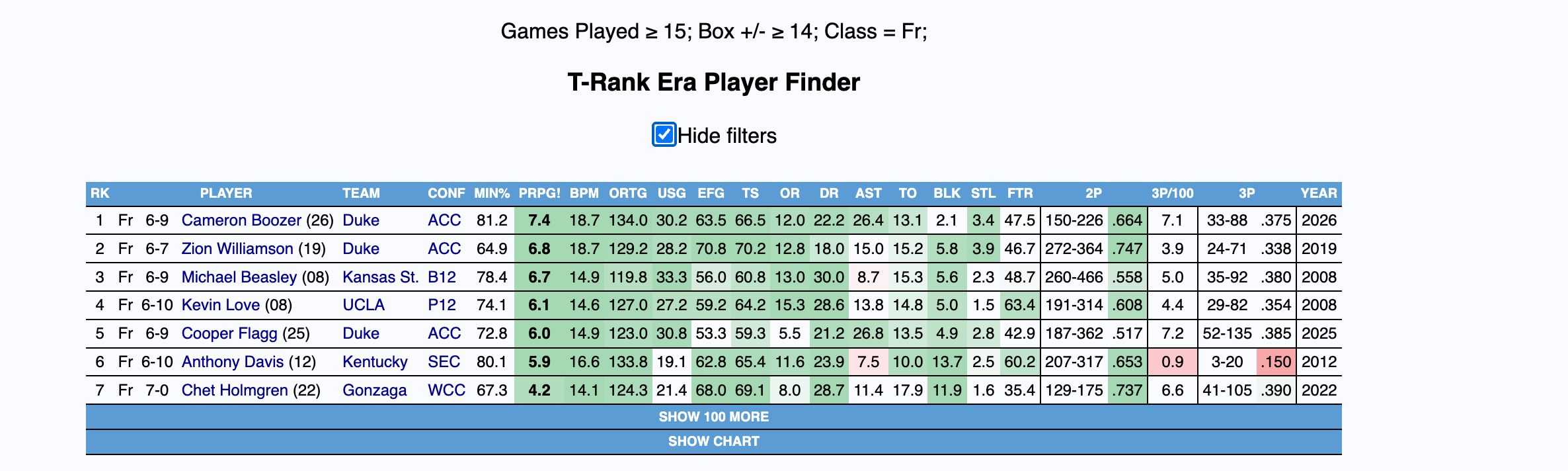
The biggest reason Boozer’s skeptics believe his game won’t translate to the NBA is his lack of vertical athleticism. That concern isn’t unfounded. It can limit him on both sides of the ball, but I find it to be dramatically over-indexed.
Closely tied to that concern is the belief that Boozer won’t be able to overpower NBA bigs the way he has at the collegiate level, and that his scoring efficiency will suffer as a result. This is also a perfectly reasonable concern. However, Boozer is already a 250-pound 18-year-old and could become even stronger as he matures.
Expecting the jump to the NBA to mute his scoring inherently ignores both physical development curves and how Boozer actually creates offense. As previously mentioned, he will still have a significant size advantage over the average four. If guarded by centers, he can draw them out of the paint with his shooting and use inverted pick-and-rolls as a release valve to drive to the paint.
As for his lack of vertical athleticism, it’s not as if Boozer is chained to the ground. There’s a persistent notion that he “can’t dunk,” even though he’s already thrown down over 26 dunks this season. He may not be a pogo-stick athlete, but the gap between “not explosive” and “non-athletic” is massive, and Boozer comfortably sits closer to the former.
Vertical athleticism is unquestionably a valuable trait, but NBA history is littered with players who succeeded without fitting the traditional athletic archetype, winning with strength, touch, processing, and shooting. Boozer checks all of those boxes at a good-to-great level. His ability to generate advantages without relying on vertical pop — through strength, leverage, and footwork, is precisely why his lack of elite explosion isn’t disqualifying.
The Reality
The one part of Boozer’s profile that has come under scrutiny — and fairly so — is his defensive viability. This is where the athleticism concerns are most likely to show up at the NBA level. His defense has been inconsistent and, at times, outright poor, particularly when he’s asked to switch onto quicker perimeter players who are much faster than he is.
Stiffer hips and slower foot speed limit his mobility and lead to blowbys, to which he doesn’t have the athleticism to recover. Additionally, he doesn’t have the size or vertical pop to function as a true defensive anchor and can find himself out of position, occasionally late on a close-out or rotation, or simply unable to deter a shot at the rim. He has just a 1.0 block percentage against top-100 teams.
That said, Boozer isn’t devoid of defensive value. Most of it will come from ending possessions with defensive rebounding and from leveraging his feel for the game and strong hand-eye coordination to generate steals and deflections.
He’s never going to be a scheme-proof defender, and he’ll have to be proactive with his positioning and become more disciplined, but he has pathways to being a neutral or slight plus defender.
Offensively, there’s still room for growth as well. Boozer has yet to develop a consistent midrange counter; his handle can tighten and become more dynamic, and he can improve as a passer on the move. These are real limitations, not nitpicks — and acknowledging them is essential.
But here’s where the conversation around Boozer often goes wrong.
He isn’t the high-floor, lower-ceiling prospect he’s frequently framed as when compared to his two peers in this class. Boozer’s skeptics claim that his ceiling is lower in comparison to Boozer and Peterson because of his lack of athleticism, but they often speak about him as if this 18-year-old player, who is younger than the other two, has somehow capped his development because he’s grown into his body already.
To those people, I ask: Can his shooting not continue to improve? He’s already shooting at a high clip on good volume for his size and position. Can his handling not improve? What if he develops a mid-range counter or shoots the mid-range more as he did in high school?
Today, he’s an exceptionally talented offensive player whose playing style should make him one of the more versatile stars. He’ll be able to thrive in different contexts and scale up and down.
On his tough shooting nights, he still adds value because of his impact on the four factors, which Dean Oliver, a pioneer of modern basketball analytics, deemed the four most important stats for winning a basketball game. Boozer’s ability to not only score efficiently for himself but also create for others while taking care of the ball and extending possessions through offensive rebounding leads to immense offensive influence.
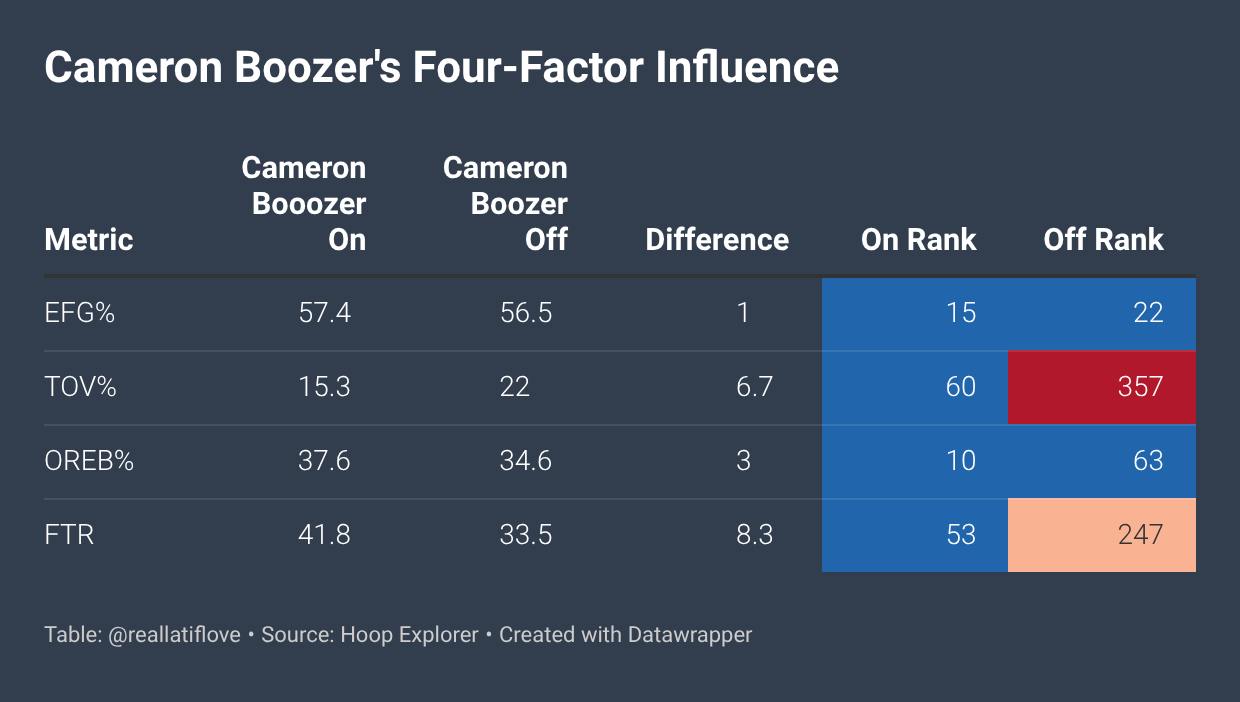
The reason many struggle to see him as a legitimate #1 pick is simple: what he does isn’t flashy. It doesn’t look like the archetype of a player who’s been the first option on a championship team. And while I said earlier that this discourse confused me, I do understand where it comes from. It is how I used to think just 18 months ago.
Yet, I still think the broader basketball world must move away from this monolithic view of stardom rooted solely in the eye test and aesthetic bias. The goal isn’t to draft the player who looks the part — it’s to draft the player who most consistently impacts winning.
And by that standard, Cameron Boozer belongs squarely in the #1 pick conversation.
In fact, it should start with him.
The four-factor chart is brutally effective. Aesthetic bias is real and its weird how people treat "doesnt look like a star" as legitimate scouting when its just vibes. The play-type versatility angle is underrated too, like being able to switch contexts mid-game is probably more valuable than having one elite skill that needs the system built around it. Seen that dynamic play out alot with roster construction.
legit draft analysts need to get off twitter. It’s because Cameron dosent look like a “deep bag” idiot basketball player. He’s not as aesthetically pleasing, and on twitter that MEANS everything to “hoop” fans. Twitter users are the same people who say cam Thomas is a winning player, bones hyland deserves more minutes, AJ Dybantsa is Rj Barett, that Kobe is a top 5 player of all time. It’s just full of nonsense.