

Every NBA Draft Cycle, there’s a mystery box player who nobody had on their preseason boards but explodes onto the scene in November.
This season, a few players fit this mold, but none are more recondite than Baylor’s Cameron Carr.
The junior had appeared in just 18 games and played 102 minutes in his first two collegiate seasons at Tennessee. Now, just seven games into the season, he’s increased that figure by 223% and, with that, has seen increased production.
As I type into my keyboard, he’s averaging 23 points on 70.1 true shooting percentage, grabbing five rebounds a game, and adding 2 stocks. His production makes me wonder how a player this talented struggled to get on the court for Rick Barnes two seasons ago.
So naturally, I went back and watched his high school film to see what I missed.
What I found gives me even more questions about his outlook as an NBA wing.
Off-Ball Oriented
Carr spent his senior season in Missouri at Link Academy alongside Toronto Raptors guard Jak’obe Walter and Michigan guard Elliot Cadeau. He was a consensus four-star recruit and helped the Lions finish with a 28-1 record, averaging 11.1 points on 61.1 true shooting percentage.
During his time at Link, Carr operated as an off-ball wing who got up a ton of threes and thrived in transition. He finished the year with a 67 percent 3PAR, knocked them down at a 33 percent clip and wasn’t shy about taking them from well beyond the line.
However, outside of the catch-and-shoot three-point shot-making and finishing plays in transition, there isn’t a ton from his pre-NCAA sample that suggests he’d be a starter-level wing. His shooting profile wasn’t versatile. Ninety-one percent of his three-point shots were catch-and-shoot attempts; he took just 11 shots at the rim in the half-court, and the vast majority of those looks were assisted as well.
Carr also didn’t create for others or put the ball on the floor. He had a six percent drive frequency and finished with a 1.04 assist-to-turnover ratio.
Heading into Tennessee, he profiled as an off-ball wing that didn’t draw fouls (18.9 FTR), didn’t rebound well (especially for his size and length) and did not create turnovers (0.8 stocks per game).
After watching his film, it felt abundantly clear why he didn’t play as a freshman at Tennessee. He needed to put on weight, improve his handle to create off the dribble, and would have likely struggled with the physicality of the SEC.
But now he’s at Baylor—stronger than ever, creating on the ball a bit more and off to an explosive start.
The question is: How much better has Carr gotten since high school?
Blossoming at Baylor
Evaluating a player whose last tangible sample was three seasons ago is difficult, especially so early in a season, but it’s clear that Carr has improved.
He’s gone from rotational piece (before injuring his thumb and transferring) to the Bears' most impactful player. According to Hoop Explorer, Carr has a +23.6 adjusted net rating, which I suspect stems from weak competition and ridiculously hot shooting so far.
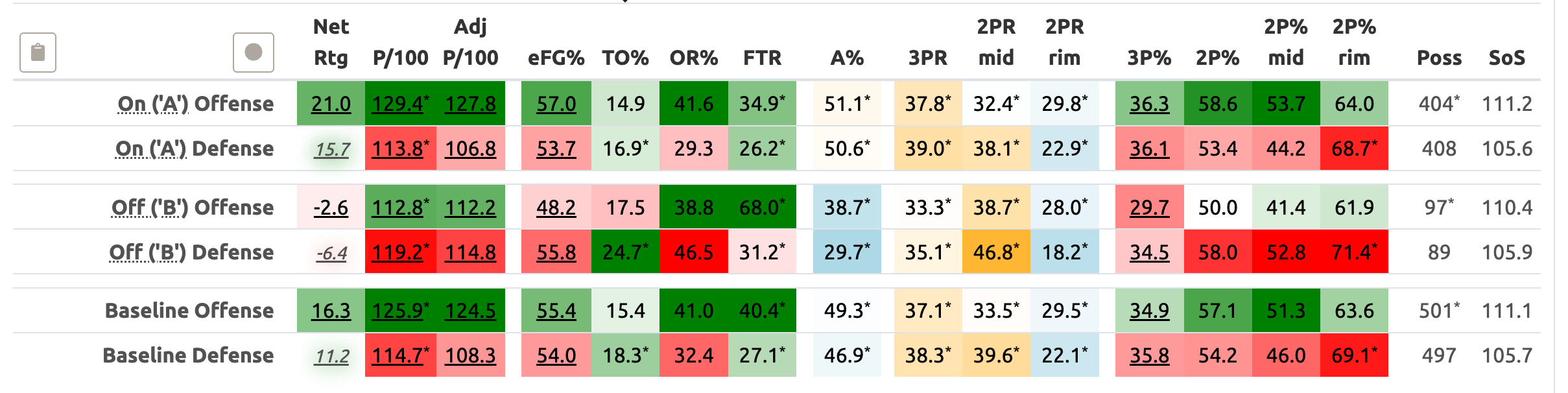
He won’t shoot 50 percent from behind the arc for the entire season, but his volume (39.1 3PAR), shot difficulty, and confidence are those of a knockdown shooter. Additionally, Carr is creating more of his three-point shots off the dribble. 41.6 percent of his attempts are pull-up jumpshots in comparison to 8.7 percent in his final year at Link.
When Carr hasn’t been able to get a three off, he’s been able to counter in the mid range, which is another thing he did not display in high school. Through seven games, he’s shooting 62.5 percent on non-rim twos.
Carr’s athleticism has popped, especially off the ball, as he cuts or attacks a closeout. The wing is quick for his size and has long strides that allow him to cover a ton of ground. Scott Drew runs him off down screens and curls that create an initial advantage, and he’s able to use his elasticity to get to the rim. Carr Wing is shooting an eye-popping 80.8 percent at the rim in the half-court, though 19 of his 21 makes are assisted.
Defensively, Carr’s shown flashes of being an impactful defender. His athleticism and ability to cover ground translate mainly as a help defender, where he’s shown the ability to erase shots from the weakside when his teammates get beat at the rim.
On the ball, I think he’s been best by guarding in isolation and using his 7’2 wingspan to contest shots. With Carr as the primary defender, opponents have shot below 34 percent from the field.
Carr has shown tremendous improvement to begin the year and has risen drastically on my big board, but I do have reservations about his projection, and I’m lower on any star outcomes.
Improvement Areas
While Carr has taken on a bigger role for the Bears, I don’t think his play style or value that he will add to NBA teams has changed a ton from his prior at Link. He still profiles as an athletic, off-ball, play-finishing wing (most of his production has been assisted), which can be valuable, especially if you are a plus defender.
Still, the last part of my statement is an area I’ll continue to watch.

I think Carr can be an impactful defender in the NBA, but I'd like to see him improve his on-ball screen navigation and awareness. He tends to lose shooters throughout possessions and occasionally leaves his feet when closing out. The junior can stand to add weight as well, as opponents have been able to dislodge him this season and create separation with a simple bump.
He’s posted a 1.2 steal percentage and a 4.1 block percentage, which are much-improved figures compared to his high school career, but that production has 1.2 and 2.5 against top 200 teams.
Carr also needs to improve as a decision-maker. He tends to have scoring blindness on some of his drives, missing open teammates in favor of a tougher shot attempt. The wing has a 0.6 AST/TO ratio, which, if continued, would not bode well for his NBA projection. NBA teams want wings who can not only finish advantages but also extend them.
Though I’ve critiqued him quite a bit, I am becoming relatively high on Carr’s outlook as an NBA player. His blend of athleticism, shot-making from all three levels, and defensive potential has intrigued me.
But like any mystery box player, the question isn’t what he is right now—it’s what’s still inside. How much his decision-making sharpens, how he adapts as the shooting regresses, and how he responds to higher-level competition will ultimately determine whether the early-season breakout is real or just a glimpse of something that still needs time to form.