

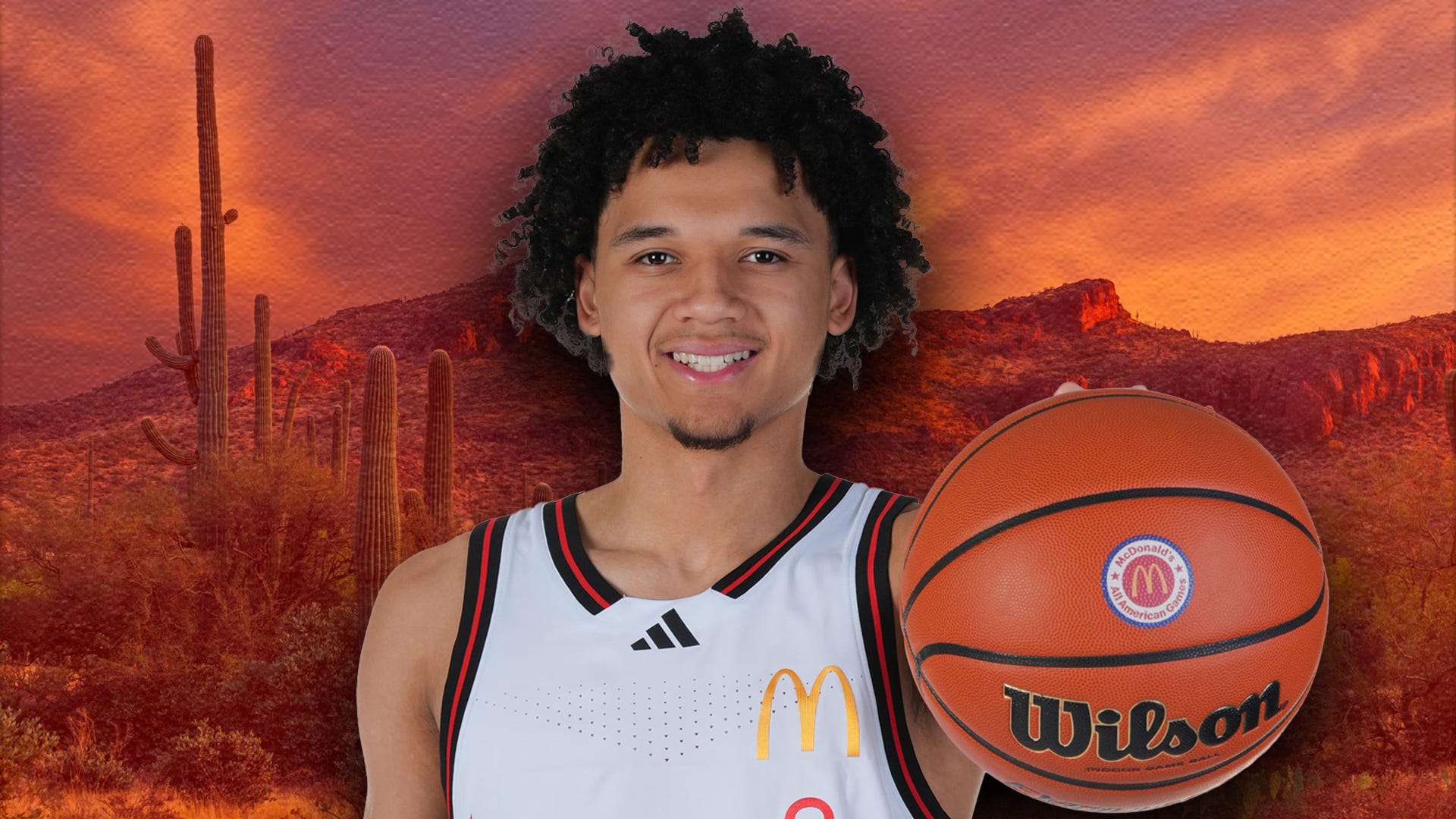
Arizona freshman Koa Peat has gotten the large majority of the Wildcats’ NBA Draft love, but there is another player on the roster who deserves lottery consideration and may even be a better prospect than Peat.
That player is fellow freshman Brayden Burries, a 6-foot-4 combo guard from California who averaged 29 points, eight rebounds and three assists in his final season at Roosevelt High School.
Burries was a finalist for the Gatorade national player of the year, led the Mustangs to the Open Division State Championship, and, according to ESPN, finished his high school career as the 11th-ranked player in the class.
The guard is highly touted for his scoring ability, which is the primary selling point of his evaluation. Burrie’s scoring prowess and the fact that he isn’t a true point guard have led some scouts to put him in a box and undersell other aspects of his game.
But he’s more than a bucket.
A research question
When I went into my scout of Burries, the first question I asked myself was: How is he different?
It’s no secret that the NBA has begun to fade combo guards, especially those who aren’t star-level scorers.
Look around the league this offseason, and competent GMs weren’t chomping at the bit for players like Cam Thomas, Jalen Green, Anfernee Simons and Jordan Poole.
His driving ability is the first answer to my question.
Burries is all of 205 lbs, has broad shoulders and has a strong frame that allows him to be extra physical when going downhill and bump his defenders off their spots on the way to the rim.
The guard can finish with both hands and has excellent touch, flexibility and body control. Burries is especially potent when attacking the top foot of a defender out of triple threats or when attacking a closeout.
He’s ultra-aggressive, which leads to a lot of drawn fouls. In a sixty-game sample over his final two seasons in high school, he drew seven free throws a game and had a 40.6 free-throw rate.
During his final AAU season with Strive For Greatness, he had an 18.2 drive frequency, generated 1.177 points per drive and shot 63.3 percent at the rim.
Burries isn’t the most athletic—he doesn’t have elite speed or vertical athleticism—but he does have a great first step, handle, excellent pacing and viable counters in the midrange.
Burries shot 36.7 percent on dribble jumpers in his final EYBL season and generated 0.97 points per shot.
But it’s not just the driving. Burries has one of the most complete scoring packages in the class.
If the guard can become a more consistent three-point shooter, he has a pathway to becoming an efficient three-level scorer. At times, he can be streaky. He shot 29.5% from three in EYBL but 36% over his last two high school years.
However, I am relatively confident in his ability to be a good three-point shooter down the line because of his volume (6 per game), confidence, shot distance and free-throw percentage (83%)
As good as Burries is on the ball, he does not need it to make an impact. Because of his shooting and cutting ability, he has the skillset to be an off-ball option next to another ball-handler.
I’m not sure if Tommy Lloyd will use him in off-ball sets, but he should, as Burries can hurt a team going downhill with an advantage already created or simply knock down a three off of a screen.
Underlying Layers
As I continued to watch his film, I began to see other layers to his uniqueness. I wasn’t just impressed by Burries's play in the half-court; I was also impressed with how consistently he turned defensive stops into transition opportunities.
It is an underdiscussed part of Burrie’s evaluation and something I generally find underdiscussed during prospect evaluation.
Very few guards in the class use transition as effectively to put constant pressure on opponents before defenses can get set.
Burries hasa also displayed intriguing passing flashes. He does not put up gaudy assist numbers and isn’t the quickest processor, which can limit his outlook as a lead guard, but he did post a 1.7 AST/TO ratio in his final two seasons.
Burries is a reactive passer who thinks he scores first and then finds his teammates as he causes the defense to collapse. He hasn’t shown a propensity to make advanced reads consistently, but he isn’t a ball-stopper by any means and is a good interior passer.
Defensively, it’s more of a mixed bag. Burries‘ strength translates well when containing drives. He’s able to bump guards off their spot and wall up as they try to drive to the rim. He competes at the point of attack and can fight through screens. He stays active off the ball and acted as a free safety for an undersized Roselevelt team, allowing him to generate about two steals per 40.
However, I can foresee Burries having problems with quicker guards. He does not possess the most incredible foot speed, and once he’s beaten, he does not have the length or athleticism to recover consistently.
What I’m watching for while he’s a wildcat
For all of his strengths—driving, shot-making, rebounding, and solid passing—Burries is one of the more underrated prospects in this class. His placement on most preseason boards ranges from the lottery to the late first round.
That said, there’s still room for growth. The biggest area is his shot selection. Burries was an extremely efficient scorer in high school, but at times, he settled for tough, contested pull-ups in favor of getting to the rim or finding an open teammate.
He can also improve his handling in traffic. Burries is adept at handling through physicality but can be prone to turning the ball over when seeing double teams and traps. The source of most of his turnovers is plays like the examples below, where he gets caught in traffic or defenders dig at his handle as he drives.
If Burries can refine his shot selection, improve his consistency from three and continue to grow as a passer, the guard has a real chance to solidify himself as the best prospect at Arizona and top ten pick in the 2026 NBA Draft.
This was a good read on Burries. I definitely understand why some have Peat higher at this point, but Burries has the chance to be a ceiling raiser for Arizona.